Index Pages

Saturday, 31 January 2026

The Little Girl Who Lives Down the Lane (1976)

Director: Nicholas Gessner
Writer: Laird Koenig, based on his novel
Stars: Jodie Foster, Martin Sheen, Alexis Smith, Mort Shuman and Scott Jacoby

Index: The First Thirty.

As of Smile Jenny, You’re Dead, it increasingly became clear that if Hollywood ever needed a precocious child actor in a non-children’s film, Jodie Foster was who they should hire. Echoes of a Summer was a statement of intent and Taxi Driver (and its Oscar nod) was a guarantee. She lives up to all that promise here by leading a psychological thriller over actors as worthy as Alexis Smith and Martin Sheen.

“Happy birthday,” she tells her reflection in the mirror. She’s turning thirteen and she’s on her own, dressed in a robe that looks ritual but which we later learn is Moroccan. She’s hardly a typical new teen. She listens to Chopin, reads Emily Dickinson and is studying Hebrew on LP records. She doesn’t go to school, but she has a joint account at the bank to cover her costs.

Wednesday, 28 January 2026

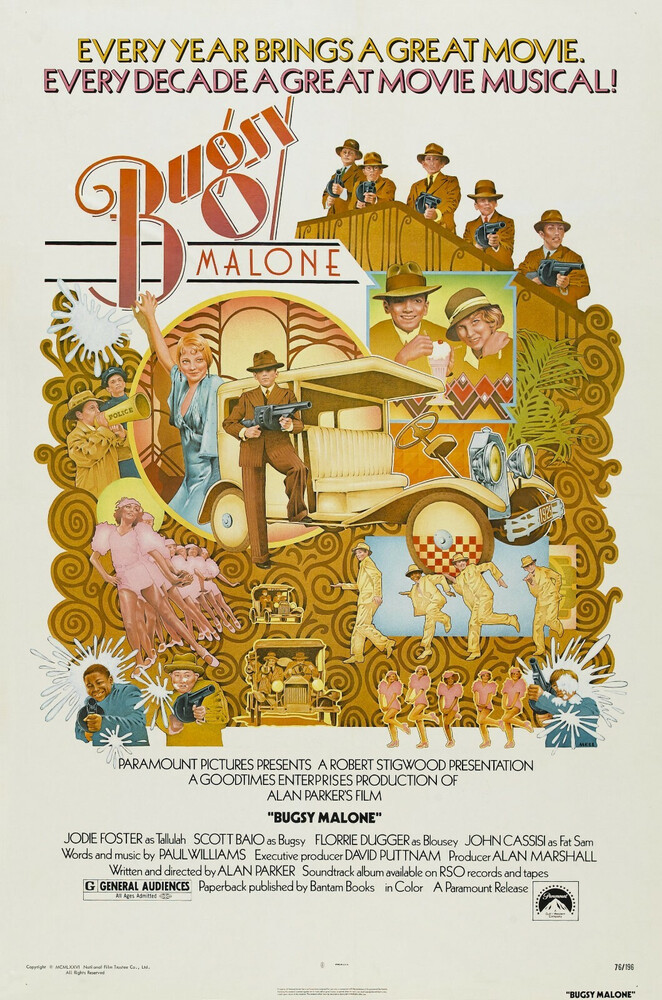
Bugsy Malone (1976)

Director: Alan Parker
Writer: Alan Parker
Stars: Scott Baio, Florrie Dugger, Jodie Foster and John Cassisi

Index: The First Thirty.

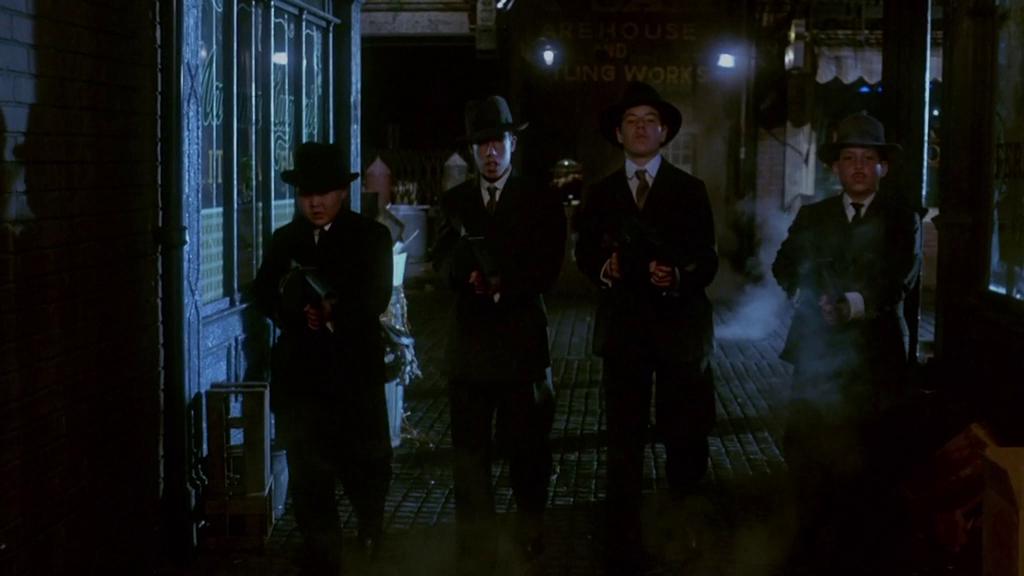
If we’re being brutally honest, Bugsy Malone is a curiosity, a Prohibition era gangster spoof performed by an all-child cast and staged as a musical with songs by and mostly sung by Paul Williams. It should sit alongside films like The Terror of Tiny Town, an all midget western shot on regular sized sets, or The Crippled Masters, a kung fu movie starring a pair of actors with no arms and no legs respectively.

Certainly it can’t escape its gimmick, even if it looks bigger and more sophisticated than its sub-million pound budget might warrant. Alan Parker, at this point known only as a director of TV commercials, somehow survived this to make such notable dramatic films as Midnight Express, Birdy and Mississippi Burning, as well as musicals cast for adults like Fame, Pink Floyd’s The Wall and The Commitments. This therefore stands the test of time as his curiosity rather than merely a curiosity.

And, if we can sit back and suspend disbelief one time, it does offer rather a lot of fun. That shouldn’t surprise. What surprised me is that a majority of that fun sprang from sources that I wasn’t expecting far more than the ones I was. Only a few details held up to expectations, like Parker’s direction being much better than his script. He’s fondly remembered as a director; I doubt anyone remembers him as a writer.

Monday, 26 January 2026

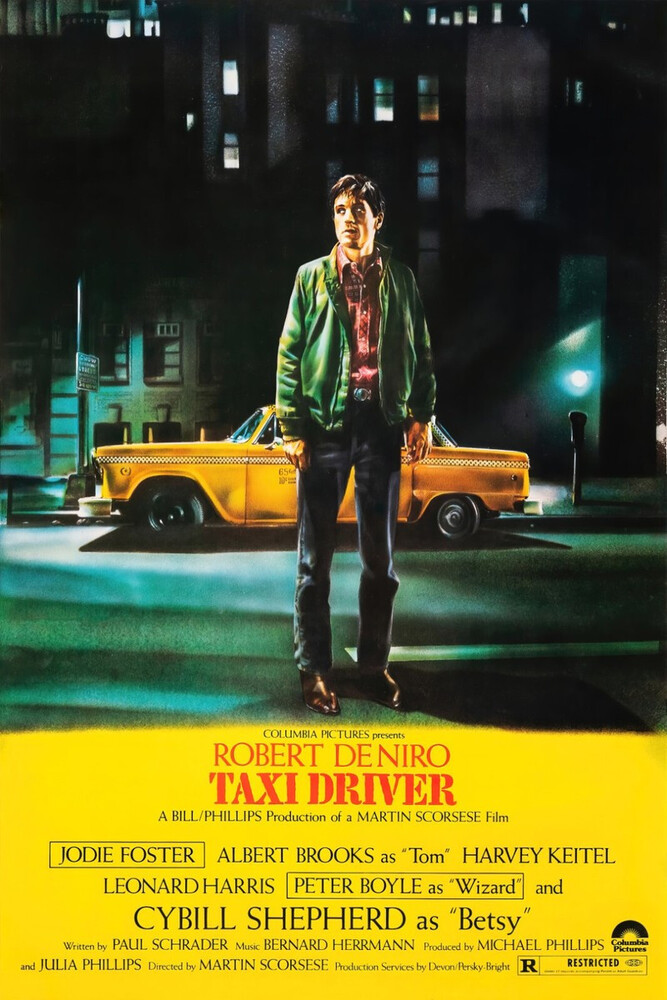
Taxi Driver (1976)

Director: Martin Scorsese
Writer: Paul Schrader
Stars: Robert De Niro, Jodie Foster, Albert Brooks, Harvey Keitel, Leonard Harris, Peter Boyle and Cybill Shepherd

Index: The First Thirty.

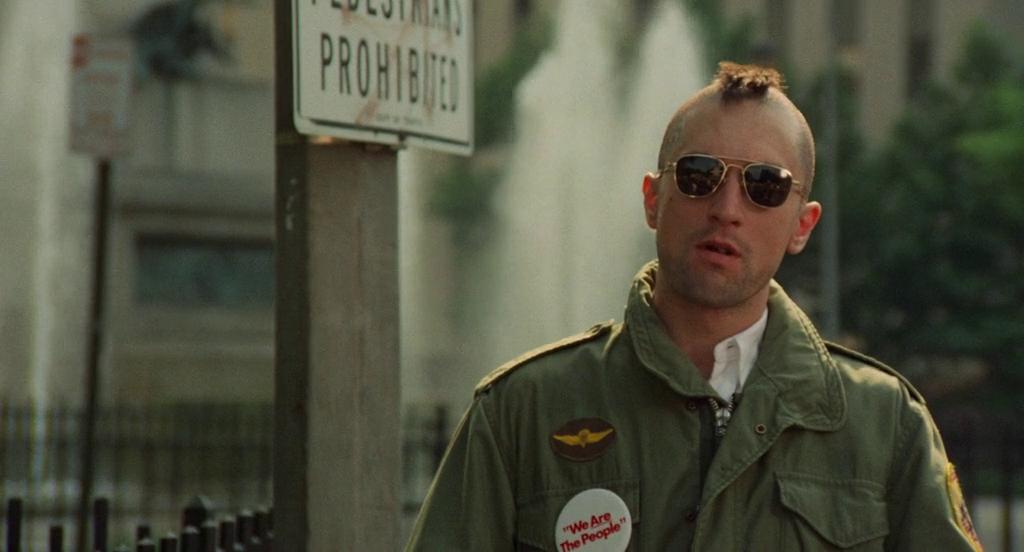
I’ve seen Taxi Driver a number of times over the years and I’ve always struggled with it. It’s clearly an impressive film, technically, but I’ve never been affected by it until now. Last time I saw it, back in 2010, I unwisely wrapped up my review with “I think I’m getting it.” I wasn’t.

I think what unlocked the door for me was a cultural change and not a positive one. Back in 1976, we didn’t have a name for Travis Bickle’s situation, so we had to build boxes of our own to label him. Now we do and it really helps.

He’s an incel and one of the scariest aspects of the picture is that he’s an incel who’s been radicalised without the internet, with its great ability to connect people. If Bickle is believable to us in 1976, then the logical extrapolation to make is that online radicalisation is making an awful lot more Bickles every day, all across the country. The problem is worsening.

Thursday, 22 January 2026

Echoes of a Summer (1976)

Director: Don Taylor
Writer: Robert L. Joseph
Stars: Richard Harris, Lois Nettleton, Geraldine Fitzgerald, William Windom, Brad Savage and Jodie Foster

Index: The First Thirty.

There are reasons why Echoes of a Summer is largely forgotten today. It feels just like a play, the staginess of much of the acting, especially that of Richard Harris, outweighing a handful of gems of dialogue in the script. It seems that it was indeed a play, Isle of Children, which was adapted by its author, Robert L. Joseph, even if the opening credits suggest that he wrote this for the screen.

Conversely, there aren’t a lot of reasons for Echoes of a Summer to be remembered, perhaps only one, but that reason is Jodie Foster. She’s young here again, I believe twelve during the shoot, thirteen by the time it was released in a limited Canadian run, but her character needs someone able to look roughly her age but act a lot older and she does it with aplomb.

She’d already done that in Smile Jenny, You’re Dead and Alice Doesn’t Live Here Anymore, both her 1974 films, but she only played a relatively small supporting part in each. Here, she’s the point. In fact, she isn’t far from being the only point, because this is all about Deirdre Striden, closing in on her twelfth birthday, but without much hope that she’ll see her thirteenth.

Wednesday, 21 January 2026

The Giant of Marathon (1959)

Directors: Jacques Tourneur and Bruno Vailati
Writers: Ennio de Concini, Augusto Frassinetti and Bruno Vailati, from an idea by Alberto Barsanti and Raffaello Pacini
Stars: Steve Reeves, Mylene Demongeot, Sergio Fantoni, Alberto Lupo, Ivo Garrani, Philippe Hersent and Daniela Rocca

Index: Centennials.

This is a perfect afternoon movie, a blend of historical accuracy and mythic hokum; divine cinematography and flimsy props; and a cast from many homelands all dubbed into Italian (except, I presume, for the Italians).

I have a fondness for peplum or sword and sandal flicks, the primarily Italian response to Hollywood’s big budget historical epics of mid last century. This is a more grounded example of the genre, though there’s as much made up out of whole cloth as has roots in history.

The setting, around the Battle of Marathon, is real, taking place in 490 BC as the Persians, under King Darius I, aimed to conquer Greece. Many of the characters are real on both sides: Darius and Hippias, exiled dictator of Athens, on one; Miltiades, Callimachus and Phillipides on the other, even if the latter’s heroics have been wildly mythologised.

Monday, 19 January 2026

Alice Doesn’t Live Here Anymore (1974)

Director: Martin Scorsese
Writer: Robert Getchell
Stars: Ellen Burstyn, Kris Kristofferson, Billy Green Bush, Lane Bradbury, Vic Tayback, Jodie Foster and Harvey Keitel

Index: The First Thirty.

From a TV movie that prompted an ABC TV show to a feature film that prompted a CBS TV show. However, this time the film is a Martin Scorsese and the show ran for nine seasons. In fact, Alice ran longer than any U.S. sitcom with a female lead until Roseanne passed it in 1996.

Little of that is evident in the film because it isn’t a laugh a minute comedy—adding a laugh track would be a crime against humanity—and there isn’t one central location; Mel’s Diner is that only for the last forty five minutes. This is a drama before it’s a romantic comedy and it’s not a romantic comedy in the romcom sense.

Ellen Burstyn won an Oscar for Best Actress, against tough competition, and she’s the focus throughout. What drew her to the script, after her huge success with The Exorcist, was that it’s the story of a woman who doesn’t have a story beyond being a woman, a wife and a mother. She’s just Alice Hyatt and that was refreshing.

Saturday, 17 January 2026

Smile Jenny, You’re Dead (1974)

Director: Jerry Thorpe
Writer: Howard Rodman
Stars: David Janssen, John Anderson, Howard da Silva, Martin Gabel, Clu Gulager, Zalman King, Tim McIntire, Andrea Marcovicci and Jodie Foster

Index: The First Thirty.

Other than her minuscule part in Kansas City Bomber, Jodie Foster’s first non-children’s film was this second TV movie about Harry Orwell, a cop who became a private investigator after he was shot in the back and forcibly retired.

He’d debuted in 1973 in Such Dust as Dreams are Made On, another TV movie, and those two pilots presaged a show, Harry O, which ran for two seasons on ABC from 1974 to 1976.

Harry O was played by David Janssen, so he’s technically the only star here. Everybody else listed above is a guest star, except for Foster, a mere co-star. And, sure she was twelve, but it’s another rather unfair credit, because she’s the main character in the secondary story and she actually gets the film underway.

Thursday, 15 January 2026

The Hanging Tree (1959)

Director: Delmer Daves
Writer: Wendell Mayes and Halsted Welles, based on the novelette by Dorothy M. Johnson
Stars: Gary Cooper, Maria Schell, Karl Malden and Ben Piazza

Index: Centennials.

Dorothy M. Johnson may not be a household name today, even among film aficionados, but she wrote three short stories later turned into notable westerns. The two best known are The Man Who Shot Liberty Valance and A Man Called Horse, but this third is unjustly underseen.

It’s a Gary Cooper film, not only because he stars in it, but because it was made by Baroda, his production company, the first of two, with the other being 1961’s thriller The Naked Edge.

Doc Frail is an unusual role for him, a good man, as we’d expect, but one with a dark past, which we don’t. As his daughter Maria pointed out, “You don’t expect a Cooper character to pump several bullets in a body and kick it off a cliff!” Well, that certainly happens here.

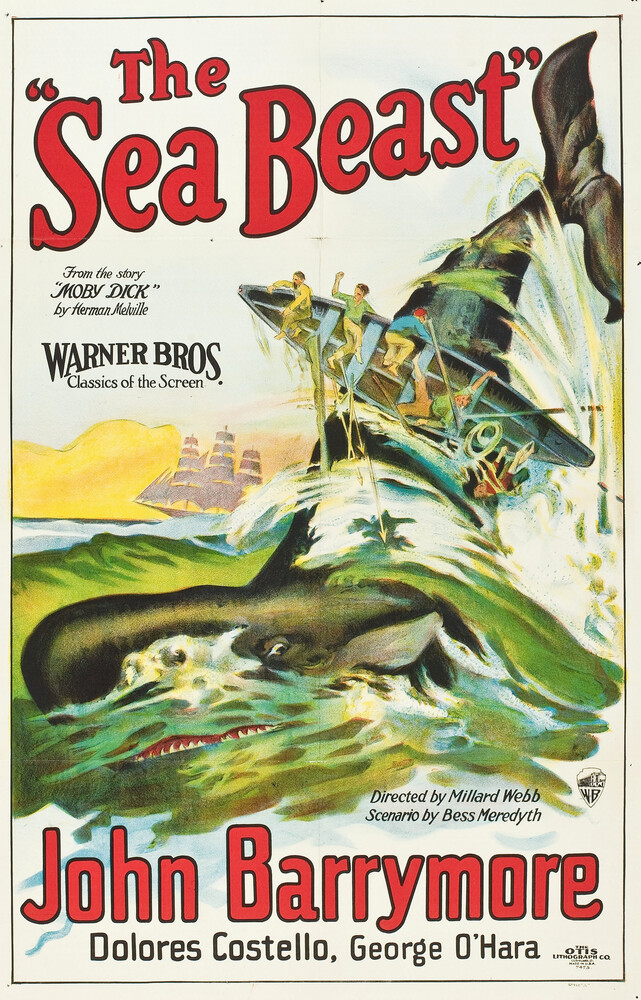
The Sea Beast (1926)

Director: Millard Webb
Writers: Bess Meredyth, based on the novel Moby Dick by Herman Melville
Stars: John Barrymore, Dolores Costello, George O’Hara and So-Jin

Index: That's a Wrap!

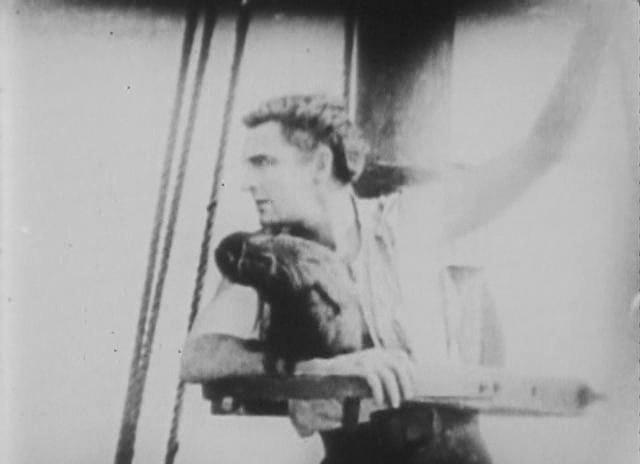
By all accounts, The Sea Beast was successful, the tenth highest grossing movie of the year, a film given a sound remake as early as 1930. To me, watching the movie in the pitiful version that’s available today, it’s hard to see why.

For one, it’s an awful print. It reminds me of the old Keystone shorts Charlie Chaplin made in his first year in film. I’d seen most of those in crappy nth generation public domain copies but often couldn’t tell what the fuss was about until I saw the Flicker Alley restorations. What this film needs is that treatment, urgently.

And I do mean awful. My print appears to be a transfer from a Televista DVD that was itself sourced from a 16mm film. It’s not easy to see nuance at any point but there are letters that are presented to us to read that look like blank sheets of paper. I don’t know what I missed on those shots, but it certainly didn’t help.

Wednesday, 14 January 2026

The Scarlet Hour (1956)

Director: Michael Curtiz
Writers: Rip Van Ronkel, Frank Tashlin and John Meredyth Lucas, based on a story by Rip Van Ronkel and Frank Tashlin
Stars: Carol Ohmart, Tom Tryon and Jody Lawrance

Index: Centennials.

The poster states “starring” Carol Ohmart, Tom Tryon and Jody Lawrance, but the movie itself chooses “introducing”. It started Ohmart and Tryon’s careers and restarted Lawrance’s. I’m watching for Tryon, today’s centenarian, but should note that this film, unusually, only began the first of his two careers in film.

This first, rather traditionally, is as an actor, initially in a rather passive role utterly under the control of Ohmart’s character, but finding his way out as the film runs along. He’s Marsh, E. V. Marshal, Sales Manager at the Nevins real estate company. Ohmart plays Paulie, or Mrs. Pauline Nevins. Yes, Marshal’s boss’s wife. His much younger trophy wife.

They start out on Lover’s Lane, hiding from anyone else who might venture up there, thus speaking volumes about their relationship. In fact, they’re secreted among the bushes when a gentleman explains the details of a robbery to two men that he’s hired to commit it.

Tuesday, 13 January 2026

One Little Indian (1973)

Director: Bernard McEveety
Writer: Harry Spalding
Stars: James Garner, Vera Miles, Pat Hingle, Morgan Woodward, John Doucette and Clay O'Brien

Index: The First Thirty.

This was Jodie Foster’s fifth movie, her third for Disney and her third under the direction of a McEveety brother. Surely they recognised a nascent potential in her, but unfortunately the elevation of opportunity she found in Napoleon and Samantha is not echoed here. Then again, it simply isn’t a film about women.

In fact, the only women we see in the initial forty minutes are Cheyenne refugees brought into a U.S. army fort as a stop on the way to a new reservation. Not one of them speaks, even Blue Feather, the “mother” of the titular little Indian. I use quotes because, after she prompts him to run and the soldiers catch him, they’re shocked to quickly discover that he’s white.

He makes it out at a second attempt and off he goes on his own into the Utah desert. Now, as we’ve already seen, there’s someone else on his own in the Utah desert and that’s Corporal Clint Keyes, trying to stay one step ahead of a patrol who want to take him back to a fort to hang him for mutiny and desertion. Needless to say, the two soon team up.

Saturday, 10 January 2026

Tom Sawyer (1973)

Director: Don Taylor
Writer: Robert B. Sherman & Richard M. Sherman, based on the novel The Adventures of Tom Sawyer by Mark Twain
Stars: Johnny Whitaker, Celeste Holm, Warren Oates, Jeff East and Jodie Foster

Index: The First Thirty.

While I can’t say that any of the three Jodie Foster movies before this will become abiding favourites of mine, I enjoyed them all. This is a film I’d describe mostly as “disappointing”.

For one, it’s a musical. While I’m very much looking forward to Bugsy Malone because it was so different from anything else out there, this is just another musical whose songs got in the way of the story. There are nine. I enjoyed two of them and didn’t mind a third, but the rest I could have happily done without.

I should point out here that the songs were written by the Sherman Brothers, Richard and Robert, who also wrote songs for what must be every other Disney film, including many of the most lively, cheerful and characterful songs in films like Mary Poppins, Chitty Chitty Bang Bang and The Jungle Book. These aren’t their best.

Wednesday, 7 January 2026

Moana (1926)

Directors: Robert J. & Francis Hubbard Flaherty
Writers: Robert J. & Francis Hubbard Flaherty with titles by Julian Johnson
Stars: Ta’avale, Fa’amgase and Pe’a

Index: That's a Wrap!

No, not the Disney animated film; that came out in 2016. And no, not their new live action version; that’s 2026. This is 1926 and it’s a very different picture, a slightly old fashioned look at life in Samoa from Robert J. Flaherty, maker of a similar film, Nanook of the North, in 1922.

John Grierson, a critic for the New York Sun, invented a new word in his review to describe what Flaherty was doing with these films. He called it a “documentary”. Ironically, it isn’t a documentary at all, in the sense that we know it today. It’s what we might call docudrama, a fictional and scripted slice of life that’s rooted in reality and acted by actual natives.

That isn’t judgement, by the way, though it isn’t difficult to get to that point. What we see in this film is valuable to anyone with interest in the history of Polynesia and I appreciate the rituals and activities that Flaherty dramatises for us. We just have to acknowledge that they are only real at a remove.

Tuesday, 6 January 2026

Kansas City Bomber (1972)

Director: Jerrold Freeman
Writers: Thomas Rickman and Calvin Clements, based on a story by Barry Sandler
Stars: Raquel Welch, Kevin McCarthy, Helena Kallianiotes and Norman Alden

Index: The First Thirty.

If the serious increase in lines, screen time and prominence that Jodie Foster received in her second film hinted at an imminent career, this third must have seemed like a kick in the teeth. She plays Rita, the daughter of the title character, Diane “K.C.” Carr, but that sounds a lot more important than it is.

Foster gets one scene a quarter of an hour in when K.C. comes home for a visit. Rita skates down the street with her mum and up to the house where she lives with her brother Walt and her grandma, who never gets a name, just Mrs. Carr. She’s good enough for us to buy into her being a kid wanting to emulate her mum, a professional skater.

She gets a few lines here, unlike her screen brother, who not only doesn’t want to talk to her, he even runs away from her, as if she’s a stranger. This whole family scene is done in a breath over two minutes. The only other time K.C. visits, the scene is just her and her mum, who argues for her to come home and be with the kids permanently. Spoiler: she doesn’t.

Sunday, 4 January 2026

Napoleon and Samantha (1972)

Director: Bernard McEveety
Writer: Stewart Raffill
Stars: Michael Douglas, Will Geer, Arch Johnson, Johnny Whitaker, Jodie Foster, Henry Jones and Major the Lion

Index: The First Thirty.

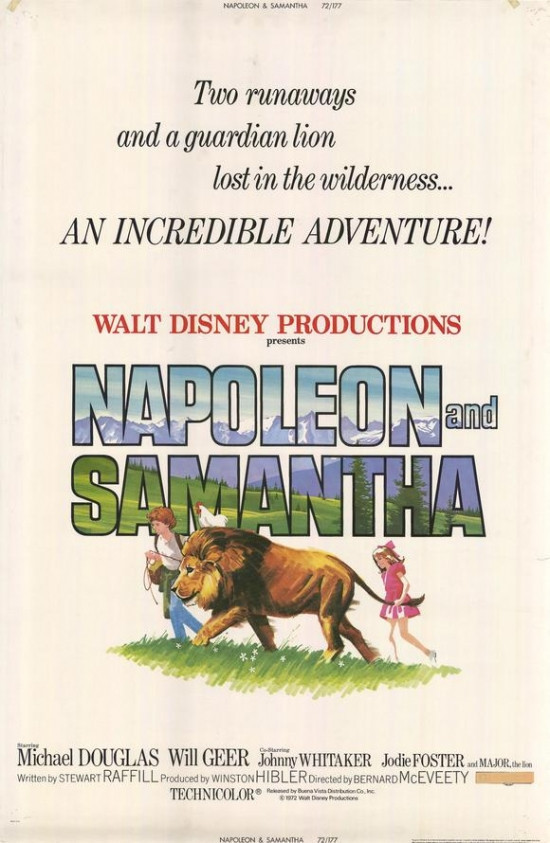
After Menace on the Mountain, here’s another Disney movie, though this one was made that way and so debuted in theatres rather than on television. However, the visible clash between the poster and the cast list above does warrant quite an explanation.

You see, this is a film about Napoleon, much more than it’s about Samantha, but the two do team up and head out into the mountains with a lion called Major. The artwork on the poster is pretty accurate for the film’s middle third.

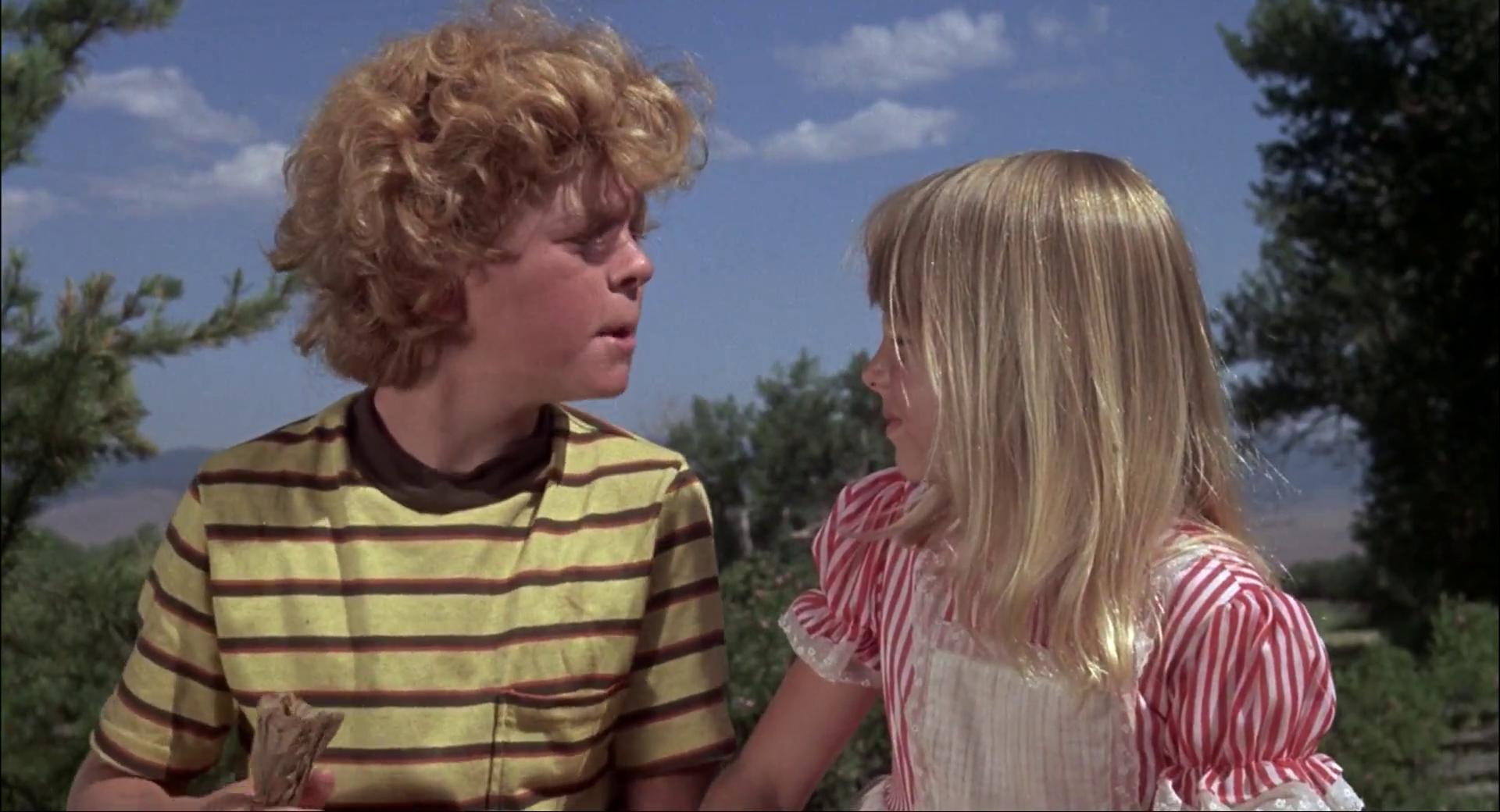
Napoleon is Johnny Whitaker, a child actor who had already made an impact, playing Jody Davis on five seasons of Family Affair. If this is anybody’s film, it’s his. Fortunately, he does an excellent job, even at twelve, and I’m looking forward to seeing him again soon playing Tom Sawyer in a film released a year later.

Samantha is his best friend, maybe his only friend other than the grandpa with whom he lives. She’s Jodie Foster, of course, and she was ten here. She has far more to do here than in the film before and the one after put together and she justifies that decision. In fact, she gets the movie rolling by delivering its first line.

Friday, 2 January 2026

Menace on the Mountain (1970)

Director: Vincent McEveety
Writer: Robert Heverly, based on the novel by Mary A. Hancock
Stars: Patricia Crowley, Albert Salmi, Charlies Aidman, Mitch Vogel, Richard Anderson and Dub Taylor

Index: The First Thirty.

The quickfire opening credits, which list no actors at all, underline that this is a TV movie, released to theatres in 1972, but it didn’t start that way. Before that, it was a two-part story on The Wonderful World of Disney in 1970. Before that, it was a book, the debut of M. A. Hancock, who sold the movie rights to Disney before the novel even reached print in 1968.

What’s odd to me about that is that it breaks so naturally into two parts that it doesn’t flow like a feature and thus presumably didn’t flow like a novel. I haven’t read it to find out.

I’m watching for Jodie Foster, because this is her debut as an actress. She was seven when it was first broadcast on TV and nine when it hit theatres. As that might suggest, she is far from the star here, but, at least for the first half, her screen brother is. He’s played by Mitch Vogel, who was fourteen and about to join the main cast of Bonanza for its final three seasons.

Thursday, 1 January 2026

The Bride of Glomdal (1926)

Director: Carl Theodor Dreyer
Writer: Carl Theodor Dreyer, from the novels by Jacob Breda Bull
Stars: Einar Sissener and Tove Tellback

Index: That's a Wrap!

When people ask me which film I believe is the best ever made, I tend to say The Passion of Joan of Arc, a French silent movie by the Danish director Carl Theodor Dreyer. That won’t pop up in this project for another couple of years, but this is the movie he made before it.

Frankly, it feels like a film by someone else, because it’s built not of majestic close ups but sparse pastoral long shots. There are scenes in farmhouses and a vicarage, but mostly, they’re of fields and the river and more fields. Even as the tension is ratcheted up during the closing scenes, it’s still a relaxing movie that allows us to slow down to the pace of the countryside.

There isn’t much of a story, mostly because Dreyer improvised it as he went, albeit loosely based on a couple of novels by the Norwegian author Jacob Breda Bull, Glomdalsbruden, which means The Bride of Glomdal, and Eline Vangen. It seems to me that the former is likely to be the bulk of the story even though the latter is the longer work. Sadly I can’t find details online.