
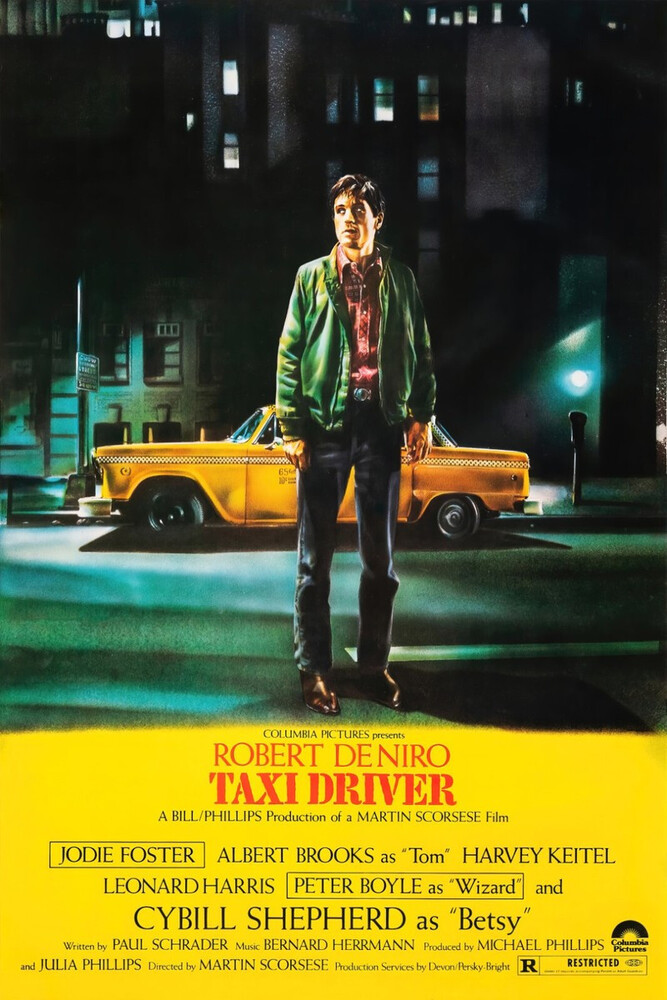
Director: Martin Scorsese
Writer: Paul Schrader
Stars: Robert De Niro, Jodie Foster, Albert Brooks, Harvey Keitel, Leonard Harris, Peter Boyle and Cybill Shepherd
 |
Index: The First Thirty.
I’ve seen Taxi Driver a number of times over the years and I’ve always struggled with it. It’s clearly an impressive film, technically, but I’ve never been affected by it until now. Last time I saw it, back in 2010, I unwisely wrapped up my review with “I think I’m getting it.” I wasn’t.
I think what unlocked the door for me was a cultural change and not a positive one. Back in 1976, we didn’t have a name for Travis Bickle’s situation, so we had to build boxes of our own to label him. Now we do and it really helps.
He’s an incel and one of the scariest aspects of the picture is that he’s an incel who’s been radicalised without the internet, with its great ability to connect people. If Bickle is believable to us in 1976, then the logical extrapolation to make is that online radicalisation is making an awful lot more Bickles every day, all across the country. The problem is worsening.
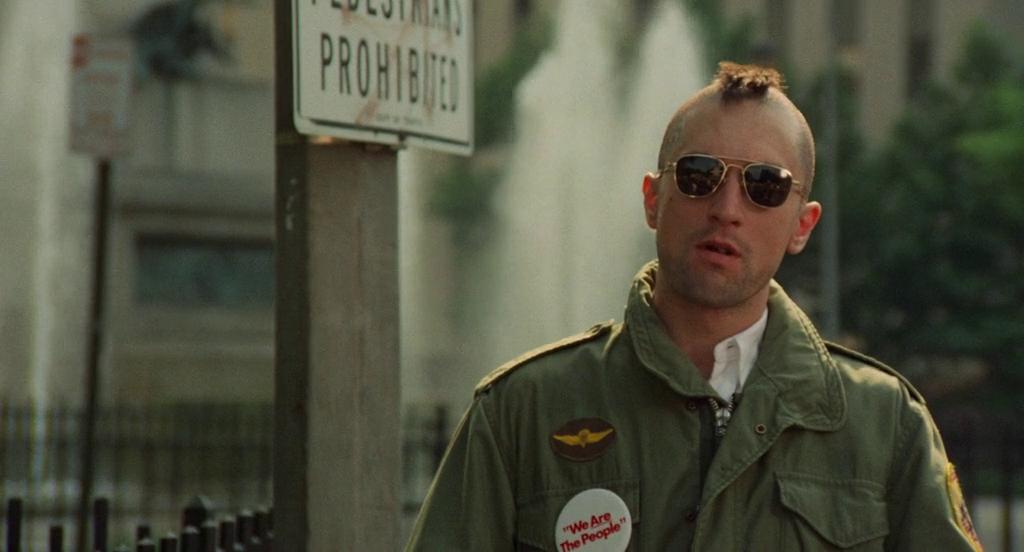 |
All that said, I had some sympathy for Bickle this time through. He’s a Marine, honourably discharged but unable to sleep, so prompting a job that allows him to work over twelve hours a day during the night. He’s twenty-six, so saw action in Vietnam that it isn’t hard to believe traumatised him. Later, we see horrific scars on his back. He’s taking pills for headaches by that point, and it seems from his letters home that he’s isolated from his family too.
In short, he’s alone, even though he drives a cab in the most populated city in the country, so is always around people. Not one of them is truly there for him. Not one of them notices or cares that he can’t sleep, that he’s distracted a good deal of the time, that he clearly has some form of PTSD. If anything, his colleagues help to enable him as he becomes more extreme.
It’s not enough to say that he doesn’t have family, care workers or therapists to help him through what he’s going through. It’s that he’s practically invisible to the world. “You talkin’ to me?” may be the most famous quote, but to me it’s the next part—“Well, I’m the only one here”—that’s the most eerily accurate. What’s more, he has absolutely no ability to connect to the world. He’s blissfully ignorant of pretty much everything and knows it, but he doesn’t ever seem to want to change that.
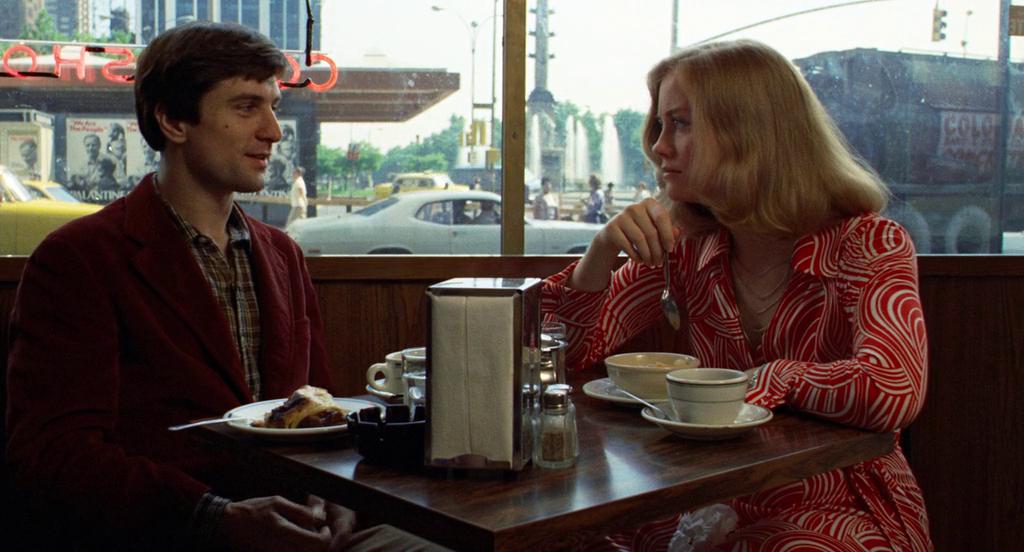 |
All he has is his work and a vision of beauty that turns out to be Cybill Shepherd as Betsy, who’s working on a political campaign to elect Sen. Charles Palantine president. He goes into its offices to ask her out, but can’t find a single common subject on a kinda sorta date beyond his dislike for one of her co-workers, who he believes is a competitor. She’s up for a movie, but he takes her to see a porn flick because he sees couples there. Relationship over.
Frankly, Betsy understands more about him in their coffee date than he understands about the world. In particular, she observes that he’s a contradiction, something we’ve already seen in early scenes. He bitches about the filth that he sees in the streets but visits adult theatres. He seems to be racist but tries to chat up the black concession girl at one theatre, ironically played by Diahnne Abbott, who was about to become De Niro’s first wife.
It’s a fantastic way to establish a character who becomes either a villain or a hero, partly depending on our point of view but really due to mere quirks of circumstance. He thinks he’s a hero in his own story, as all the best villains do, but the actions he takes to become praised as one (maybe, depending on what you believe the final scenes represent) are just unplanned backup. The actions that he plans but fails to pull off would have painted him unmistakably as a villain. No interpretation needed.
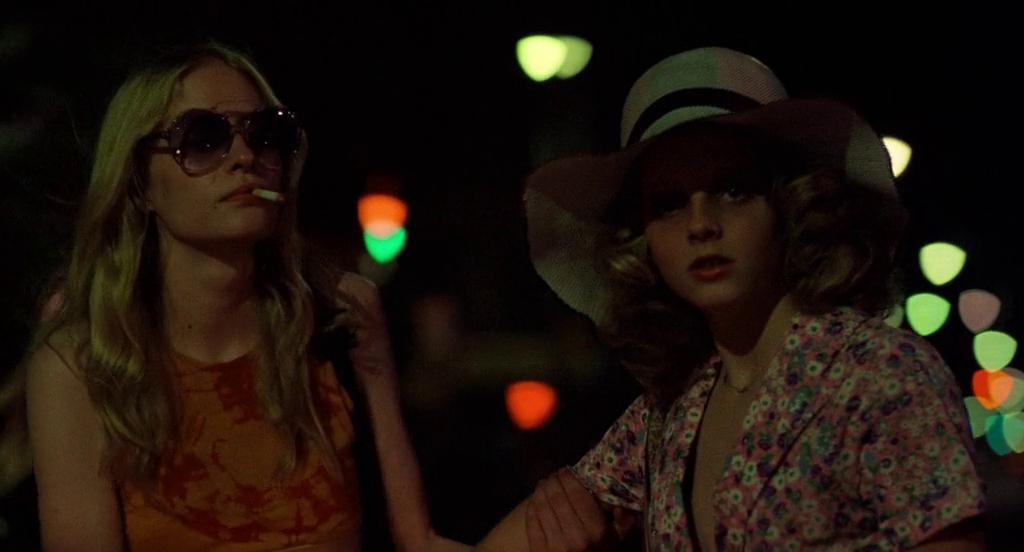 |
After Betsy’s rejection, he’s adrift and starts to focus on an underage prostitute who he saw get into his cab once. Her pimp pulled her out again and threw him a crinkled twenty, which he doesn’t want to touch. He isn’t interested in her sexually; he wants to save her from the life she’s somehow found herself in.
She’s Iris Steensma and famously, of course, she’s played by Jodie Foster, twelve when this was shot in the summer of 1975 and thirteen when it was released. Her on screen pimp talks her up to customers as twelve and a half. Sport does use much cruder language, of course, not least because he’s played by Harvey Keitel, the actor who so effectively threatened her screen mum only two films earlier in Alice Doesn’t Live Here Anymore. Hoops were jumped through to protect her emotionally during the shoot and her elder sister Connie doubled for her in the more extreme scenes.
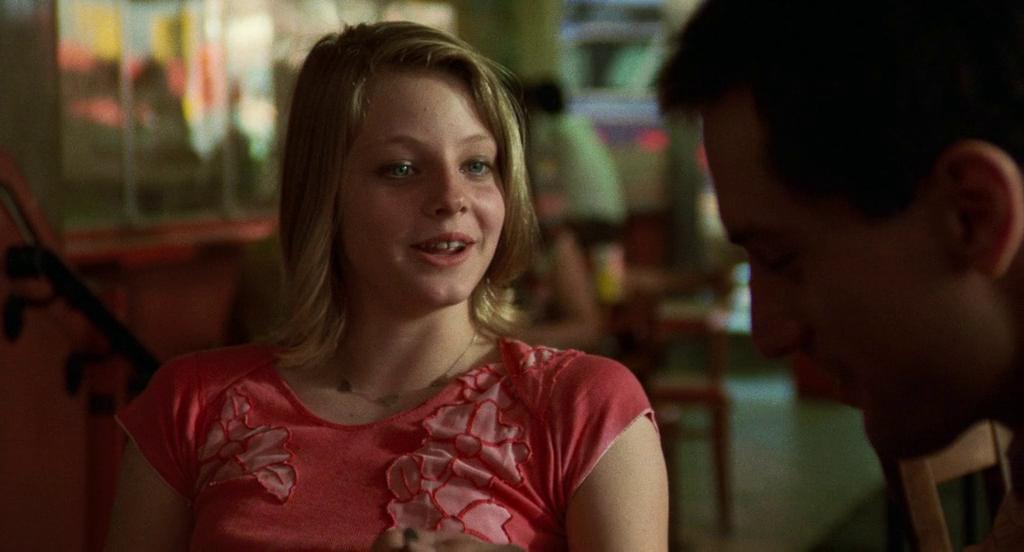 |
Oddly, while she was usually underbilled in her early pictures, it could be argued that her billing here, second after De Niro, is excessive given that she doesn’t actually have that much screentime. However, the counter is that there aren’t any actors with substantial screentime here, except De Niro himself. Cybill Shepherd, as Betsy, vanishes from the film early on, only reappearing occasionally after that, usually in the background. As her replacement, even if it isn’t in the same way, in Bickle’s delusions, she may well have more screentime. Certainly, her scenes come at a more impactful time.
In fact, her scenes often are more impactful. As Bickle tries to explain how he plans to save her, in a sleazy motel room, he has to stop her unzipping his fly. A later scene in which Sport dances with her is extremely uncomfortable, as he talks up his love for her and his reliance on her as if they’re a married couple.
She’s incredibly good, which wouldn’t have shocked anyone who saw her earlier films for adults. No wonder that she was landing lead roles, not just in Echoes of a Summer before this but The Little Girl Who Lives Down the Lane soon after it. She also received one of Taxi Driver’s four Oscar nods (unlike Martin Scorsese) but, like De Niro, she lost to Network.
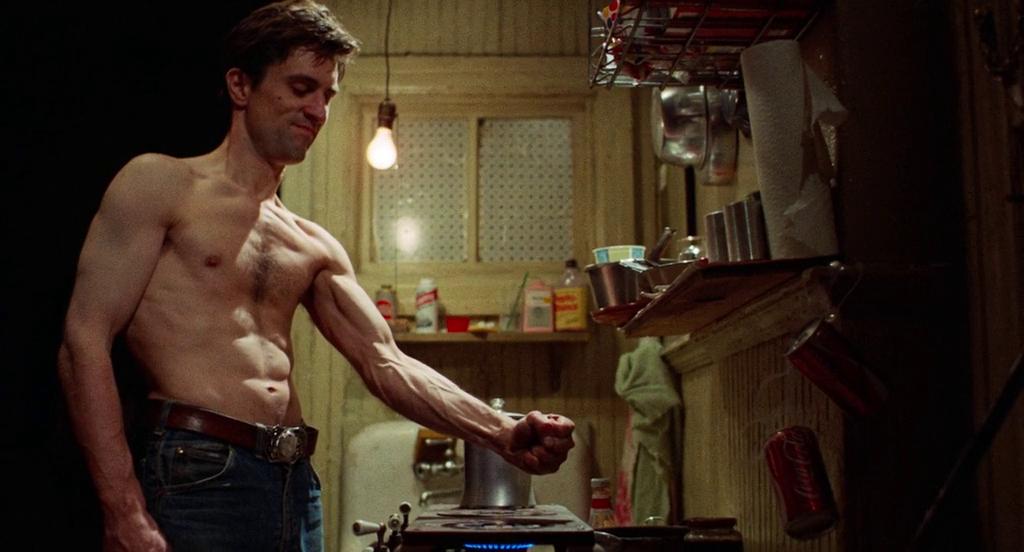 |
Of course, as good as she was, De Niro is the primary reason to see this film, along with the direction (Scorsese memorably acted too) and the work of a number of other crew members. The cinematography of Michael Chapman is a dreamlike effort and the score gave legendary composer Bernard Herrmann his final credit. The script was by Paul Schrader; it wasn’t his first but it firmly put him on the map.
Finally, there’s New York City, which plays a character here just as much as any actor. This is clearly the sleazy Big Apple of the seventies, which makes a memorable backdrop. I wonder if it would be viable to remake this today and, if so, what backdrop it would adopt in 2026.


 Posts
Posts


No comments:
Post a Comment