Showing posts with label Weird Wednesdays. Show all posts

Wednesday, 26 April 2023

Aaaaaaaah! (2015)

Director: Steve Oram
Writer: Steve Oram
Stars: Lucian Barrett, Lucy Honigman, Tom Meeten, Steve Oram, Sean Reynard, Julian Rhind-Tutt and Toyah Willcox

Index: Weird Wednesdays.

In many ways, Aaaaaaaah!, actor Steve Oram’s debut feature as a director, is just a soap opera, because all the characters are defined entirely through their relationships, which change considerably over the course of the picture. Denise lives at home with her mum, Barabara, who’s currently with Ryan, even though her ex, Jupiter, is still hanging around looking forlorn. Denise clearly hates Ryan and what passes for a home life that their family has, so acts up accordingly, drinking and shoplifting with her cousin, Helen. When a stranger named Smith shows up at a party that they’re hosting at their house, she hooks up with him prompting things to change. Smith and Ryan clash repeatedly, trawling in friends and family members to their fight until everything eventually settles down to a new normal. The good times are good and folk enjoy cooking or playing console games. The bad times are bad, deteriorating into violent arguments that leave nobody happy. This could be Eastenders or Coronation Street, right? But it isn’t. Oh no!

Oram’s soap opera world has one major difference to anything you’ll see on primetime television, perhaps best highlighted with a note that the film’s title is the most coherent line of dialogue anyone utters in 79 minutes of running time. These characters might look like regular human beings and they might live lives that oddly echo our own, but they’re not regular human beings. What they are, Oram refuses to explain, so we have no easy recourse to a virus or a chemical leak or an alien experiment to explain anything. Things just are and it falls to us to figure out what Oram is trying to do in this film with all his actors communicating only through animalistic grunts. It’s like the world as we know it simply changed one day when everyone woke up with the primal urges and low (comparatively) intelligence of a chimpanzee. They carry on regardless, being British, but just through routine, because any higher functions, such as speech, have been forever lost. Civilisation has fallen, even if nobody’s apparently acknowledged it yet.

Wednesday, 5 April 2023

If Footmen Tire You, What Will Horses Do? (1971)

Director: Ron Ormond
Writer: Ron Ormond, from the book by Estus W. Pirkle
Stars: Estus W. Pirkle, Judy Creech, Cecil Scaife, Gene McFall and Wes Saunders

Index: Weird Wednesdays.

I’ve long held to the idea that the most interesting people in Hollywood aren’t the stars of big budget blockbusters; they’re the folk behind exploitation films. And I don’t just mean the stars, but the producers, directors, writers, the folk who were flexible enough and aware enough to jump from one thing to another as times changed. One of the people I’ve long wanted to read more about is a gentleman named Ron Ormond, who was all over this weirdly titled movie like a rash. It was a production of his company, simply named the Ormond Organization. He directed it. He wrote it, from the “book” by Estus W. Pirkle, which was really a pamphlet that ran 46 pages long. He edited it with his son, Tim, and the two of them also operated the cameras. Both of them also appear in brief, uncredited roles within the movie. About the only job that Ormond didn’t do was production supervisor, because that was his wife, June. It’s a very strange movie, but I feel like I should build up to it by explaining how Ormond got to this point.

Born Vittorio di Naro in Baldwin, LA in 1910, he soon found his way into vaudeville as Vic Narro, taking his eventual name from his friend, Ormond McGill, who was a magician and hypnotist. He met June in Oregon while working as a magician and MC on shows in which she was a singer and dancer. The Ormonds managed the Three Stooges, produced roller derby on television and travelled in the exotic east, Ormond penning a string of books with McGill with exploitation titles like Religious Mysteries of the Orient, The Master Method of Hypnosis and The Magical Pendulum of the Orient. And they got into the movie business, Ormond directing a fantastic string of B movies. He started out with Lash LaRue westerns like King of the Bullwhip and The Frontier Phantom but lent his hand to anything that looked likely to make a buck, especially in the deepsouth. Forty Acre Feud had an all-star country music cast led by Minnie Pearl. White Lightnin’ Road is a stock car drama. The Monster and the Stripper (aka The Exotic Ones) is, well, it’s exactly what you think it is.

Wednesday, 29 March 2023

The Secret of Magic Island (1956)

Director: Jean Tourane
Writers: Louise de Vilmorin, Jean Tourane and Richard Lavigne
Star: Robert Lamoureux

Index: Weird Wednesdays.

Sometimes tracking down the weirdest movies of all time takes some effort, which is why I’m watching this 1956 French-Italian co-production in a VHS rip that’s been dubbed into Swedish and fan subbed into English. I have to applaud the dedication needed for the former, even though there’s no dialogue and it’s always easier to dub a narration than the words of a dozen characters. I thank Dr. Death at Cinemageddon for the latter, even though my streaming device wouldn’t pick them up on my TV so I had to read them on my laptop while the film was playing. Such are the lengths to which I must go to in order to report on this cinematic insanity for your edification and pleasure! And talking of insanity, there’s plenty of it because this picture is entirely acted by animals. And no, I don’t mean animals playing animals interacting with humans; you’re not going to see Lassie in a book like this. All these characters could have been played by regular human actors, just as we might expect. But they aren’t. They’re played by animals. Because.

And we get to see a whole heck of a lot of them during the first half of the movie, because nothing happens beyond regular sort of folk going about their business in a regular sort of town, merely one sized to appropriate levels for the cast. It’s a damn good model and it’s easily the best thing about the movie. So we follow the postman as he delivers the mail, just as a human might do it, except that Gustaf is a duck. His cantankerous wife is a duck too, which is probably a good thing. The barber is a fox named, I kid you not, Foxy. The tavern has a dog for a bartender, who pours wine better than some human bartenders I know. It’s not merely the model town that’s immediately impressive; it’s the props as well because this is a well equipped model. There’s a pool table in the bar. The fireplace has a fire in it. The goose drives around town in an actual moving vehicle. And, amazing as it might seem, we fall into this logic because it’s never commented on. Within the framework of this story, it isn’t worthy of mention.

Wednesday, 25 January 2023

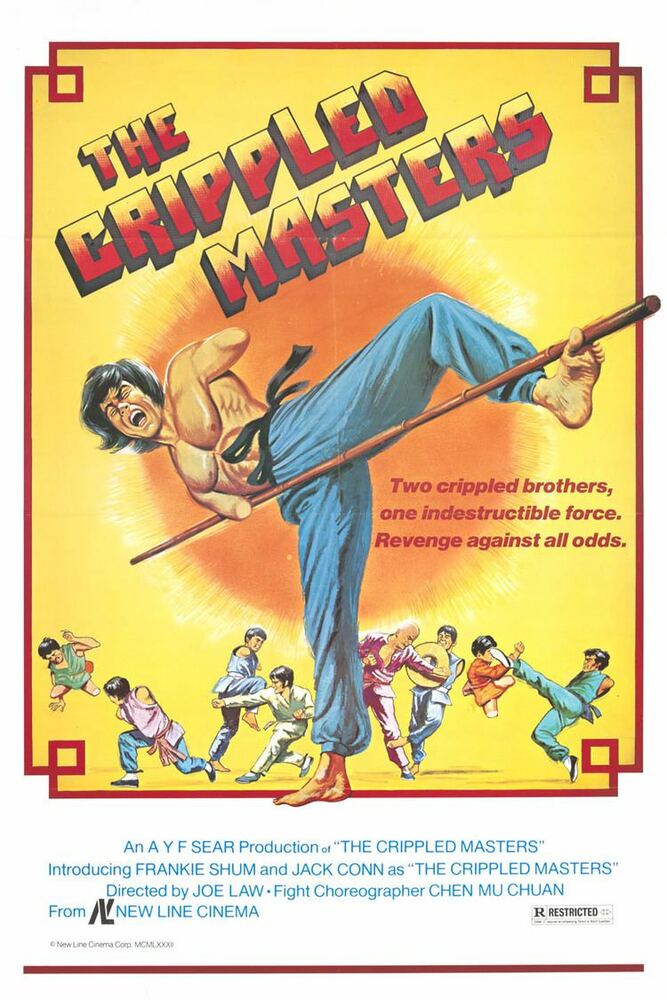
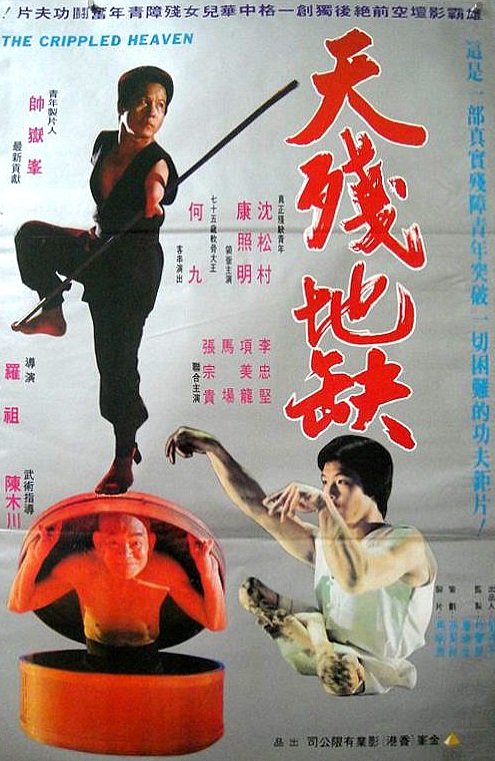
The Crippled Masters (1979)

Director: Chi Lo (Joe Law)
Writer: Unknown
Stars: Li Chung Keng, Chen Mu Chuan, Frank Shum, Jack Con and Ho Chiu

Index: Weird Wednesdays.

Every now and then, I see mention of Blazing Saddles, the groundbreaking 1974 Mel Brooks comedy, and, wherever that mention is, it’s usually accompanied by two opinions: firstly, it’s still incredibly funny, and, secondly, nobody could remake it today. Now, they may have a point about that (even though they just did, as Paws of Fury), but The Crippled Masters never fails to spring immediately to mind as an equivalent. Even though it has an easy reading as a film that enables the disabled, it’s so outrageous in the way in which it does so that many would find it difficult to watch and I can’t imagine that anyone could tread this ground in 2020. I adore it and, even though it’s a truly awful film in many quantifiable ways, I think I always will, however many times I watch it. The basic idea is to cast a martial arts movie with cripples, a word I only use here because it’s the word used throughout the English dub of the film to describe the characters at its heart. That’s not just Lee Ho and Tang, the two crippled masters of the title, but presumably their nemesis, Lin Chang Cao, as well.

It’s Lee Ho we see first, losing his arms in a judgement by his boss. No, I’m not talking about heraldry, I’m talking about the severing of his upper limbs with a sword. Fewer than ten seconds after the opening credits wrap, we hear a scream and watch an arm fall to the Pluahchi crime organisation’s courtyard floor and, fifteen seconds later, his other arm joins it. We don’t actually see the act and the fake arms are props, but it appears shockingly real. This is a Hong Kong movie shot in Taiwan in 1979, after all. Do you think the production had a CGI budget? This is surely why there’s surprisingly little blood and no arterial spray, but the actor, Frankie Shum, is clearly not hiding his limbs inside his shirt or behind his back. It looks as if he just has no arms, only a flipper-like stub sprouting out of his left shoulder that looks rather like a mandrake root. And, crucially, this is because he really has no arms. Shum was born with thalidomide syndrome, which often leaves flippers instead of limbs, among many other deformities and health issues.

Wednesday, 4 January 2023

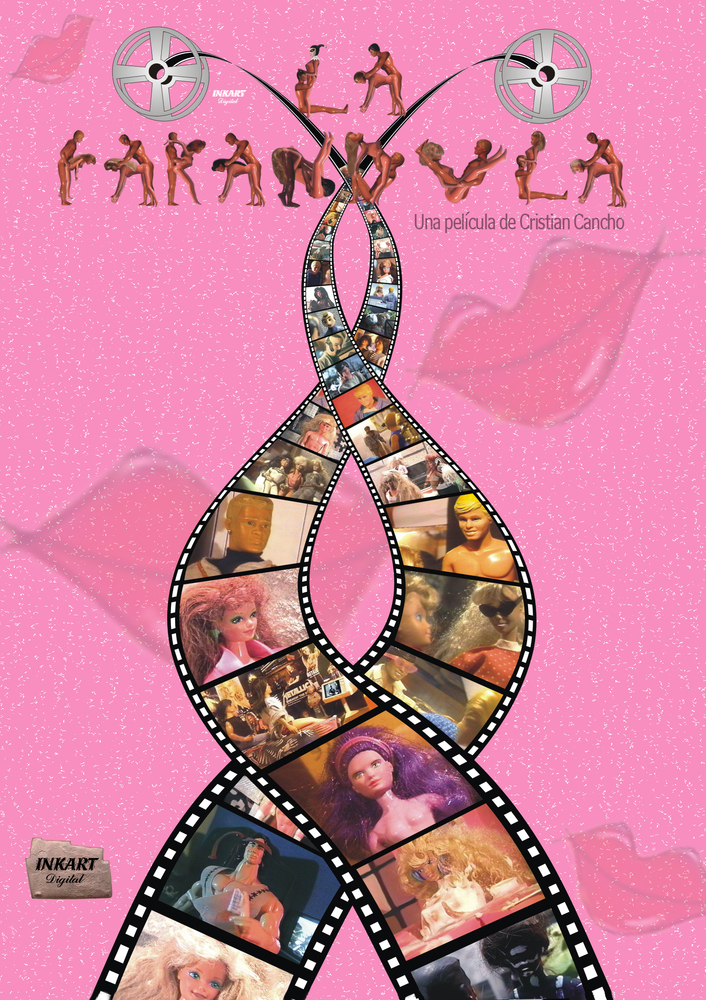
La farándula (1998)

Director: Cristian Cancho
Writer: Cristian Cancho
Stars: Erick García, Fanny Labbé, Karla Aquije and Daniël Schoonenboom

Index: Weird Wednesdays.

La farándula, which means Showbiz in Peru, where it was made, is the epitome of the movie that you won’t believe exists. While you might assume that’s because of what happens within it, given that this is basically a porn flick acted out entirely by Barbie and Ken dolls, I’d call out the hour long running time as even more unlikely. I can imagine filmmakers with the intense discipline needed to animate an hour’s worth of stop motion with Barbie dolls, because it’s been done before and with more nuance; Todd Haynes used that technique in Superstar: The Karen Carpenter Story so that he could progressively shave down the title character’s doll during the movie to illustrate her raging anorexia. I can also imagine filmmakers sitting around the mancave, probably drunk, laughing about how funny it would be to make a porno with Barbies, but never actually doing so because, hey, we’re all out of beer and we have to be at Walmart for the early shift at nine. Is that the time? The wife’s going to kill me.

The thing is that I wouldn’t have expected any crossover between those two sets of filmmakers but there’s apparently one down in South America. In fact, this isn’t the first South American adult stop motion animated Barbie movie to cross my path, because I first heard about an Argentinean short film from 2002 called Barbie Can Also Be Sad. This was apparently broadcast on television in Brazil but eventually fell afoul of Mattel, the company that manufactures Barbie. They obtained a court order to prevent it being shown at the Urban-Fest film festival in Mexico City, pushing it underground where Superstar: The Karen Carpenter Story had grown into such a cult success, after Richard Carpenter sued Haynes for copyright infringement and got the film withdrawn from circulation. This is the longest of the three films and easily the most outrageous, given just how much Cristian Cancho crams in to his hour. That’s one good reason to cover it here, with another in the hilariously broken English subtitles. “You may uncomb my hair with one fart.”

Wednesday, 9 September 2020

The Flying Luna Clipper (1987)

Director: Ikko Ono
Writer: Ikko Ono
Stars: Anne Lambert, Ina Krantz, Mark Hagan and Zev Asher

Index: Weird Wednesdays.

Back in the eighties, films weren’t as available as they are now, because the internet is a wonderful thing and we shouldn’t ever lose sight of that. Then, I’d read about amazing movies in fanzines that I had no expectation of ever seeing myself. Because I read quite a few zines, I could see the paths of the underground tape trading circuit manifest like a map out of the order by which the latest wild title that came out of nowhere, like Nekromantik or Urotsukidoji, would see review in those zines. For decades, The Flying Luna Clipper was one of those wild titles, a film for the psychotronic cognoscenti to rave about like it was manna from heaven but rarely seen by the rest of humanity. Now, of course, it’s on YouTube in entirety, because, of course it is. The world has fundamentally changed. It’s said that someone found a laserdisc copy in a thrift store, ripped it to digital and sent it to Matt Repetski, because he doesn’t merely write about movies, he writes about video games too. He showed it to Matt Hawkins at Attract Mode, who uploaded it to YouTube.

And that sparked a resurgence of interest in The Flying Luna Clipper, which is very possibly the most unique film I’ve ever seen and a sort of visual shot of happiness. It’s batshit insane, it makes next to no sense and yet, while watching it, I drift into a feeling that all is right with the world. Given that I’m writing in September 2020, the ninth level of the Jumanji game that has comprised this crazy year, that’s quite the achievement, especially for a film released in Japan in 1987, on Video8, Betamax, VHS and LaserDisc, for what was then the equivalent of sixty bucks. And, quite frankly, it’s not really even a film in the sense that we tend to think. It’s more of a psychedelic graphics demo, created on an 8 bit MSX computer. Nishi Kazuhiko had clout, as a founder of the ASCII Corporation and a vice president at Microsoft, and he wanted to create a unified standard for home computers in 1983, but he failed. Sony made the bulk of the MSXs and they only shipped five million units in Japan, those sales helped by the original Metal Gear game.

Wednesday, 29 March 2017

United Trash (1996)


Director: Christoph Schlingensief
Writer: Christoph Schlingensief and Oskar Roehler
Stars: Udo Kier, Kitten Natividad, Joachim Tomaschewsky, Johnny Pfeiffer, Jones Muguse, Miklós Koniger and Thomas Chibwe


Index: Weird Wednesdays.

I’ve brought you some weird movies as part of my Weird Wednesdays project, but perhaps I’ll never be able to bring you another one weirder than this, a 1996 art film from German auteur Christoph Schlingensief, rather appropriately called United Trash. I am sure that the director had a serious purpose, namely to provide a socio-political commentary on the failure of the United Nations in Rwanda, but he chose to do it in an incredibly offhand manner. What he delivered was a sort of screwball comedy, in which no taboo is too low to exploit. It’s what you might get if Luis Buñuel took aim at western political and religious power structures and John Waters rewrote his script. If that sounds schizophrenic, it really is. The entire approach screams for analysis, as if there are deep and meaningful metaphors in every scene, but they’re all smothered in faeces and hurled at us by a chimp tripping on acid. The end result is somehow both aberrant and magnetic; we really don’t want to watch at all but we just can’t look away.

Let me introduce you to the key characters and you’ll get the idea. First up is Werner Brenner, a German general working for the United Nations somewhere in sub-Saharan Africa; we’re never told where, but the film was shot in Zimbabwe, so that’s as good a location as any. Brenner, played by Schlingensief regular Udo Kier, who I now see has been superbly described as the ‘Ron Jeremy of cult movies’ because he’s in so damn many of them, is clearly effete Prussian nobility which, to Schlingensief, translates to poor leader, flagrant queen and scat muncher. His wife, Martha, is Kitten Natividad, voluptuous vixen of many a Russ Meyer film, who’s racking up (pun not intended) quite the cult career of her own. She’s a former American hooker, whose debauched past (a twenty year stretch for exhibitionism) has been inexplicably replaced with a sexless present as a bored housefrau. She begins proceedings heavily pregnant and the baby shows up as black as the ace of spades, so that life change surely didn’t happen the way we’re told.

Wednesday, 15 March 2017

Little Red Riding Hood and Tom Thumb vs. the Monsters (1962)


Director: Roberto Rodriguez
Writers: Fernando Morales Ortiz and Adolfo Torres Portillo, from a story by Fernando Morales Ortiz and Adolfo Torres Portillo
Stars: María Gracia, Cesario Quezadas, Jose Elias Moreno, Manuel ‘Loco’ Valdes and El Enano ‘Santanon’


Index: Weird Wednesdays.

Once upon a time, so long ago that I can’t remember how long, I stumbled onto the surreal joy that is the filmography of K. Gordon Murray. He was an entrepreneur who borrowed a wild combination of children’s movies and horror features from Mexico, dubbed them poorly into English, gave them new, often more outrageous titles, and released them to the American market. I don’t know if I popped my Murray cherry on The Brainiac or The Robot vs. The Aztec Mummy, but I revelled in these pictures and was rather happy to discover, on moving to the American southwest, that many of them were easily available in dollar stores. However, I’m a strong believer in experiencing films in their original forms and it was only much later that I started to find some of these Mexican films sans the later Murray treatment. Sadly Mexican movies are rarely available in the U.S. with English subtitles, a poor situation that I really hope starts to change, but those that are tend to make a lot more sense than Murray’s bastardised versions.

This is one of Murray’s signature films, under the title of Tom Thumb and Little Red Riding Hood. The more recent DVD completes the original Mexican title, as Caperucita y Pulgarcito contra los monstruos has more than just our two childhood heroes, it has them facing off against the Monsters, the primary reason why this film is such a blast, in the very title. Let’s have fair advertising, please! If the Mormon family round the corner took their kids to see Tom Thumb and Little Red Riding Hood, they might reasonably think that they would have plumped for a safe family friendly movie, only to be progressively traumatised by the wild array of monsters sprawled across their screen. I would love to be a fly on the wall as they fought for their refunds. Would they be more upset about the Satan-worshipping Queen Witch that they stole from Disney’s Snow White and the Seven Dwarfs or the paedophile who gets strung up to be used as a piñata? Maybe the monster who looks like Carrot Top if he was a fish man from Innsmouth.

Wednesday, 15 February 2017

Zombies vs. The Lucky Exorcist (2015)


Director: Jaguar Lim
Writer: Jaguar Lim
Stars: Jaguar Lim, Bobby Yip, Kieran, Hidy Yu, Henry Thia, Jaguar Lim, Jaguar Lim, Jaguar Lim, Jaguar Lim and Jaguar Lim


Index: Weird Wednesdays.

If you haven’t heard of the name Jaguar Lim before now, be warned: you’re going to be repeating it in your sleep after this review because the man is like a human meme. His Facebook page is a research rabbit hole from which I may never escape and, you know what? I’m OK with that. I have no idea what planet he’s from but he seems to spend his time in Malaysia, where he runs a nostalgic chain of candy shops of all things. It’s Country’s Tid-Bits & Candies Cottage, which apparently made him a large amount of money, and I mention it here because its name is the first thing we see in the movie after the ident of the production company, Jaguar Lim Films & Productions (M) SDN BHD, and the crediting of Jaguar Lim as producer on a dedicated screen. We get no less than fourteen such dedicated screens before the title card, detailing the key members of the cast and crew, and Jaguar Lim himself has, get this, ten of them, each with a different photo. No, I’m not kidding. Sorry, Tommy Wiseau, you’re clearly not egotistical enough.

He’s less a credit and more a drum beat. Producer: Jaguar Lim. Executive Producer: Jaguar Lim. Director: Jaguar Lim. Scriptwriter: Jaguar Lim. Starring Jaguar Lim. Then we take a brief break to introduce some other folk who appeared in the film, highlighting in the process how Jaguar Lim has connections. Credited with special appearances are Bobby Yip, a prolific Hong Kong actor who has worked for Wong Jing, Tsui Hark and Stephen Chow; and Kieran, a DJ on Hot FM in Bandar Utama, Malaysia. In shorter cameo roles are Hidy Yu, a model, actress and martial artist from Hong Kong; and Henry Thia, a comedian and actor from Singapore. Then it’s back to Jaguar Lim because he has no less than five cameo appearances too, three of them in drag. By the time we get to the end of the movie, we find ourselves in the forest with our hero, played by Jaguar Lim, watching his grandparents, both played by Jaguar Lim, fly away on a giant banana. Originally called Red Haired Priest, I’m unsure as to why this wasn’t simply renamed to Jaguar Lim.

Wednesday, 1 February 2017

In Search of the Wow Wow Wibble Woggle Wazzie Woodle Woo!? (1985)


Director: Barry Caillier
Writers: Tim Noah and Barry Caillier, from a story by Tim Noah, Creed Noah, Mary Noah and Barry Caillier
Star: Tim Noah


Index: Weird Wednesdays.

Yes, that’s the real title and it’s enough to suggest that this short 55 minute feature is prime material for me to review as a Weird Wednesdays entry. But wait, there’s more! The film is a solo performance for Tim Noah, who has done almost nothing, according to IMDb, and comments there and elsewhere suggest that it’s a particularly surreal trip. ‘Try to imagine Pee Wee’s Playhouse in the Guggenheim without Lawrence Fishburne or any other entertainment value,’ writes one IMDb reviewer. ‘Is this what inspired the Just Say No campaign in the 80’s?’ asks a shocked viewer. ‘Saving it for the next time I drop acid,’ suggests another. It seemed like an utter obscurity, best appreciated by people who were already stoned by the time they pressed play. That it’s a musical comedy for children performed by a man who is far older than he should be only adds to the weirdness. And I can’t deny that it really did live up to all those expectations within the first twenty minutes. But then something strange happened: I started to dig this.

Now, I am still trying to figure some of it out, as there are some things going on that play very oddly, but I delved deeper into the history and reception of the film and found a lot that surprised me. For a start, it apparently won four Emmys, which is four more than, say, Star Trek, which was nominated for thirteen of them but didn’t win one. Now, I can’t seem to find any information about which Emmys it won because the Emmy website doesn’t mention it at all, so it’s likely that these are Northwest Regional Emmys, like the dozen which Noah won a decade and some later for a children’s TV show entitled How ’Bout That. His IMDb credits are also misleading; it’s fair to say that he’s a versatile and busy talent, merely not on the big screen, as his one feature, 1990’s Daredreamer, utterly failed to set the box office on fire. He’s recorded albums and written books. He’s toured exotic countries and even founded his own performing arts center, the Tim Noah Thumbnail Theater in Snohomish, WA.

Wednesday, 18 January 2017

The Baron Against the Demons (2006)


Director: Ricardo Ribelles
Writer: Ricardo Ribelles
Stars: Juan Carlos Romeu, Helena Lecumberri, Alejandro Ribelles, Xavier Bertran, Irene Belza, Gerardo Arenas, Eva Barceló, Susana Palma and Paulina Gálvez


Index: Weird Wednesdays.

Much of the joy of my Weird Wednesdays project is in finding movies, watching them and trying to figure out who the filmmakers thought their audiences might be. I really have no idea about this one, because it mixes a few very deliberate approaches that I’m pretty sure I never expected to coincide in a movie. For instance, as the usual English language title, The Baron Against the Demons, suggests, this feels like a tokusatsu picture at heart, with foam latex suits, imaginative monsters and bizarre tale about a futuristic organisation dedicated to fighting evil. That it was made with Spaniards rather than the Japanese is one reason why that doesn’t quite ring true, but there’s also the BDSM comic book aesthetic and the gratuitous gore effects, which suggest that this was never meant for kids, and the most important aspect is the overriding Catholic dogma which drives the whole thing so fundamentally that this can only be a Christian metaphor dressed up for sexual deviants who like the Power Rangers. You know, that sort of film!

Oddly, for a movie so overtly about good and evil, we’re never quite sold on the good and evil bit. Sure, the villain is Satan himself, visiting from the Ninth Planet to witness the birth of the Antichrist, which here means a man in a rubber suit, conceived from seed stolen from a chained hero by a leather clad dominatrix with gigantic knockers, who’s birthed by a hermaphroditic stick monster. We may be relatively safe in assuming that they’re the bad guys! But who represents the side of good? Initially, we might presume that it’s Exorcio Deus Machine, a late 21st century band of Spanish Inquisition commandos sharing their steampunk space satellite with an alien race of muppets, from which lair they combat evil. After all, that’s who our hero, the titular Baron, works for. Yet, if he’s clearly on their side, they’re not quite so clearly on his, as the man in charge, Coronel Doménico, dreams of dropping an atom bomb on his head. What’s wrong with the usual Triumph of the Will inspired awards ceremony for heroes? No, atom bomb it is.

Wednesday, 4 January 2017

Marquis (1989)


Director: Henri Xhonneux
Writers: Roland Topor and Henri Xhonneux, based on the writings of the Marquis de Sade
Stars: Bien de Moor, Gabrielle van Damme, Philippe Bizot, Bernard Cogniaux, Olivier Decheveau and Pierre Decuypere


Index: Weird Wednesdays.

It’s been a while since I’ve written a Weird Wednesdays review but, if Apocalypse Later has become a place of discovery for films you may not know about, it’s the purest Apocalypse Later project there is because these are movies that you may not even believe exist! For instance, would you believe that someone would dare to make a movie about the French revolution with a key focus on the Marquis de Sade, who’s locked up in the Bastille writing pornographic novels? That’s weird but perhaps not weird enough for Weird Wednesdays. How about if all the human actors appear as anthropomorphic animals, aided by freakish masks that journey deep into the Uncanny Valley? Yeah, that’s a little more like Weird Wednesdays territory, but we need something more to seal the deal. I know! What if the most prominent character is Colin, the Marquis’s gigantic penis, with whom he chats at length and depth, their relationship being the most important one in the picture? Yes, now we have Weird Wednesdays material!

I should mention quickly that this is not the outrageous comedy you may expect. There are comedic elements, of course, most of them utterly surreal, but it doesn’t reach for laughs and there’s as much history and tragedy as there is comedy. It’s nothing like we might remember from Spitting Image or Meet the Feebles, to name but two easy comparisons. Also, those are both puppet shows, whereas this is really acted by human beings, merely in masks that completely cover their heads and often parts of their bodies, a sort of un-furry version of the furry community. The story is also full of outrageous topics, but they’re not played exploitatively. If anything, most are underplayed, especially rape, a core plot element that affects a few of the characters. One was raped before the movie begins and is pregnant because of it; for political reasons, scenes are staged to suggest a more palatable rapist to the public. Circumstances prompt the same character to be raped again, during the film, but that isn’t shown on camera.

Wednesday, 10 February 2016

The Finishing Line (1977)


Director: John Krish
Stars: Juniors and Seniors of Roebuck Junior School, Watton-at-Stone Primary School and the Simon Balle School, Hertfordshire, Peter Hill, David Millett, Jeremy Wilkin, Kevin Flood, Antony Carrick, Yolande Palfrey, David Howe, Don Henderson and members of the St John Ambulance Brigade, Hertfordshire


Index: Weird Wednesdays.

If One Got Fat was traumatising, and I’ve heard that adjective used a number of times, then The Finishing Line is nightmare-inducing. It’s a British short, made by John Krish for British Transport Films, on his return to work for them after a period on the blacklist, following his unauthorised commentary on the closure of London’s trams in 1953’s The Elephant Will Never Forget. He was asked to make a film that might help to stop children playing on railway lines and vandalising them. What he came up with, in collaboration with co-writer Michael Gilmour, was The Finishing Line, which surely features more maimed and dead children than The Hunger Games and Battle Royale combined. It proved immediately controversial (like, duh) and was debated on the TV show Nationwide. Some felt it was a tough film for a tough problem, while others worried about it traumatising their kids or even encouraging the very sort of vandalism that it purported to prevent. It was promptly pulled from circulation, replaced by a safe, inconsequential film called Robbie.

So what did John Krish do that so upset the British public in 1977? Well, contrary to every other example of a public safety film out there, he turned the problem at hand into a game. Well, not really a game. It’s a competition, a prominent school competition spawned from the sonorous words of a headmaster that resonate over the opening shots. ‘The railway is not the game field!’ he pronounces, so the one kid who sits dangerously on the edge of a stone bridge overlooking a railway line, immediately thinks, ‘Yeah, but if it was...’ He’d have lots of trains, a twenty foot scoreboard and even a brass band, which strikes up as we watch his twisted imagination at work. I grew up with British sports days and was six when this was released, so there’s much I remember here, from the bowl haircuts to having to restart the first race after some eager kid jumped the gun. The only bit that doesn’t feel familiar is when the folk from the St John’s Ambulance bring stretchers out of tents in preparation for what’s to come.
And off we go! We get four events, to be competed by four teams of kids. They’re each introduced by an announcer, eagerly explained by the anonymous kid on the bridge through narration and illustrated by a very basic diagram of what’s going to happen. It begins with ‘9 and Under Fence Breaking’, a particularly simple to explain event, in which the kids from each team have to run to the wire fence, break through it, get all their members down the bank, across the rails and up the opposite bank to cross the finishing line. Sounds easy enough, right? Well a train is due to drive through halfway just to spur some extra speed out of these kids, and you just know someone’s going to trip on a rail and lie sprawled on the track. It’s a girl from the blue team and his team-mates have to abandon him when they can’t summon up the strength to carry him away. ‘Blue are disqualified for failing to complete with a full team,’ mentions the announcer as everyone goes silent while the bloody corpse of this pre-teen is lifted onto a stretcher and hauled off.
Now you’re getting the idea? Well you have ‘12 and Under Stone Throwing’ next, then ‘Last Across’, with the ‘Great Tunnel Walk’ to finish things off. Each event wraps up with dead or maimed children and stone throwing adds disfigured adults to the mix. That involves simply throwing bricks, colour coded for teams, at a passing train from ten feet away from the track. There’s two points for each smashed window, we’re told, and four for ‘a direct hit’, which means a passenger. Yellow even score six for hitting the driver, who holds in his eyes while the blood pours out of them. Last Across ups the stakes, with two teams on either side of the tracks, fighting each other to get across before the oncoming train hits them head on. By this point I was counting myself and can swear there are twelve kids sprawled in the train’s wake, even if the announcer only claims five injured and five dead. The Great Tunnel Walk is when it gets really serious; as Krish told Fangoria, he wanted to make it ‘look like the Somme from 1914.’ And yes, it did.
It’s utterly surreal to watch this and realise that it was commissioned by a government department. Krish pitched the concept to British Transport Films, which he had co-founded decades earlier before his stint in the wilderness, and their in house psychiatrist loved it. ‘This is exactly what we need!’ he announced. So Krish made it, with the expected audience to be schools, screening to children between the ages of eight and eleven, as it was felt that older kids might see it a little differently. It played in some schools, always to a ‘very silent’ audience, with a few kids needing to be taken out partway through. Krish describes them as ‘the nosebleeders - the ones who are going to faint at anything’. Then the controversy that built up led to it being screened on TV and, to quote Krish, ‘there was a riot afterward,’ so British Transport withdrew it from circulation and banned it for 21 years. The next time anyone saw it in public was in 2003 as part of the Krish retrospective that was organised by the British Film Institute.
Anyone immediately surprised by the boy sitting on the wall of the bridge at the beginning of the picture, in a long shot that zooms into him and clearly shows that there’s no safety equipment underneath just in case he falls off, won’t be too surprised to hear stories of the shoot. According to Krish, he was given 175 kids for five days in the last week of term before the holidays. Given that the line was active, he couldn’t get onto it until 9.30am and he had to be back off it by 3.30pm. He had to finish by the Friday or all those kids would vanish and some of the extras with them, as none of the parents were there. The final shot of the massed dead had to be shot in only twenty minutes, because the production office had cut costs with the sign for the Great Tunnel Walk. They’d printed ‘Start’ on one side and ‘Finish’ on the other so, running out of time, Krish had to shoot the beginning, pull the sign down, transport it through the three and a half mile tunnel and put it up the other way round so he could shoot the final scenes.
I was six when The Finishing Line was made, so I didn’t see it in school. I vaguely remember seeing a few films but not what any of them were, which is a shame as apparently the seventies were strong for public safety films in Britain. Donald Pleasence voiced Lonely Water as the Grim Reaper, warning kids about the dangers of playing near rivers. Apaches was made in 1977 by John Mackenzie, who would go on to helm The Long Good Friday with Bob Hoskins; it features kids playing Cowboys and Indians in the countryside, only to fall prey to a host of hidden dangers, like suffocating in grain pits or burning alive in hayrick fires. Perhaps part of this came from the techniques being borrowed from the horror and exploitation films that dominated the late sixties and early seventies, as Katy McGahan, a BFI curator, suggests. This is helped by the BBFC, the censors whose scissors got busy in the video nasty era, as they left public safety shorts alone. They didn’t even ban this which, like A Clockwork Orange, was voluntarily withdrawn.

The Finishing Line can be watched for free on YouTube.

Sources:
Kier-La Janisse - School of Shock: Q+A: John Krish on Railway Scare Film 'The Finishing Line' at Fangoria.
Jude Rogers - Consider Yourselves Warned: Public Information Films at The Guardian

One Got Fat (1963)


Director: Dale Jennings
Stars: Charles Hagens, Dick Hutto, Kevin Lindsay, Janice Powell, Dan Whitehead and Lucie Hagens


Index: Weird Wednesdays.

I got a pleasant surprise when I played this bicycle safety short because it turned out that my better half had seen it. It was screened to her and her class in school, somewhere between kindergarten and second grade, perhaps a decade after its original release. Over four decades later, it had stuck in her mind to the point that she remembered it immediately, just from the opening shot of a odd huddle of kids with rather immobile tails. Yes, that will become clear shortly, I promise. The film didn’t traumatise her, she says, but then she didn’t ride a bike! She remembered the film as merely creepy, but probably funny to her too, at least as a six or seven year old kid. I’d only read about it, so this was a first time experience for me and I have no idea what the filmmakers thought they were doing. Why would they set up something so surreal just to make one meaningless punchline work at the end of fifteen minutes, especially given that it hurts the points of the film, which, the more we think about it, are really horrible life lessons.

The logical explanation for the film is that the folk at Interlude Films wanted to tell kids how dangerous it could be to ride their bikes without following safety precautions. Nobody has a problem with that, right? I fell off my bike as a kid, breaking one bone in my left arm and bending the other, so I know what it’s like to get hurt. Then again, I didn’t break any of the cardinal rules that are outlined in this film; I just fell off and landed on the kerb. Anyway, I’m all for this film in principle. But then I watched it. So now I wonder if anyone actually benefitted from the intended message. Did anyone avoid an accident on their bike after remembering to abide by the rules they learned in One Got Fat? Or did kids get into more accidents after emulating the bad behaviour of the monkeys on bikes. And there, I said it. The ten kids who get together and decide to go have a picnic in the park nine blocks away aren’t really kids. Well, one is. The others are all monkeys, wearing a variety of monkey masks and curiously immobile monkey tails.
Why? Well, I’m going to spoil the joke because it’s an irresponsible joke that gets worse the more we think about it. The title refers to the one real human boy, who makes it to the park safe and sound just because he isn’t, get this, a monkey! So what’s the lesson? Is it that monkeys make terrible cyclists? Is it that kids have no peripheral vision when they ride their bikes while wearing monkey masks? Nah, I’m just kidding. Surely it’s that when all your friends die horrible deaths all around you, you should carry on regardless so you can eat their lunches and get fat. Don’t call 911. Don’t make a responsible adult aware. Don’t stay to comfort your dying buddies in their last moments on earth. Just think about all those packed lunches and the carnage won’t even register. Then again, not acknowledging what’s going on while you’re riding down the road sounds pretty dangerous. And hey, didn’t ‘Slim’ Jim McGuffney’s bike collapse under his weight? Eat up all those lunches, Orville Slump, because you’ll be next, kiddo, you’ll be next!

I was actually as flabbergasted by the narration as the visuals, courtesy of Edward Everett Horton, one of the gems of thirties Hollywood. Each time I tried to figure out why I was watching a bunch of monkeys on bicycles, he’d throw out a new line of inappropriately chipper monologue to grab my attention back. For instance, the reason why Orville has all ten lunches defying the laws of physics on his bike’s back rack is because, ‘Slim thought that his sack would be hard to handle.’ Did Dale Jennings write this deliberately? He certainly aimed to fit as much humour as he could into this morbid monologue of mangled monkeys, so perhaps he did. Just look at the names of the characters! Just watch the cartoon explosions and listen to the squishing sounds! Just think about how cheerful Horton sounds after each accident! His dismissals of each character after their horrible deaths is reminiscent of the dark wit that Vincent Price got to use so frequently when making horror pictures for William Castle. ‘Phillip Floogle is no longer bored.’ Oh yeah.
I won’t run through all the deaths, because you should certainly watch this surreal how-not-to yourself. I’ll just illustrate the comments above with some examples. First up is ‘Rooty Toot’ Jasperson, described as ‘a slam-bang go-getter headed for big things in life.’ Like a car, when he gets fed up of making hand signals when he wants to turn and swerves into traffic. ‘At this point,’ enthuses Horton, ‘Rooty Toot Jasperson left the party.’ We can only assume that he was so far ahead of the pack that the emergency services cleaned up the road before the rest of them caught up. Otherwise, why wouldn’t these monkeys stop and gawk in horror at the bloody remains of their friend? Those damned dirty apes! They just carry on and continue to make mistakes. Tinkerbell McDillinfiddy (seriously, where did these names come from?) is just a forgetful soul and, in this film, that leads to being hit by a big frickin’ truck. Worst is maybe Filbert Bagel, who gets squished by a steamroller because he can’t swerve, I mean doesn’t do maintenance so his brakes fail.
Best of all is Mossby Pomegranate, who doesn’t even have a bike, because he didn’t register it and failed to obtain a license, so the cops couldn’t do anything when it got stolen. He’s the first monkey not to die in a horrible fashion, which perhaps leaves us with the lesson that the safest way to ride a bike is to get the frickin’ thing nicked so you can’t get into an accident on it. All he ends up with is fallen arches because a few blocks of jogging was apparently deeply unhealthy in 1963, albeit not as deeply unhealthy as riding a bike in an ape mask. Of course ‘Slim’ Jim McGuffney gets his, as does Trigby Phipps and Phillip Floogle, Nelbert Zwieback (who’s a girl, by the way) and Stanislaw Hickenbottom, who rides his bike into a tunnel without lights or reflectors and apparently exits into the Twilight Zone. ‘Picture this: a world populated by apes, who ride bikes and drive cars and do all the things that we do, except adhere to the safety rules of cycling in traffic.’ That’s what it felt like. Right? Right!

One Got Fat can be and, frankly, should be watched for free on YouTube.

Wednesday, 13 January 2016

The Groper Train: Search for the Black Pearl (1984)


Director: Yojiro Takita
Stars: Kaoru Kaze and Yuka Takemura, Naoto Takenaka and Yukijiro Hotaru


Index: Weird Wednesdays.

When I found out about this Japanese pinku film, I had to see it for my Weird Wednesday series because it refuses to play by any of the rules we’ve come to expect for cinema. For a start, this is the 23rd movie in a series, something almost unprecedented in the west where we believe the Friday the 13th franchise has gone on way too long after ten original features, one crossover with A Nightmare on Elm Street and one reboot. Have you ever seen the 23rd movie in any series? I’ve seen a couple, like The Lone Wolf in London, which in 1947 was the 23rd and penultimate outing for Michael Lanyard, the jewel thief turned private detective of the title, but that was hardly a consistent series with Gerald Mohr the ninth actor to play the part in thirty years. I’ve seen all thirty Carry On movies, so 1972’s Carry On Matron was another 23rd movie for me, but those films were a thematic series rather than a real one. Perhaps this one is too, but I doubt I’ll check out the rest as there are at least 120 movies in this series! That’s truly insane.

What’s even more insane is that it’s a series called The Groper Train or, according to other translations, Molester Train. You know all those stories you’ve heard about the Japanese having weird sexual fetishes? Well, I’ve never been to Japan, so I really shouldn’t say, but when used panty vending machines do exist on Tokyo streets, tentacle porn goes back to 19th century woodblock prints and there are a hundred and frickin’ twenty Molester Train movies, it’s rather hard to argue against the idea. The Groper Train concept is based on the fact that men, often older men, grope women, often sailor suited schoolgirls, on Japanese trains so often that some transit companies now reserve some carriages for women only. A 2001 survey suggested that 70% of female students at two high schools had been groped. It’s illegal, of course, but a chikan-minded soul can always go to a girls’ club instead and pay $130 to legally grope his choice of girl on a full size reproduction of a train. What a surreal way to make a living!
Another weird aspect to this concept is that, unlike in the west, where major actors or directors are often embarrassed by the movies they started out in and try to pretend they don’t exist, the Japanese have no problem with genre material that extends to pinku or soft porn films. I noticed when I was devouring the Japanese films of the fifties and sixties that actors would often alternate arthouse films with kaiju movies. Takashi Shimura, for instance, made nineteen pictures for Akira Kurosawa, for whom he gave one of the best performances of all time in Ikiru. In 1954 he was the leader of The Seven Samurai and the doctor in Godzilla; in 1955 he made I Live in Fear and Gigantis: The Fire Monster; in 1956 Throne of Blood and The Mysterians. No stigma was attached to the latter half of each pairing. I mention that here because Yojiro Takita, who directed eleven Groper Train movies, including this one, would in 2008 accept the Academy Award for Best Foreign Film for his picture, Departures.

Even with that background, I still wasn’t prepared for Search for the Black Pearl. It’s clearly a pinku film, with everything revolving around sex and a whole slew of groping scenes in which actual intercourse is almost an afterthought. Yet it’s also a mystery, a comedy and a drama, though rarely all at once. It even becomes a romance at one point, which is rather jarring. And, it begins and ends like a horror movie. Do all these genres really get mashed together into one soft porn flick over a short 64 minute running time? You may need to watch this yourself to figure out how that happens, but I’ll do my best to cover it. Never mind all those sex scenes, because anyone actually wanting to get off on the movie would do better with the visuals off at those points because there’s almost never any dialogue or accompanying score to take away from the young Japanese ladies moaning. What’s interesting about the film isn’t the sex, which is a distraction from the sheer imagination on show during the rest of the film.
In this film, the Black Pearl isn’t a pirate ship, it’s just a black pearl, mounted onto a ring worn by Zhang Zuolin, who is killed by a Japanese Army Unit 69 bomb in Manchuria in 1928. It’s promptly scavenged off his severed hand by Gohei Yamamori, a Japanese soldier who can’t believe his luck in finding the largest pearl in the world. When we leap forward to 1984 Tokyo, where he doesn’t look much older, we discover that it’s worth a cool two million dollars. Gohei soon dies though, literally shagged to death by his much younger wife, Matsuko, who displays her true feelings by asking him where he hid the thing even during sex. He won’t tell her, of course, but he does leave her a clue with his final words, which are ‘pussy print’. No, he isn’t referring to the octopi in 19th century woodblock hentai, he’s really talking about a framed work of art that’s hanging on his wall. It’s an abstract and monochrome piece, created by covering the labia of his niece, Yoko, with ink, then pressing them onto a piece of paper.

Now, why any niece would even consider doing this, I have no idea, but it’s hardly the most outrageous or unbelievable element in this picture, so perhaps we should pass it by with the note that this was the only pussy print in Gohei’s collection to survive a fire that destroyed all his others and took half of this one too. ‘What a unique hobby!’ cries Ippei Kuroda, the private detective whom Matsuko promptly hires to investigate the pussy print and he isn’t kidding. Now, I knew about chikan but I didn’t know anything about pussy prints and I don’t want to spend an hour or six filtering through animated cat gifs to figure out if they’re a major Japanese fetish or not. Watching this PI test the process on his assistant, Hamako, suggests that it does, at least, make more sense than groping schoolgirls on a train. Then again, I have trouble understanding the latter concept. When your fetish relies on the subservient nature of Japanese women to not report you for sexual assault, it’s probably not a particularly promising fetish.
Now, of course, Kuroda immediately gets to indulge in chikan, because he’s a dedicated private eye and Yoko is a mystery. Apparently she was close enough to Gohei to make a pussy print for him but not close enough to actually leave him any contact details and his wife only knows that she has two big moles on her thigh, not exactly much to go on. So, given that the population of Tokyo, the most crowded metropolis in the world, was over 11 million in 1984, how would you go about tracking down which vagina made this particular piece of art? Well, Kuroda puts on some kind of gas mask apparatus, jumps on the train, gropes every young lady he can find and gets a pussy print from each of them in the process. That’s the same idea you had, right? Well, if it’s the most ridiculous thing that you’ve ever heard in your life, it won’t help to tell you that it works pretty quickly. In only a few days of madcap comedy, accompanied by a madcap piece of music and grossout visuals, Kuroda does find Yoko, only to wonder how that even helped at all.

Now his only option is to solicit the assistance of Mr Matsuki, a ‘great mystery writer’ who appears on a show called 20th Century’s Mysteries. He’s a really strange man, a sort of hunchback pervert who floats about like a ghost with his head stuck out from his body and his bottom lip stuck out from his head. He’s a little like Columbo if Columbo was played by a Japanese Donald Duck. His method of investigation is to have Yoko strip naked and open wide so he can inspect inside her vaginal cavity with a magnifying glass and mutter things like, ‘Your pleasure center is the key to finding the Black Pearl.’ Of course, this clinical examination ends in sex, because everything ends in sex in this picture, whose moral message appears to be that, no matter who you are, where you are or what you choose to do to a young lady you’ve never previously met, she’ll always be politely happy and be turned on enough to submit to your every whim. I doubt that’s a good message to send out to a country with a chikan problem, but then I’m not Japanese.
As if to emphasise that Search for the Black Pearl isn’t remotely like anything you might have caught on Skinemax, we’re even given a couple of inside out shots here, as in pussy POV. Outside the framework of this movie, I might have suggested that looking out from inside a young lady’s vagina to see an old man looking in with a magnifying glass, might be a nightmarish experience not likely to be included in a soft porn movie, but this film does seem to revel in doing things that we don’t expect. Next up is a diversion to a locked room mystery, that old chestnut where someone is apparently murdered but in a room whose doors and windows are locked from the inside. Here, that’s Haruo, Gohei Yamamori’s son, which we’re not upset about in the slightest because his response to discovering that there’s no inheritance is to rape his stepmother. No, those aren’t spoilers, by the way, because she’s all for it and he’s not important at all. It just leads to a weird breaking of the fourth wall as maniacal Mr Matsuki challenges us to solve the riddle.

I can’t believe I’m writing this, but the mystery aspect of this film is surprisingly capable. Sure, there’s no shock to whodunit, but how it was done is an intricate little manoeuvre that is more impressive than the gimmicks I’ve seen in Hollywood movies lately. We even watch it done and it’s agreeably clever. What’s more, solving the murder doesn’t end the film as the black pearl, that two million dollar MacGuffin of the piece, still has to be located and there’s a clever set of sequences left to show how that happens. Again, it feels surreal to be avoiding spoilers in a review of a 64 minute Japanese soft porn flick, but these final scenes are handled magnificently, featuring a delicious stew of irony, karma, revenge, slapstick comedy, cameraderie, horror, romance, sex and, of course, groping a young lady on a train. You try to write a film that features all that, let alone just a finalé! Search for the Black Pearl is surely intended to give perverts a safe and legal thrill, but this is a far more imaginative way to do that than it ever needed.
I have to say that, while it’s not exactly a good film, I enjoyed it immensely and not because of the sex. I’m hardly going to complain about young Japanese ladies getting naked and moaning a lot, as that sort of thing would improve most movies, but there’s way too much of it and it’s far too unimaginative, oddly given how imaginative everything else is. If it wouldn’t take all the weird fetish elements out too, I might suggest that the Mormon company that bowdlerises movies so the faithful can watch without seeing any boobs or hearing any bad language should release an edit of this that cuts out the sex scenes. Sure, the result would only be about half an hour long, but it would be a weird and wonderful half an hour without the other half hour of panty groping to slow it down. Frankly, if there weren’t so many similar sex scenes to get through, this wouldn’t even feel like a soft porn flick, just another example of Japanese weirdness. Maybe we should just walk out during the seventh inning stretch, like this was The Room.

Much of the reason is that the quality is a lot higher than we’d expect, given that soft porn movies tend to care a lot more about boobs and butts than sets and lighting and camera angles. This was never going to win Yojiro Takita any early Oscars, but it’s well put together by filmmakers who have delusions of artistry and some who may actually be artists. I was surprised to find that I’ve seen some of these actors before. While the ladies, Kaoru Kaze as Matsuko and Yuka Takemura as Hamako, were stuck in pinku movies, the former making threee Groper Train films and the latter seven, Naoto Takenaka, who made his debut here as Mr Matsuka, went on to be a regular for Takashi Miike and I’ve seen him in pictures as wildly varied as Shinjuku Incident, RoboGeisha and The Happiness of the Katakuris. I also noticed a number of pictures in their filmographies which I’ll be covering under an upcoming project about sports movies, such as Ping-Pong, Waterboys and Sumo Do, Sumo Don't, not to mention Female Gym Coach: Jump and Straddle.
Clearly, though, it’s director Yojiro Takita whose work I should be pursuing, even if the filmography of the private eye, Yukijiro Hotaru, looks more spectacular. While he’s done more mainstream genre movies like Stacy, Suicide Club and the three nineties Gamera films, he’s also appeared in much more enticing titles like Reigo, the Deep-Sea Monster vs the Battleship Yamato, Banana, Gloves and Whale Shark and, more pertinent to this film, Female Detective Molester Buster: My Ass Wins. Unsurprisingly, it was Takita’s film that won the Best Foreign Film Oscar and Departures isn’t the only highly regarded film to his name. His eighties work was prolific and pinku, but slowed down when he got serious late in that decade. I’ve only seen one of his other films, a feudal supernatural fantasy from 2001 called Onmyoji, and I loved it. Now I want to see Ashura, a theatrical adaptation about demon war, Tenchi: The Samurai Astronomer, about a go master reforming the Japanese calendar, and a mind transfer drama called Secret.

Wednesday, 16 December 2015

The Star Wars Holiday Special (1978)


Director: Steve Binder
Stars: Mark Hamill, Harrison Ford and Carrie Fisher


Index: Weird Wednesdays.

Of all the films I’ve reviewed for Weird Wednesdays, this is surely the most notorious, partly because it’s a tape trader’s dream. The first official Star Wars tie-in after the original movie, it was broadcast once on CBS in November 1978 and once in a few other English-speaking countries, before vanishing into legend. It has never been re-screened or given an official release, meaning that it’s circulated for years only in a variety of horrendous quality copies. Fortunately, a first generation copy surfaced a couple of years ago, recorded directly from that CBS broadcast on WHIO in Dayton, OH. It’s of vastly higher quality than any previous version I’ve seen, enough so that I finally sat down and watched the whole thing. What I found was that it’s pretty awful, though not quite as irredeemable as some would have it. There are points that are deliberately funny rather than just accidentally so. However, it’s so consistently off kilter that it’s an easy choice for Weird Wednesdays. What’s weirdest is that George Lucas allowed it to happen.

Today, we tend to look down on Lucas, who turned to the cinematic dark side and became everything he hated: the businessman over the filmmaker, known as much for Jar Jar Binks, midichlorians and licensed products as weird as severed wampa arm ice scrapers for your car windows as he is for creating the Star Wars universe. Back in 1978, however, he was admired not only for the original Star Wars movie but also for American Graffiti, which is a quality film that deserves to be remembered as more than a footnote in his career. People even enjoyed the unprecedented movie tie-in merchandising that Star Wars generated and I’m sure many of them regret ditching their 1978 toys after deciding that girls were more important. What people didn’t enjoy was this, which stunned audiences in roughly the same way that The Phantom Menace did 21 years later. Today, it’s hard to figure out who might have enjoyed it as it’s so inconsistent as to bore kids and make adults roll their eyes. No wonder it went down in legend.

The opening sets the scene magnificently. Everyone who fell in love with Star Wars and eagerly wanted more got an early Christmas present for about seventy seconds. Sure, the cockpit set of the Millennium Falcon looks a little flimsy but that’s really Han Solo and Chewbacca racing through space in an attempt to escape not one but two Star Destroyers. As they hit light speed, the holy words, ‘a long time ago in a galaxy far, far away...’ appear on screen to the joyous accompaniment of John Williams’s famous theme. I’m sure that, at this point, people were not too fussed about having to miss a week’s worth of Wonder Woman and The Incredible Hulk. The opening credits are horribly narrated but at least folk were going to see a host of original cast members: not merely Mark Hamill, Harrison Ford and Carrie Fisher but Anthony Daniels as C-3PO, Peter Mayhew as Chewbacca and, well, R2-D2 as R2-D2. Quite why Kenny Baker would be so slighted, I have no idea, but it’s still promising. See, the voice of James Earl Jones as Darth Vader!
It’s at this point that everything goes horribly wrong and never manages to recover. We’re going to see Chewbacca’s family: his wife, Malla, his father, Itchy, and his son, Lumpy. C’mon! Oh, and special guests: Beatrice Arthur, Art Carney, Diahann Carroll, the Jefferson Starship and Harvey Korman. And just in case that hadn’t sunk in, it immediately breaks for commercials and returns with what must be the weakest sponsorship screen ever. ‘The Star Wars Holiday Special, sponsored by General Motors, people building transportation to serve people.’ That was as catchy as an entire advertising department could think up? And Itchy and Lumpy? What sort of family did Chewie have? It might have helped if the five writers had explained that these were pet names, Malla being Mallatobuck, Itchy being Attichitcuk and Lumpy being Lumpawarrump. Then again, no. That would suggest that Star Wars made fun of ethnicities two decades before Jar Jar and Watto would delve into African American and Jewish stereotypes.

Fortunately, we can sit back and relax a little because the first nine and a half minutes of the movie are actually silent. As a classic film aficionado, this approach can’t help but remind me of the Dawn of Man sequence that begins 2001: A Space Odyssey and I have to respect the sheer balls of the producers for delivering almost ten minutes of banal but surely family friendly Wookiee dialogue entirely unsubtitled. Why they thought it might be a good choice, I have no idea, but maybe they’re silent movie fans, as the first variety performance, of an acrobatic troupe displayed holographically from some plastic device in Chewie’s front room, is highly reminiscent of what French cinemagician Georges Méliès was doing three quarters of a century earlier. Even this is kept silent, the intended announcements of ringleader Yuichi Sugiyama cut and replaced by electronic music. The tumblers are the Wazzan Troupe, the jugglers the Mum Brothers and the gymnast Stephanie Stromer. They’re all far better than this movie.

As I’m sure you haven’t guessed by now, the plot of the Holiday Special has to do with Chewie trying to return home to his home planet of Kashyyyk through an Empire blockade to celebrate Life Day with his family. What Life Day actually is we’re never too sure, even though we eventually get to see a bunch of Wookiees in blood red robes walking into a star, only to find themselves in a cave full of dry ice in which Princess Leia sings some soporific nonsense to the vague tune of the Star Wars Theme. Nobody explains how Luke, Leia and the droids magically make their way to this cave but, if it was that simple, why was it such a trek for Han and Chewie? Did they really need five writers to come up with plotholes like these? Then again, this must all be high entertainment on Kashyyyk, where the Empire apparently broadcasts routine dispatches to stormtroopers via every TV set on the planet, just in case. And you complained about Jersey Shore? The only reason Wookiees keep TV sets is because they double as communicators.
And yes, as communicators suggest, we do end up venturing back into the world of dialogue that isn’t in what is presumably the Thykarann dialect of Shyriiwook. Somehow that never achieved the popularity of Klingon among nerds. I wonder why. Thykarann Boggle must be a riot. Anyway, having the special centre on Chewie’s family means a number of things. One, the budget needed for the cast is cleverly contained: Mickey Morton, Paul Gale and Patty Maloney hardly commanded salaries like Hamill, Ford and Fisher were surely asking post-Star Wars. And why Chewie’s wife is played by a man and his son by a girl, I don’t want to know. Two, Chewie being late home for Life Day celebrations is a convenient way for Malla to reach out to everyone in the Rebel Alliance to ask about him and so provide them with much cheaper cameo slots. And three, we don’t see Kashyyyk in the first movie, so we can’t complain about how much cheaper it’s look here. Well, except that Chewie apparently lives inside a painting. That’s cheap.

Finally, there are plenty of opportunities to throw in variety performances and guest appearances without having to spend much money on sets. Most of them are televised, so they didn’t even need to fly people in to the same place. Jefferson Starship appear in the form of a holographic video used to distract a thug from the Empire, which basically means that they’re small and they glow pink throughout. Art Carney is a local trader who shows up initially via communicator but joins the main thrust of the story at Chewie’s as the only guest who takes part in the plot. Bea Arthur is Ackmena, bartender at the infamous Mos Eisley Cantina, her story oddly told as an official Empire broadcast to highlight Life on Tattooine. Harvey Korman appears as three different characters: in drag as Chef Gormanda, a four-armed parody of Julia Child, who Malla fails to keep up with; as a malfunctioning Amorphian android on an instruction video which makes precisely no sense; and as a complete moron in Mos Eisley who’s fallen hopelessly in love with Ackmena.

Worst of all is Diahann Carroll in what must surely be the most misguided scene in this misguided special, credited as Mermeia Holographic Wow. When Saul Dann, Carney’s rebel supporting trader, brings Life Day presents to Chewie’s family, we think he’s nice, but he brings weird presents. Itchy, Chewie’s father who looks remarkably like a furry version of the Cryptkeeper, is apparently a pervert, so he’s given a full size cyber sex machine that allows him to conjure up his fantasy, right there where his grandson’s playing. It is a private gizmo but many parents surely spent some acutely uncomfortable minutes wondering if their kids were imagining a geriatric Wookiee whacking off to a black chick in some nightmarish shared Star Wars bestiality fan fic experience. ‘I exist for you,’ croons Carroll suggestively. ‘I’m getting your message. Are you getting mine?’ ‘Ah, we’re excited, aren’t we?’ ‘We can have a good time.’ ‘I find you adorable’. ‘I am your fantasy.’ ‘Experience me.’ Trust me, I’m never going to see Paris Blues the same way again.
There’s no doubt that this section is the most wildly inappropriate part of this special. It’s so wrong that I can’t comprehend why anyone could ever have thought it a good idea to write it, shoot it or, once they’d seen it, leave the frickin’ thing in. When Nathan Rabin, the first head writer of the AV Club, wrote, ‘I’m not convinced the special wasn’t ultimately written and directed by a sentient bag of cocaine,’ he was surely thinking first and foremost about Diahann Carroll and Itchy the perverted Wookiee granddad. Hilariously, as relentlessly suppressed as this holiday special is, it’s officially canon, partly because the animated bit introduces the popular character Boba Fett for the first time, so we can’t ignore that Chewie’s dad is into bestiality, Luke Skywalker understood Wookiee before The Empire Strikes Back and Bea Arthur has more Star Wars dialogue than any other woman except for Carrie Fisher until the prequels showed up. That’s a heck of a factoid to use to upset nerds everywhere. What’s most hilarious is that she’s pretty good.

And that’s the real surprise here. Sure, this is an unholy mess, even for variety television, but it’s not the $115m unholy mess that was The Phantom Menace. Carrie Fisher has said that she has a copy to screen at parties, ‘mainly at the end of the night when I want people to leave,’ but I’d suggest that it’s not quite as embarrassing for its actors as that first prequel. Sure, it’s hardly a jewel in their filmographies, but the work they do in it is generally cameos or skits, not serious acting; nobody’s judging their talent based on this holiday special. However, actors of the stature of Liam Neeson, Ewan McGregor and Natalie Portman, whose talents were so spectacularly wasted in The Phantom Menace, have to live with millions of people knowing their work only from that billion-dollar grossing nightmare. Remember that Sir Alec Guinness, a legendary actor with classic after classic to his name, is known primarily today for what he describes as ‘fairy-tale rubbish’, albeit fairy-tale rubbish that made him rather wealthy late in life.

The only part that most see as a highlight is the animated segment, officially titled The Faithful Wookiee to keep in theme with the rest of the special, but known today as the introduction of bounty hunter Boba Fett. It’s a ten minute piece, produced by the Canadian animation studio Nelvana, best known today for children’s television shows like Strawberry Shortcake and the Care Bears, but George Lucas was a fan of their holiday specials and kept them onboard after this for Saturday morning Star Wars cartoon series in the eighties like Droids and Ewoks. It’s actually quite fun, as utterly stupid as it is, with Han and Chewie crash landing onto the ocean planet of Panna while searching for a mystical talisman that makes things invisible. Luke and the droids follow them, only to fall prey to Boba Fett, who seems to be a nice guy just trying to help. It’s primitively done but with some style, like a budget cross between Moebius and Carlos Ezquerra. Of course, I like it just because it forced the Holiday Special into being canon.
If The Faithful Wookiee is arguably the best segment and Mermeia Holographic Wow is clearly the worst, my favourite is probably the Life on Tattooine broadcast that unfolds in Chalmun’s Spaceport Cantina in Mos Eisley, where a whole bevy of actors in recognisable alien costumes drink, enjoy the music of Figrin D'an and the Modal Nodes and refuse to leave when the Empire imposes curfew and closes them down. Just as Art Carney treats the weak material in his scenes with respect, Bea Arthur does far more with her portion of the film than anyone perhaps expected. She’s funny in the early scenes with Harvey Korman’s lovesick Krelman, an alien who drinks by pouring alcohol into a hole on the top of his head, but suitably emotional when she buys a round for everyone and sings a song that’s half Jewish singalong belter and half cantina jazz. I have no idea why the Empire wants stormtroopers to see this or how Chewie can be a secret rebel when Wookiees watch cartoons about him, but I enjoyed both.

That’s not to say that I enjoyed the entire holiday special. Most of it alternates between being horrifying, unfunny and boring; it often manages to be all three at once. The cast are almost entirely ashamed of it, George Lucas has said that, ‘If I had the time and a sledgehammer, I would track down every copy of that show and smash it’ and even the die hard Star Wars fans who have kept this alive on the grey market for 37 years are hard pressed to say good things about it. Yet, I’d suggest that it’s worth watching once, just for the experience and as a warning about how careful you should be when licensing your product. Sure, Lucas clearly wanted to make as much cash from his budding franchise as possible, so agreeing to such outlandish ideas as inflatable tauntauns, Darth Vader ponchos and Jabba play gel, but this was one step too far, even with a Kenner action figures advert to wrap up proceedings. Lesson learned: don’t license a television special and don’t license a Christmas album, but everything else is fair game.