Sunday, 31 January 2021

The Mole People (1956)

Director: Virgil Vogel
Writers: Laszlo Gorog
Stars: John Agar, Cynthia Patrick and Hugh Beaumont

Index: 2021 Centennials.

I have to admit that The Mole People surprised me. Sure, some of that was because I had memories of watching this colour Universal monster movie, memories which turned out to be of something else entirely that I can’t figure out, as this is emphatically black and white. A large part is because of how it unfolds, because, while it’s often the poorly researched B-movie nonsense I expected, with a heck of a lot of ancient Egyptian iconography populating a supposedly Sumerian story, but there’s actually a lot of thought given to science in something I’d classify more as fantasy than science fiction. Most of all, though, it was the introduction that surprised me, because I’m used to the “scientists” gushing forth in them about whatever subject is to come having even fewer credentials for that role than the actors playing the parts they were paid to interpret. Maybe I’ve seen too many pseudo-educational flicks by showmen like Dwain Esper and Kroger Babb and far too much Criswell. But this introduction is by someone who’s really a big deal.

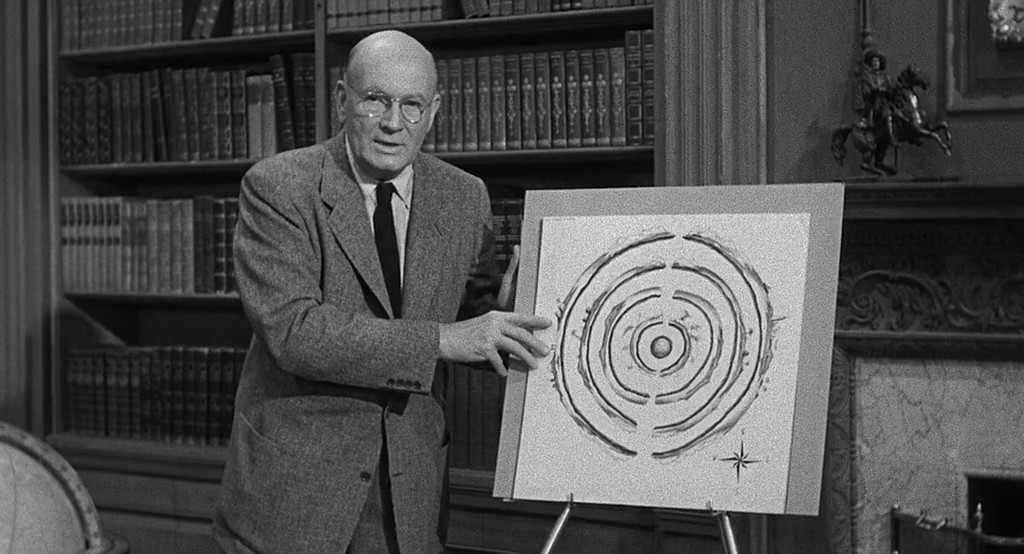
His name is Frank C. Baxter and he’s introduced as the Professor of English at the University of Southern California that he actually was. His spiel is pure Forteana, explaining to us that we know so much about the surface of our world and that we’ve reached out to the stars but we know very little about what might be hiding beneath our feet. “What’s inside this globe?” he asks us, launching into swift explanations of Victorian Hollow Earth theories by people like Cyrus Teed and John Cleves Symmes, Jr. The former suggested that we don’t live on the surface of our planet at all but inside it, with the heavens a giant sphere, the sun a gigantic battery and the stars mere refractions of its light. The latter believed that there are five concentric spheres inside our planet, each habitable and lit by the one above, with light getting in through giant holes at each of the poles, surely entranceways for us to visit our subterranean brethren within our Hollow Earth. These theories are pseudoscientific nonsense, of course, but Baxter is no pseudoscientist.
Wednesday, 27 January 2021

Scandal Sheet (1952)

Director: Phil Karlson
Writers: Ted Sherdeman, Eugene Ling & James Poe, from the novel The Dark Page by Samuel Fuller
Stars: Broderick Crawford, Donna Reed and John Derek

Index: 2021 Centennials.

Any opportunity to review a Sam Fuller picture, I will happily take without hesitation, and, while Scandal Sheet isn’t either directed or written by Fuller, it is based on his novel, The Dark Page, published in 1944. It’s also a story about newspapers, something that he knew very well, having been part of the news industry since the age of twelve. He became a crime reporter at the New York Evening Graphic at seventeen and his film set in that world, Park Row, is possibly my favourite of all his movies; it was certainly his. Oddly, it was also released in 1952, though that was coincidental; he’d sold the rights to The Dark Page to Howard Hawks during the war and had even written a treatment of it as it wound its way slowly towards the screen. A young John Derek on the ascendant played the lead initially aimed at John Payne, playing a reporter who’s very sharp but not very principled, mostly due to his being mentored by his editor, in the form not of Orson Welles, as planned, but Broderick Crawford, Derek’s screen father in All the King’s Men.

The relationship arc between these two is one good reason to watch this movie, as it’s the only one that allows me to look past such an observant character as Steve McCleary, ace newshound for the New York Express, having a notable blindspot when it comes to his mentor, Mark Chapman. However, I’m watching in January 2021 not for Derek or Crawford but for Donna Reed, the other star who got prominent billing on the poster, because the 27th would have been her one hundredth birthday. This isn’t her best role or her best known, let alone her best regarded, but it is an appropriate one, given that Julie Allison is both McCleary’s love interest and his (and our) moral compass through this film, as well as an accomplished journalist in her own right. That sort of combo worked well for the future Golden Globe-winning star of The Donna Reed Show, which, only six years on, would become the first family-oriented sitcom to revolve around a capable woman instead of a capable man.

Thursday, 21 January 2021

Gang War (1958)

Director: Gene Fowler, Jr.
Writer: Louis Vittes, from the novel The Hoods Take Over by Ovid Demaris
Stars: Charles Bronson, Kent Taylor, Jennifer Holden and John Doucette

Index: 2021 Centennials.

21st January marks the centennial of character actor John Doucette and it took me a long while to figure out what I could review in his memory. The problem is that he was such an effective character actor, stealing moments and scenes out from under the leads, often as a tough guy, whether sheriff or villain, that he was rarely given a lead of his own, even with credits in a hundred and forty films and even more TV shows. Eventually, I tracked down this picture, a relatively straightforward gangster flick released by 20th Century Fox in 1958. He’s not the lead here, either, that honour going to a young Charles Bronson, who was newly ascended to top billing himself. Doucette is fourth billed, after Kent Taylor and Jennifer Holden, but he dominates the entire film, because he’s the gangster that it’s all about, Maxie Meadows. This is his story just as much as it’s Bronson’s, even if his character has less depth and substance, and it’s easier for him to make his presence known in emphatic fashion.

We’re in Los Angeles and, to highlight what the City of Angels was like at this point, we’re treated to a montage of mayhem right at the start. Machine guns unloading their rounds directly at the audience! Cars screaming round corners at high speed! Barber shops exploding in the night! Even the title explodes onto the screen at us in military capitals: “GANG WAR”. And when our story begins, Louis Vittes’s script, adapted from Ovid Demaris’s novel, The Hoods Take Over, gets right down to business. Slick Connors slaps down his girl, Marsha, because she doesn’t like him becoming a stool pigeon. He’s turning state’s evidence against Joe Reno so that, when the syndicate moves in, he’ll become Mr. Big. “Glad to know you while you’re still alive,” she tells him, with prescience, because he leaves her apartment to find Joe and Bernard “The Axe” Duncan outside, waiting to murder him in cold blood. Which they do. Slick betrays himself to be a coward, but Joe isn’t. He takes care of business and that’s Leonard P. Geer’s uncredited performance over.

Sunday, 3 January 2021

Fort Massacre (1958)

Director: Joseph M. Newman
Writers: Martin M. Goldsmith
Stars: Joel McCrea, Forrest Tucker, Susan Cabot, John Russell and George N. Neise

Index: 2021 Centennials.

Fort Massacre is an odd movie in a lot of ways, not least because it’s well worth seeking out but it’s frustrating to watch. There’s a lot that’s wrong with it, but it takes root in your brain and stays with you, because it also does quite a lot very right indeed. The lead is Joel McCrea, playing very much against type as the story’s bad guy, though oddly he’s also one of the good guys; the explanation of that sentence would count as a good synopsis of the film. There are other easily recognisable character actors here too, like Forrest Tucker and a very young Denver Pyle, but I’m watching for John Russell, who would have been a hundred years old on 3rd January, 2021 and he’s arguably the best thing about the film. He’s one of four highlighted co-stars and he’s the only one with a story arc, as his character is just as important to this story as McCrea’s, important enough that he literally gets the last word. His story arc both goes in the right direction and in the direction of right, making him our moral compass in a complex situation.

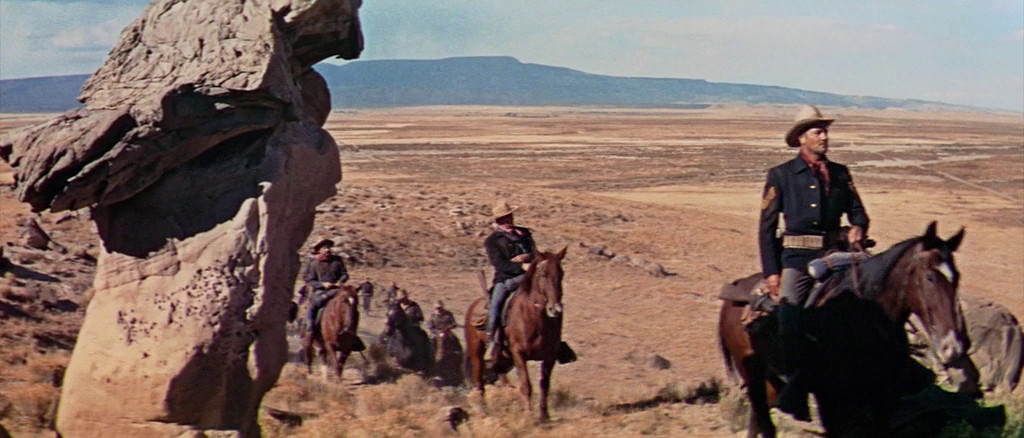
As you might imagine, this is a western, set entirely in the deserts of the southwest, and we begin on 28th July, 1879. Capt. Cole had command of C Troop, Second Regiment, Sixth Cavalry, but Capt. Cole is dead, along with half his men, after the troop was attacked by seventy Apache braves. His lieutenant survived but was seriously injured and he dies shortly into the film, having done nothing but fall off his horse, another corpse to bury. That leaves Sgt. Vinson in charge, as the only officer left alive. They’re somewhere in the southwestern corner of New Mexico and he figures that means about a hundred miles or so east of Fort Crain and safety. Their first task is to find the regiment’s main column that’s escorting a wagon train. It’s probably fair to say at this point that they never do, because this isn’t that sort of story. As expansive as the desert is, this really isn’t about what’s out there, whatever that may be, as this is a psychological western and the real story takes place inside the heads of Sgt. Vinson and Pvt. Robert W. Travis.

Thursday, 31 December 2020

Terror Train (1980)

Director: Roger Spottiswoode
Writer: T. Y. Drake
Stars: Ben Johnson, Jamie Lee Curtis, Hart Bochner and David Copperfield

Index: Horror Movie Calendar.

Slasher movies had been around for a long while by the time Terror Train came along in 1980, but they were becoming a huge deal. Halloween had kicked off the genre’s classic era in 1978, courtesy in large part of its lead actress Jamie Lee Curtis, who cemented her stature as the leading scream queen of the day with The Fog, Prom Night and this film, all in 1980. The election of Ronald Reagan the same year brought a conservative backlash against what they saw as a growing epidemic of violence on screen, and the studios got quickly on board, releasing over a hundred slashers between 1978 and 1984. This one was shot independently in Canada for $3.5m, but picked up for distribution by 20th Century Fox, who contributed another $5m worth of marketing. While it isn’t the best of the slashers, it’s a particularly interesting one for a few reasons, including the fact that the majority of the film takes place on a moving steam train booked on New Year’s Eve as a celebration for Alana, who’s graduating early, making them a captive audience.

The primary one is that there’s an underlying theme of illusion, emphasised through the surprise presence of David Copperfield as a magician hired to perform at the party. We’ve probably all watched half a dozen slasher movies in which the identity of the killer is so obvious that we’ve shouted it at the screen, even though the line up of victims to be never pay any attention to us. Here, it’s a deliberately played theme. The killer doesn’t wear a single iconic mask to slap on the movie’s poster, instead consistently adopting the costume of the previous victim at every point. The task at hand for each of the potential victims on board the Terror Train is to see through the particular illusion shown them when the killer, whose identity we know from the very first scene, appears to them in a new disguise. If they can, then maybe they’ll have a chance at survival, though this is one heck of a party and most of them are drunk before they even get off the bus that takes them to the train.

Friday, 25 December 2020

Christmas Evil (1980)

Director: Lewis Jackson
Writer: Lewis Jackson
Stars: Brandon Maggart, Jeffrey DeMunn and Dianne Hull

Index: Horror Movie Calendar.

There are so many Christmas horror movies out there (and others that may not be horror but are just as traumatising) that I may well write a book on just them, but I still needed to pick one for A Horror Movie Calendar. I avoided Black Christmas, as that’s too easy a choice and plumped for this one, which John Waters has described as “the greatest Christmas movie ever made”. As flawed as it is, it’s actually a surprisingly inventive look at Christmas and what the holiday means, wrapped up in slasher clothing. One thing I really like about it is that it seems to unfold in a world where there are no days that aren’t holidays, which is social commentary in itself. We watch Harry Stadling get out of bed in his Santa pyjamas, practice his Santa laugh and check his Santa belly as he hums a carol or three, in an apartment decorated like a greeting card. He works at a toy factory and Frank has him cover his late shift so he can take his wife out of town for the holidays. It’s so obviously Christmas, we’re shocked to discover that it’s really Thanksgiving.

Harry rings his brother Phil to tell him that he won’t make it over for Thanksgiving dinner. He’s busy watching Santa in the Macy’s Thanksgiving Day Parade, the announcer pointing out that it’s his first appearance of the season. That prompts Harry to shift into overdrive with his preparation for Christmas and a quick montage highlights that he’s not alone. The stores promptly put out their Christmas displays, Christmas trees go up in public squares and, no doubt, on the 1980 equivalent of Facebook, people would moan about how soon this is all happening. Heck, we haven’t even got to Halloween yet and everything’s suddenly Christmas. In Harry’s world, Thanksgiving and Halloween don’t exist, because the Christmas season lasts for all twelve months of the year. To Harry, the day after his Christmas-themed Thanksgiving is his work’s Christmas party and the day after that is Christmas Eve. And, we know from the intro, which took place on Christmas Eve in 1947 when Harry was a child, that’s a gigantic #C54245 Christmas Red flag.

Wednesday, 9 September 2020

The Flying Luna Clipper (1987)

Director: Ikko Ono
Writer: Ikko Ono
Stars: Anne Lambert, Ina Krantz, Mark Hagan and Zev Asher

Index: Weird Wednesdays.

Back in the eighties, films weren’t as available as they are now, because the internet is a wonderful thing and we shouldn’t ever lose sight of that. Then, I’d read about amazing movies in fanzines that I had no expectation of ever seeing myself. Because I read quite a few zines, I could see the paths of the underground tape trading circuit manifest like a map out of the order by which the latest wild title that came out of nowhere, like Nekromantik or Urotsukidoji, would see review in those zines. For decades, The Flying Luna Clipper was one of those wild titles, a film for the psychotronic cognoscenti to rave about like it was manna from heaven but rarely seen by the rest of humanity. Now, of course, it’s on YouTube in entirety, because, of course it is. The world has fundamentally changed. It’s said that someone found a laserdisc copy in a thrift store, ripped it to digital and sent it to Matt Repetski, because he doesn’t merely write about movies, he writes about video games too. He showed it to Matt Hawkins at Attract Mode, who uploaded it to YouTube.

And that sparked a resurgence of interest in The Flying Luna Clipper, which is very possibly the most unique film I’ve ever seen and a sort of visual shot of happiness. It’s batshit insane, it makes next to no sense and yet, while watching it, I drift into a feeling that all is right with the world. Given that I’m writing in September 2020, the ninth level of the Jumanji game that has comprised this crazy year, that’s quite the achievement, especially for a film released in Japan in 1987, on Video8, Betamax, VHS and LaserDisc, for what was then the equivalent of sixty bucks. And, quite frankly, it’s not really even a film in the sense that we tend to think. It’s more of a psychedelic graphics demo, created on an 8 bit MSX computer. Nishi Kazuhiko had clout, as a founder of the ASCII Corporation and a vice president at Microsoft, and he wanted to create a unified standard for home computers in 1983, but he failed. Sony made the bulk of the MSXs and they only shipped five million units in Japan, those sales helped by the original Metal Gear game.

Saturday, 16 May 2020

Hell is Empty (1967)


Director: John Ainsworth
Writers: John Ainsworth, from screenplays by George Fowler and Bernard Knowles, each in turn based on the novel Hell is Empty by J. F. Straker
Stars: Martine Carol, James Robertson Justice, Shirley-Anne Field and Carl Möhner


Index: 2020 Centennials.

Given that I’m watching and reviewing Hell is Empty for Martine Carol, born a hundred years ago today in Saint-Mandé, a high end department of the Île-de-France, it seems appropriate to remember her through this movie, produced by her last husband, because it’s quintessentially European. It isn’t just that it’s a British film shot in Prague, then in Czechoslovakia. It isn’t just that it has a set of European actors in prominent roles, like the Italian Isa Miranda and the Austrian Carl Möhner, or that they speak fluent English with accents that betray that it isn’t their first language. It isn’t just that there are two members of European nobility in the cast: Baroness Irene von Meyendorff was born in Tallinn, now the Estonian capital but then in Russia, while Catherine Schell, daughter of a Hungarian baron, is from Budapest. Ironically, the former was the most popular Nazi pinup girl while the latter’s family estates were confiscated by those same Nazis. It’s also that the film isn’t commercially available, so I found myself watching a dubious VHS rip with hardcoded Finnish subtitles. Needs must.

It’s not a good film but it is an interesting one, not least because it either had no idea what it wanted to be or because it aimed to be everything. I haven’t read the 1958 source novel by J. F. Straker, a maths teacher by profession, but he claimed to create books by outlining their beginnings and ends, then letting the middles flesh out as he wrote. That might explain why this picture, adapted from a pair of different screenplays, is so open to anything. At heart it’s a thriller but it also spends time as a courtroom drama, a heist flick, a polite mystery, a hospital drama and even a dubious romance during which the telling words “Stockholm Syndrome” aren’t ever mentioned. It isn’t even sure who to treat as the most important characters. The young crook who serves as our initial focus loses it pretty quickly. The romance angle hinted at early on is forgotten for most of the film. Martine Carol may be top billed and she may receive the most opportunities, but she’s hardly the lead. Characters come and go, their importance always unknown.

Thursday, 30 April 2020

Ritual of Evil (1970)

Director: Robert Day
Writer: Robert Presnell, Jr., based on characters by Richard Alan Simmons
Stars: Louis Jourdan, Anne Baxter, Diana Hyland, John McMartin, Belinda Montgomery and Wilfrid Hyde-White

Index: Horror Movie Calendar.

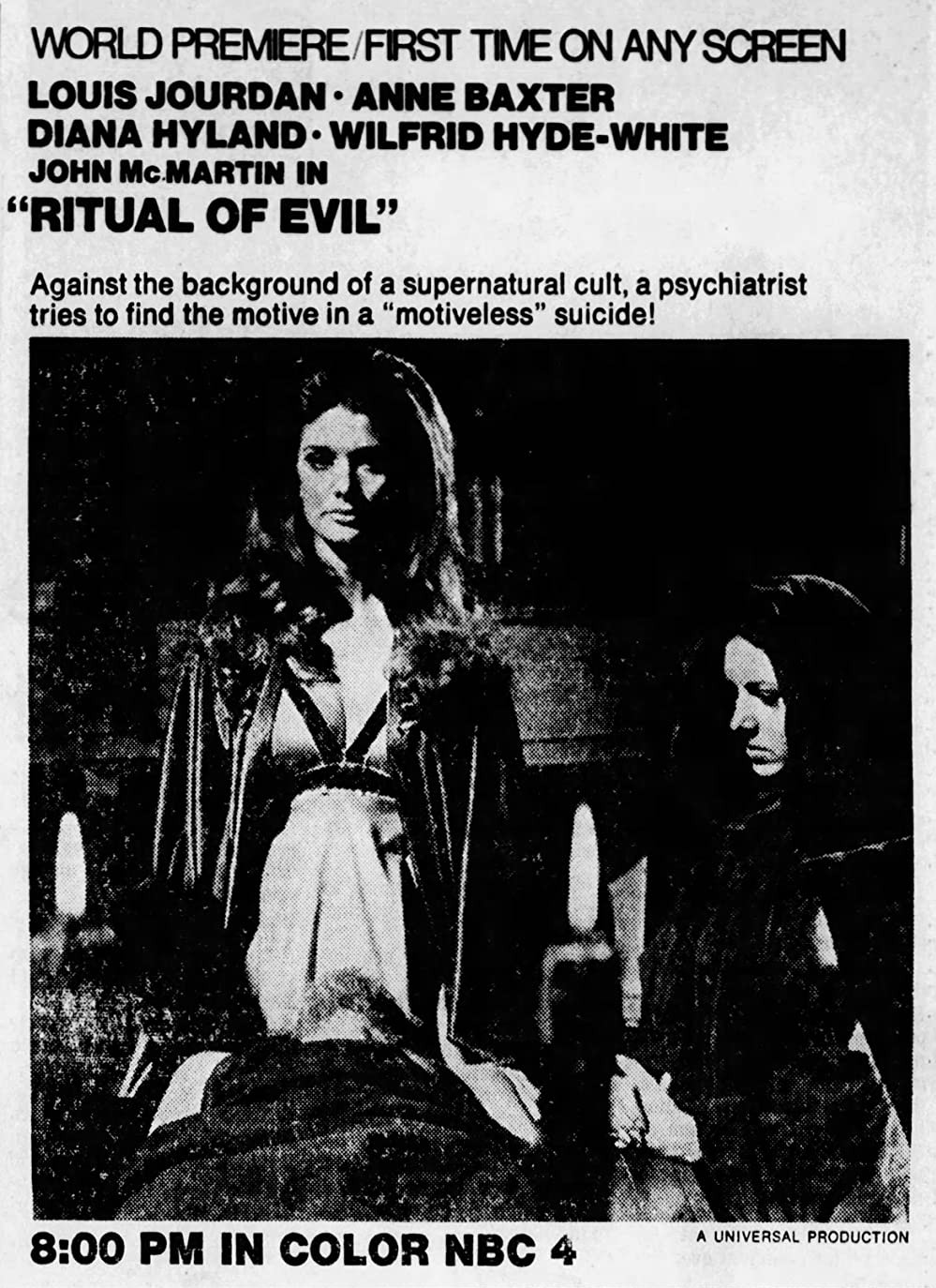
Many of the films I’ve included in this book are obscure, but for different reasons. Some were indie releases that didn’t reach a big audience. Some have been unjustly neglected. Some of them just plain suck. This TV movie may have merely arrived a blink of the eye too early to have the impact that it could have had, meaning that, instead of spawning a cult television show, it became instead a historical footnote for half a century, waiting to be rediscovered. It’s actually a sequel, to 1969’s Fear No Evil, which introduced us to a psychiatrist named David Sorell, played by the ever-reliable Louis Jourdan, who reprises his role here. Sorell is also an expert on the occult and he investigates the strange and unusual. Both films were broadcast on NBC during their Tuesday Night at the Movies series of films made for TV, which tended to run longer and cost more than their equivalents on other networks. The cast of each was stellar and Ritual of Evil even won a Primetime Emmy for cinematography, but the hoped for TV show never materialised.

Instead, they served as an influence. Another investigator of the supernatural, Carl Kolchak, showed up a couple of years later, with his history beginning on the TV movie The Night Stalker, an ABC Movie of the Week, in 1972. The Night Strangler followed it a year later, with the supernatural horror genre perhaps reaching its peak with William Peter Blatty’s adaptation of his 1971 novel, The Exorcist. ABC promptly ordered a full series, Kolchak: The Night Stalker, which only lasted a single season but was itself a primary influence on later shows like The X-Files. Had Fear No Evil and Ritual of Evil been made just a couple of years later, perhaps Chris Carter would have been inspired by the cult investigations of David Sorell rather than those of Carl Kolchak. In a parallel universe not far adrift from ours, maybe he did, but here in our universe, we’ve had to make do with terrible quality nth generation bootleg VHS tapes thus far. The good news is that Kino Lorber may well be releasing both these films on BluRay in late 2020. Fingers crossed.

Monday, 17 February 2020

Presidents Day (2016)

Director: David Zuckerman
Writers: Benjamin Goodwin, David Zuckerman and Jud Zumwalt
Stars: Monica Ricketts, David Zuckerman, Jud Zumwalt, Brittany Faith Rosoff, Chelsea Taylor Leech, Dax Hill, Benjamin Goodwin, Mike Ostroski and Michael Minto

Index: Horror Movie Calendar.

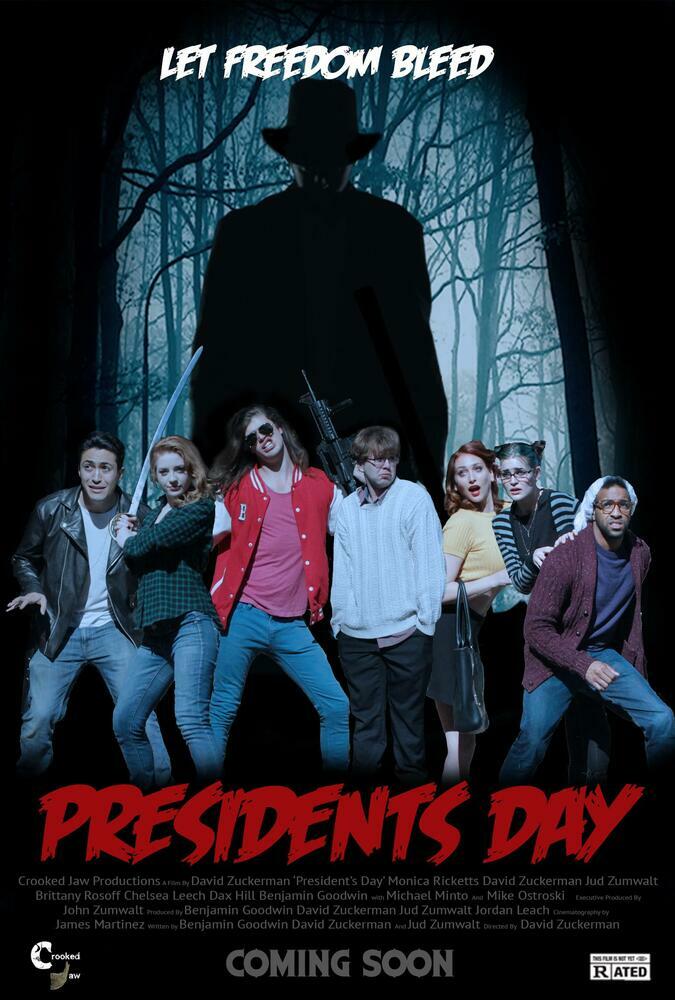
There are a lot of movies that look like they’d be great choices for the third Monday in February, but the list whittles itself down in no time flat. For example, I was planning to review President’s Day, a 2010 movie with a tiny $5,000 budget that was made by 25 year old Chris LaMartina, surely best known now for Call Girl of Cthulhu. However, while it did feature a mysterious murderer dressed up as Honest Abe, slashing his way through the candidates for Student Council President at Lincoln High (home of the Lincoln Lambs), it turned out to have nothing to do with the actual holiday known as President’s Day in eight states of the union, so it doesn’t count. Now, I did want it to count, just so that I could introduce you to Eddie Mills, who thinks being Student Council President would look great on his Naval Academy application. His pitch? “At Lincoln, everyone deserves a shot.” That’s glorious and, with a line like that, I don’t want to look at any other possibilities. But, sassinfrassin, this is a holiday horror book, so I had to move on.

Fortunately, this picture came along to help me out, and it’s absolutely set on what’s known as Presidents Day in three more states. That’s Presidents Day without any punctuation, unlike the President’s Day mentioned above, which features an apostrophe before the final S, or indeed Presidents’ Day, with the apostrophe after the final S, which is how the holiday is known in ten states, making it the most popular spelling. Oh, and that wandering apostrophe is just the beginning of the rabbit hole that was originally known as Washington’s Birthday, by which name it’s still known in six more states. Washington was born on 22nd February, 1732, though it was actually 11th February, 1731 at the time, because, while we think of George Washington as a famous American, he was born in the colonies of the British Empire, which was then on the Julian calendar. In 1752, the British Empire changed to the Gregorian calendar, and most people still alive at the time, Washington included, began to start celebrating according to that instead.