Wednesday, 29 November 2023

Die Straße (1923)

Director: Karl Grune
Writers: Karl Grune and Julius Urgiß
Stars: Eugen Klöpfer, Lucie Höflich, Anton Edthofer, Aud Egende-Nissen, Max Schreck and Leonhard Haskel

Long before La Strada, there was another big foreign language film called The Street, namely Die Straße, though “foreign language” might be a little misleading because it’s a notably silent silent film, with almost no intertitles, meaning that the storytelling is even more visual than would normally be the case in 1923.

Unfortunately, there don’t appear to be any restored versions of the film out there, so I’ve had to struggle through a terrible quality print that is, at least, ninety minutes long. Versions of higher quality run only seventy-four, which I believe is the American cut.

Whichever version we watch, there’s highly expressionistic shadowplay, with a fascinating use of light and images distorted like funhouse mirrors. It’s visually striking even before the story starts to focus. There’s even a wonderful shot of a man peeking round a corner at a lady whose face suddenly turns into a skull; when he leaves, it goes back to normal.

None of the characters are named but we do gradually figure out who we’re watching.

Tuesday, 28 November 2023

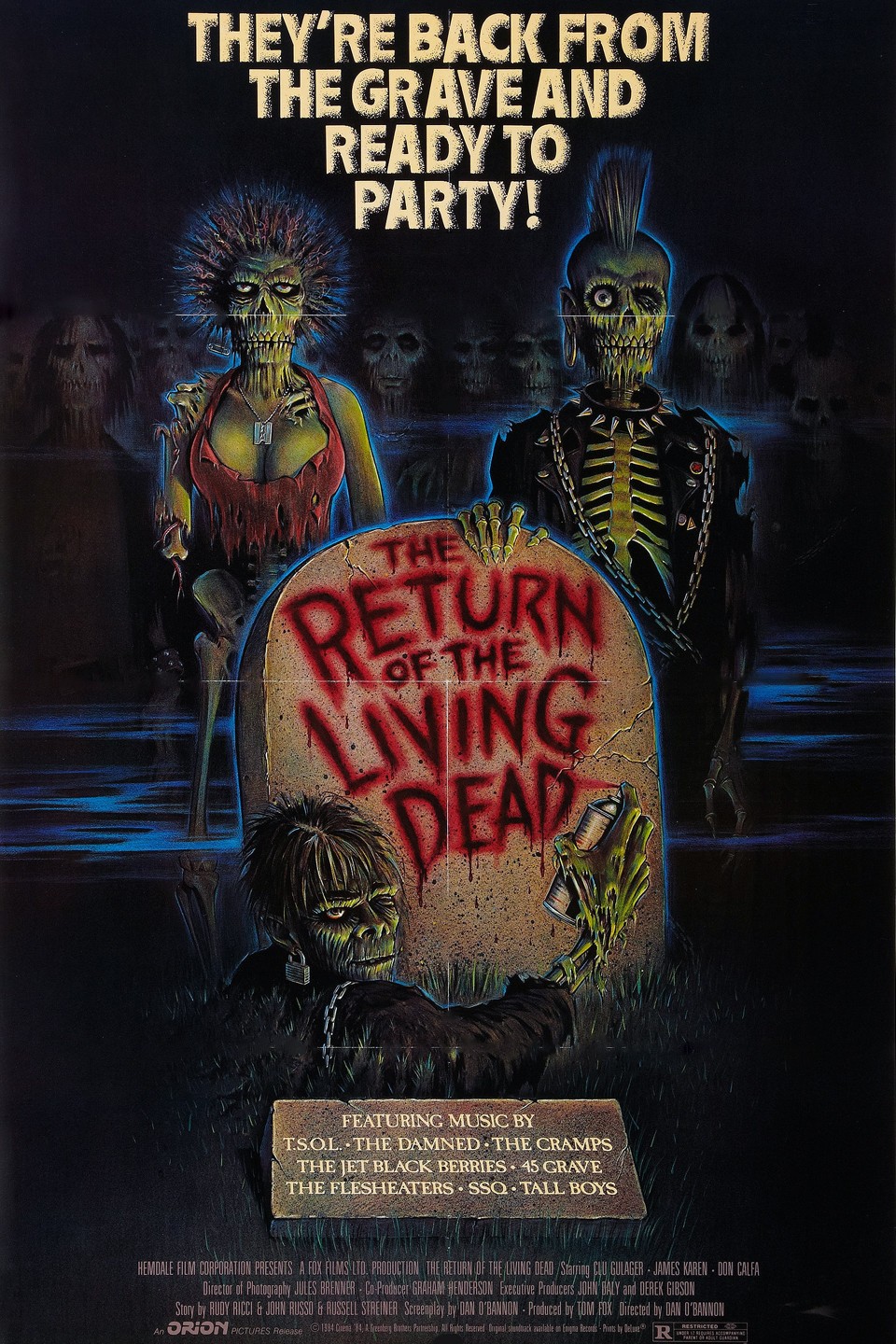
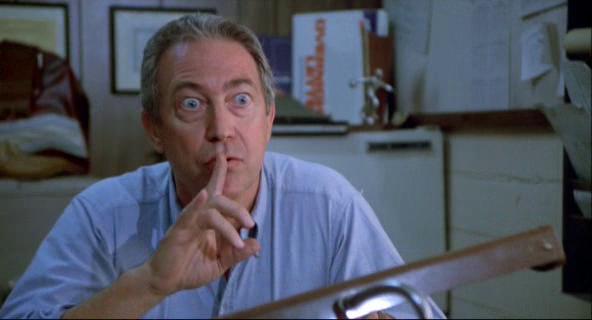
The Return of the Living Dead (1985)

Director: Dan O’Bannon
Writer: Dan O’Bannon, based on a story by Rudy Ricci, John Russo and Russell Streiner
Stars: Clu Gulager, James Karen, Don Calfa, Thom Mathews, Miguel Nunez, Brian Peck, John Philbin, Linnea Quigley, Beverly Randolph, Jewel Shepard and Mark Venturini

Index: 2023 Centennials.

The Glass Wall isn’t the only picture featuring someone born on 28th November, 1923, but The Return of the Living Dead must be about as different a feature as is comfortably imaginable. It was released over thirty years later, in 1985, and everyone and everything in it is apparently true. Well, that’s what it says on screen, so it must be real, right? Of course, it isn’t, but it does have plenty of fun with the conceit that the events that took place in George A. Romero’s pioneering 1968 zombie movie, Night of the Living Dead, were based on real life events. There was a chemical spill at the VA hospital in Pittsburgh that released 2-4-5-Trioxin and it made corpses jump as if they were alive. Somehow Romero got wind of the story and built a script around it. Meanwhile, those corpses, stored carefully in barrels, made their way, through typical military transportation screw up, to the Uneeda Medical Supply warehouse in Louisville, Kentucky, where they’ve been stored in a basement because nobody bothered to call the military phone number on the barrels.

Now, there is another important connection to Night of the Living Dead, namely writer John Russo, who co-wrote both films. The first was with Romero, with whom he had an agreement that they could both effectively continue it into a series. Russo had the rights to the Living Dead part of the title ongoing, but Romero could make his own sequels to the story. So, while the latter went on to direct Dawn of the Dead, Day of the Dead and so on, Russo wrote a novelisation of Night of the Living Dead and then a sequel novel, Return of the Living Dead, upon which this was only theoretically based. It was enough for him to get a credit for original story, alongside Russell Streiner and Rudy Ricci, but the screenplay was written by Dan O’Bannon, who had also written Dark Star and Alien and was directing a movie for the first time, later suggesting that “I spent 37 years of my life not even being alive. Now I’m fulfilled.” Hilariously, when he did so, it was Russo who wrote the novelisation, meaning that he wrote two completely different books both called Return of the Living Dead.

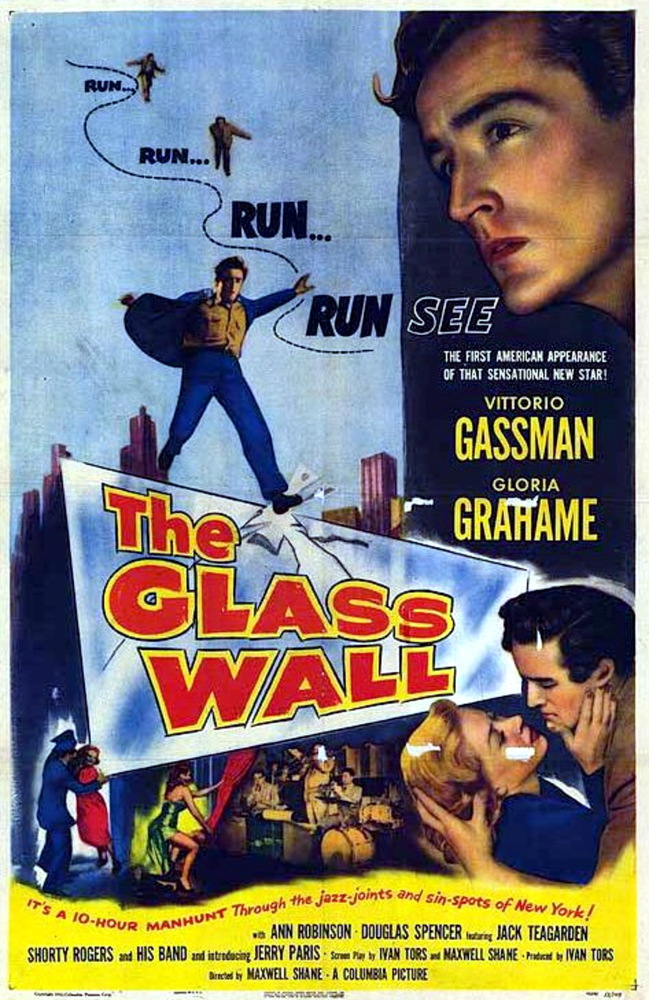
The Glass Wall (1953)

Director: Maxwell Shane
Writers: Ivan Tors and Maxwell Shane
Stars: Vittorio Gassman, Gloria Grahame, with Alan Robinson, Douglas Spencer, Robin Raymond, Jerry Paris, featuring Jack Teagarden and Shorty Rogers and His Band

Index: 2023 Centennials.

I had plenty of choices to watch in honour of Gloria Grahame’s centennial, given that she was a pivotal actress in film noir, but I’m rather happy that I plucked this one out of the blue instead of any of the more famous films I’d already seen. That’s because classic film, so often fascinating for cinematic reasons, can be a real window onto a time and sometimes the light through that window is commentary on our own time. I wonder how The Glass Wall would be received were it to be made today. It seems to me that it could prompt calls for its cancellation from the sort of people who tend to rail against cancelling their particular brand of culture. That’s because it’s fundamentally about refugees, a big issue in 1953 with so many Jews and other oppressed minorities in Europe moving to the United States during and after World War II to claim refugee status. Somehow it’s only become a bigger issue in the decades since and almost everything that happens here seventy years ago could easily happen today.

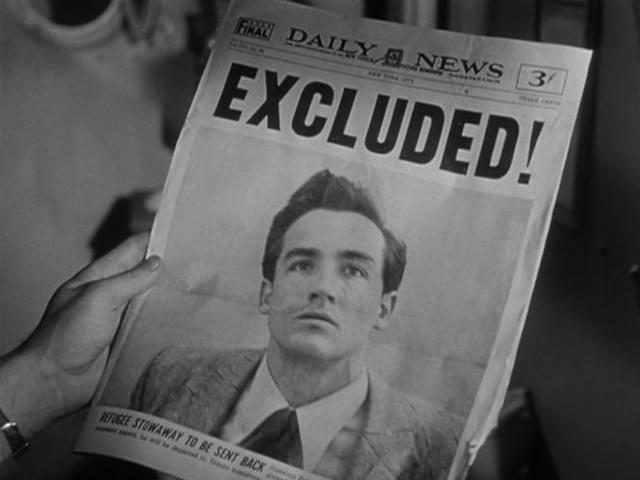
The refugee at the heart of the story is Peter Kuban, who’s on board a ship sailing past the Statue of Liberty into the United States as the film begins. There are 1,322 other displaced persons on board, each rescued by the International Refugee Organisation of the United Nations. “Welcome to America!” say the other boats in New York Harbor in yet another reminder that times have changed. The catch is that, while Kuban is absolutely a displaced person, he’s also a stowaway. That means that, while the rest of the people seeking asylum, who have escaped war and concentration camps to start a new life in the New World, are processed and admitted, Kuban is interviewed, but he’ll be sent home again because he can’t back up anything with evidence. He was born in Hungary, but that doesn’t exist any more. He spent ten years in concentration camps, where he learned English from other prisoners. His family perished in the gas chambers. He’s missing a number of fingernails from Nazi torture. Crucially, he can’t tell them where Tom is.

Saturday, 25 November 2023

Anna Christie (1923)

Director: John Griffith Wray under the personal supervision of Thomas H. Ince
Writer: Bradley King, based on the play by Eugene O’Neill
Stars: Blanche Sweet, William Russell, George F. Marion and Eugenie Besserer

In 1921, an original play called Anna Christie debuted on Broadway to much acclaim and, in 1922, it won Eugene O’Neill his second Pulitzer Prize for Drama. He still holds the record with four wins. In 1930, it became a sensation in the cinema, marketed as “Garbo Talks!” because it introduced the world to Greta Garbo’s voice.

However, it had been filmed before, in 1923, with Blanche Sweet as the title character, and it seems rather strange right now that I prefer it to its far more famous successor.

To be fair, it’s been a while since I watched all of Garbo’s sound films, but Anna Christie was easily my least favourite two of them, with the German language version faring a little better than the English one. I didn’t particularly like this either, but it was stunningly average for the time rather than annoyingly poor. Maybe I should revisit the Garbo versions.

What struck me watching this, so soon after Our Hospitality, is how fresh the Keaton picture is a century on while this feels utterly dated. It’s precisely the sort of silent melodrama that naysayers cite as the primary reason why they don’t like silent movies, with its exaggerated facial expressions, overt gesturing and drawn out scenes of overplayed drama.

Interestingly, the initial culprit for all those is George F. Marion, given that he doesn’t just play Chris Christopherson here, but originated the role on Broadway and reprised it in 1930, albeit only in the English version.

Thursday, 23 November 2023

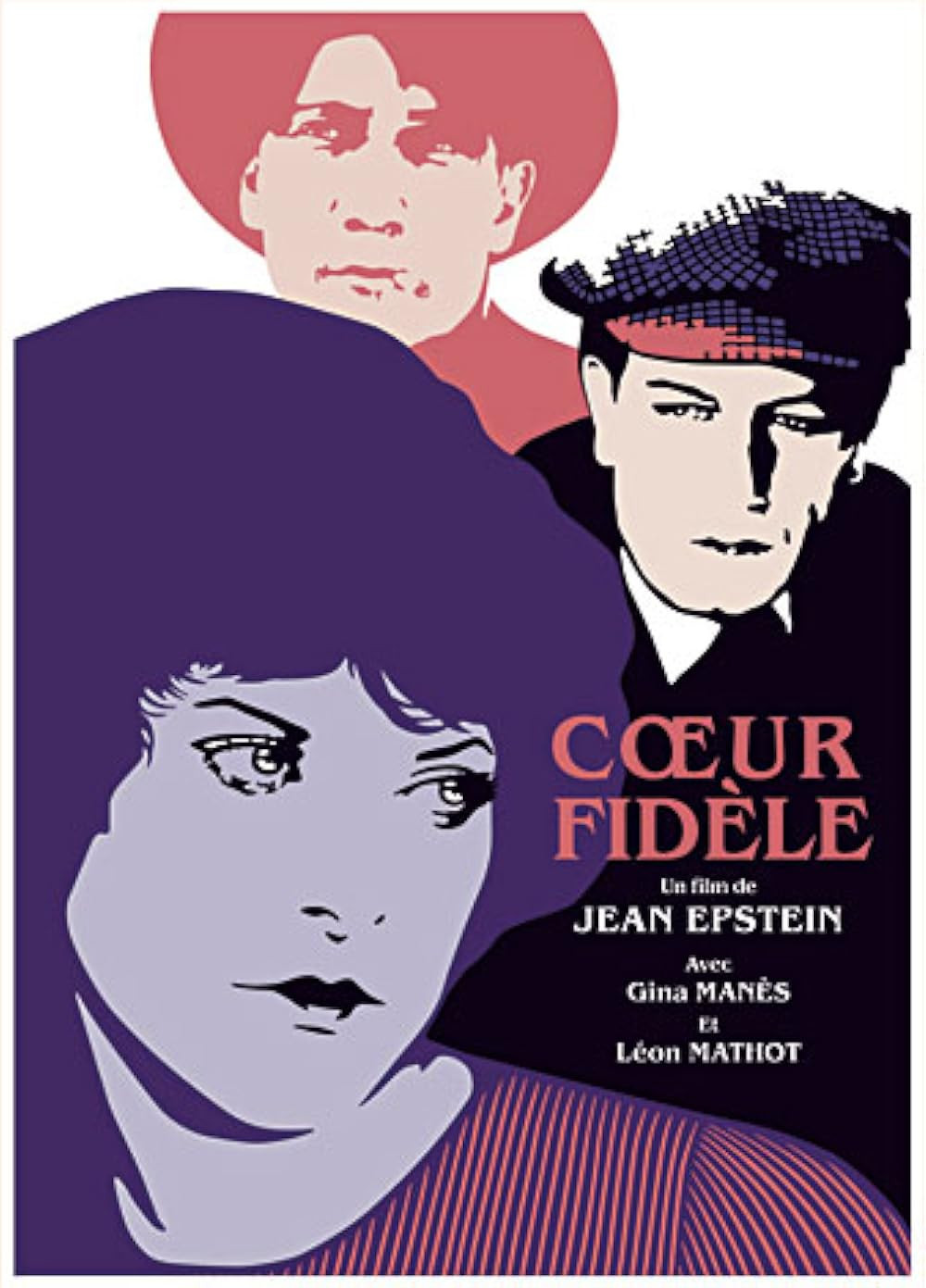
The Faithful Heart (1923)

Director: Jean Epstein
Writer: Jean and Marie Epstein
Stars: Léon Mathot and Gina Manès

A fresh face to French audiences in 1923 but known to them from a couple of books on film, Jean Epstein quickly directed three features: Pasteur, with Jean Benoît-Lévy, in celebration of the scientist’s centennial; The Red Inn, from the Honore de Balzac story; and The Faithful Heart, from an original script by Epstein and his sister Marie. This is the most noteworthy, because it’s the most ambitious, albeit only in one particular direction.

Those books were about film theory and it’s no shock to see Epstein trying out some of his ideas. The early scenes involve some rapid-fire editing, contrasting lingering shots of what a girl is doing with briefer shots of her face. This is montage work and it feels advanced, beyond the technology of the time to render as clean as he or we would like.

The girl is Marie, a foundling who’s taken in by a couple, M. and Mme Hochon, who run the tavern at which she works. Why Hochon, I’m not sure. It appears to mean “Nod” in French but “Compensation” in Japanese and the pair of meanings combine rather appropriately.

She works hard but the hardest part of her job is dealing with the unwanted attentions of Petit Paul, a shifty two bit crook who clearly scares her but seems to be on the right side of her parents, who almost throw her at him. She dreams instead of a dockworker called Jean, whom she sneaks out to meet. And...

Wednesday, 22 November 2023

The Man in the Glass Booth (1975)

Director: Arthur Hiller
Writer: Edward Anhalt
Stars: Maximilian Schell, Lois Nettleton, Lawrence Pressman and Luther Adler

Index: 2023 Centennials.

It feels a little strange that I’m reviewing this picture to celebrate its director, Arthur Hiller, on his centennial, because it isn’t flash in any of the ways we might expect from an important director. Hiller made a lot of great decisions when making it but they were a lot more about not doing things than actually doing them; it was notable in 1975 for its script and its lead performance. Maximilian Schell is utterly spellbinding as Arthur Goldman, who may or may not be Arthur Goldman, and was fairly nominated for an Oscar in a tough year; he lost to Jack Nicholson for One Flew Over the Cuckoo’s Nest and Al Pacino was also unrewarded for Dog Day Afternoon. On the writing front, Edward Anhalt got all the credit, because Robert Shaw (yes, the actor), who wrote the source novel and play, had his name removed because he disagreed with Hiller’s choice to make the movie more emotional. After he actually saw it, he was so happy with the results that he asked for his name to be restored, but the prints had been completed so it was too late.

Arthur Goldman is a fascinating character today, though he would have been seen through a different lens in 1975. He’s clearly very rich, given that he lives in a penthouse overlooking Central Park in New York and keeps two million dollars in a box. He’s connected socially, given that he’s scheduled to escort the duchess tonight, though I don’t believe that we’re privy to which or where. He’s also a Jew and a survivor of the concentration camps, an indelible experience that he can’t escape even three decades on. His father was murdered at Auschwitz but he sees him through a telescope pushing a pretzel cart on 5th Avenue; when he looks afresh, it’s now in the hands of a Nazi officer in full uniform. In Schell’s hands, Goldman is initially hard to take. The people who work for him, such as Charlie and Jack, are played by actors who appear to be acting in a movie, as we might expect. Schell, however, performs like he’s in a play, monologuing to the cheap seats with theatrical abandon. He’s not used to conversation. He’s used to being listened to.

Sunday, 19 November 2023

Our Hospitality (1923)

Directors: Buster Keaton and Jack Blystone
Writers: Jean Havez, Joe Mitchell and Clyde Bruckman
Stars: Buster Keaton and Natalie Talmadge

Buster Keaton’s second feature for 1923 was a very different film to the first. Three Ages was close to being a themed compilation of three comedy shorts, which merely happened to be new. Our Hospitality, however, is a fully fledged feature film, with a single coherent story and an elegant weaving of comedy into drama.

Keaton’s character even gets a name, that of Willie McKay, and, echoing his family’s former vaudeville act, the Three Keatons, this picture features Four Keatons, not only Buster as the lead character but his father, Joseph Keaton; his wife of two years, Natalie Talmadge; and their fourteen month old son, Buster Keaton, Jr., in his only film appearance. Technically, a fifth was present but not yet born.

Junior actually appears first as a baby Willie McKay, in a prologue that ably sets the stage for what’s to come, which is a time honoured feud. Remember the Hatfields and McCoys? Well, here are the Canfields and McKays.

It’s around 1810 when John McKay arrives home looking like Indiana Jones. Jim Canfield comes visiting as soon as he finds out McKay is back and they kill each other in a storm. Mrs. McKay is now a widow, little Willie is now the last living male in the McKay clan and Joseph Canfield, Jim’s brother, who tried to talk him out of it, now swears to continue the feud and teach his own sons accordingly.

Thursday, 29 June 2023

Bill & Ted’s Bogus Journey (1991)

Director: Pete Hewitt
Writer: Chris Matheson & Ed Solomon
Stars: Keanu Reeves, Alex Winter, William Sadler, Joss Ackland, Pam Grier and George Carlin

Index: The First Thirty.

Bill & Ted’s Excellent Adventure is one of my favourite movies. It holds an underlying truth even though it’s utterly ridiculous throughout and it’s pure unadulterated fun. I’ve gone back to it often since the eighties and it always hits the spot for me.

When I put together the list of Pam Grier’s First Thirty, I was surprised to find that a) she was even in that film’s sequel, Bill & Ted’s Bogus Journey, as I had zero recollection of her in it and b) that I haven’t gone back to it once since it came out. I was suddenly very worried about how it would hold up, not least because the much delayed third film in the series, Bill & Ted Face the Music, is truly awful, however amazing Brigette Lundy-Paine was as Ted’s daughter.

What I found was that it’s very much stuck between the two, not a patch on the original but much better than the third. It’s a triumph of the imagination, with most praise going to the writers, Chris Matheson & Ed Solomon, as they deconstruct and reconstruct not just the Bill & Ted mythos but cinematic history with The Seventh Seal a particularly key template.

They ratchet up the silliness even further and most of the best bits work simply because they went there, wherever there is from a list of “wouldn’t it be cool if” moments that I’d be shocked weren’t generated using recreational drugs. Eventually, however, the sheer weight of its cleverness prompts it to collapse in on itself, so I’m unlikely to go back to it again any time soon, but I’m happy to have acquired fresh memories of this bit and that one and especially the other bit over there.

For anyone who doesn’t know this trilogy, the idea is that the music of a pair of slacker nobodies in San Dimas, California, namely Bill S. Preston, Esq. and Ted “Theodore” Logan, is destined to turn the world into a utopia. The catch is that their band, Wyld Stallyns, sucks, because neither of them know how to play and they can’t be bothered to learn. So how does a band save the world with that attitude?

Monday, 26 June 2023

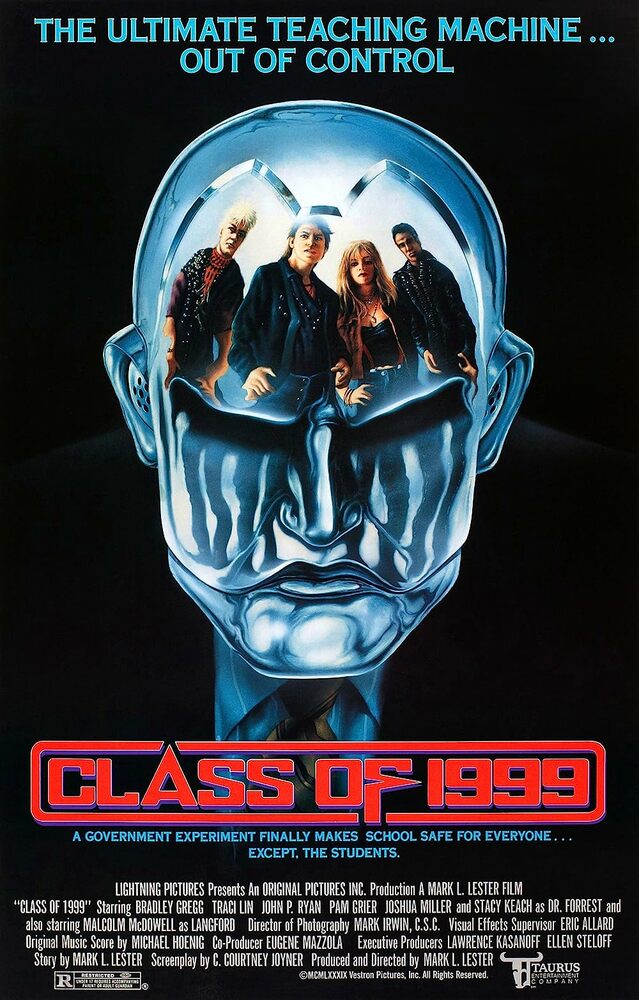
Class of 1999 (1990)

Director: Mark L. Lester
Writer: C. Courtney Joyner
Stars: Bradley Gregg, Traci Lin, John P. Ryan, Pam Grier, Patrick Kilpatrick, Joshua Miller, Stacy Keach and Malcolm McDowell

Index: The First Thirty.

There are a lot of cult movies to be found in Pam Grier’s filmography, especially during the seventies when her forte was women in prison flicks and blaxploitation. I’d seen most of them before, but I hadn’t seen her later cult films, 1981’s Fort Apache, the Bronx and this 1990 gem.

I see the names on lists and I’m very happy that this project allowed me to catch up with them. Of all the films in the second half of her First Thirty, it’s these, and The Vindicator, that I enjoyed most and am most likely to revisit.

This is the second in a trilogy of Class films that are only loosely connected. The original was 1982’s Class of 1984, a cult film in its own right, then this and finally Class of 1999 II: The Substitute, which featured a few flashbacks to this film but was otherwise unrelated.

The common factor is that they’re all set in a dystopian near future. Mass shootings didn’t prompt police forces to emulate the military as they did in our world; instead they led to an abdication of effort. The Constitution has been abolished, private businesses are banned and control of cities has fallen to street gangs. Free fire zones now exist where the police have no jurisdiction and what little law enforcement happens is by the Department of Educational Defense, which is part of the C.I.A.

Kennedy High School in Seattle is located in the middle of a free fire zone and the D.E.D. is taking an innovative approach to martial law there. They’re partnering with Dr. Bob Forrest of MegaTech, who looks and sounds utterly off his rocker but clearly has the clout to make a heck of a difference with his secret program, XT6, to deal with disciplinary problems.

What’s XT6? Why, thank you for asking. It’s where MegaTech repurposes humanoid robots previously used by the military into teachers. What could possibly go wrong, as they say?

Friday, 23 June 2023

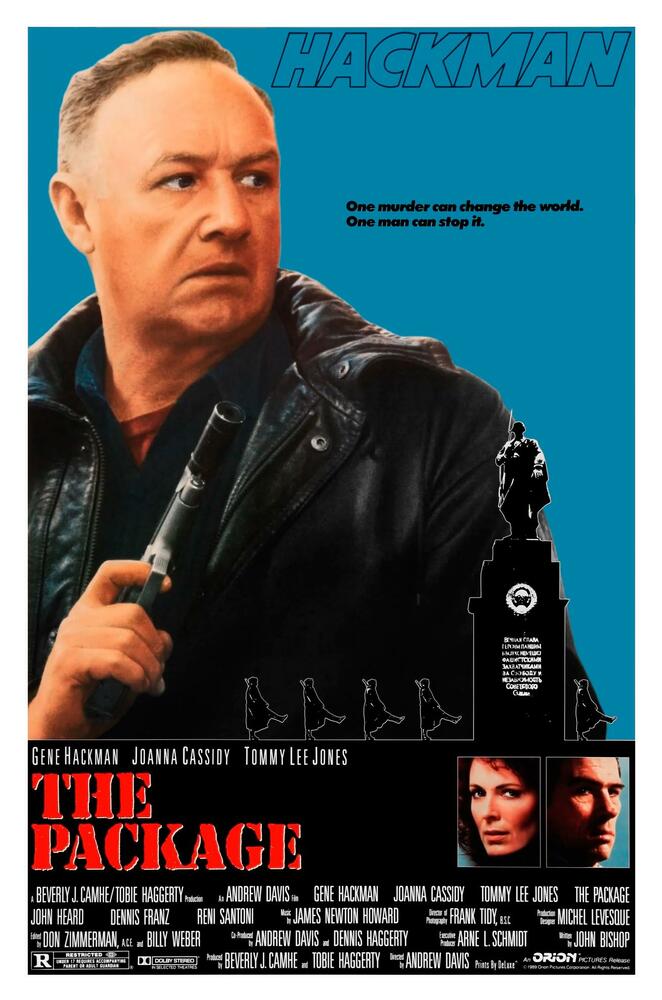
The Package (1989)

Director: Andrew Davis
Writer: John Bishop
Stars: Gene Hackman, Joanna Cassidy, Tommy Lee Jones, Dennis Franz, Reni Santoni, Pam Grier, Chelcie Ross, Ron Dean, Kevin Crowley, Thalmus Rasulala, Marco St. John and John Heard

Index: The First Thirty.

While Steven Seagal would star in a second movie for director Andrew Davis, Under Siege in 1992, a host of other actors did that a little quicker, returning for his very next film, The Package. Pam Grier’s back. Chelcie Ross is back. Joe Greco’s back. Thalmus Rasulala is back. We soon recognise bit part actors so half the cast must be back.

This is a very different film to Above the Law though, starting out as a late Cold War thriller and growing into a sort of precursor to Davis’s best film, The Fugitive. And when I say late Cold War I do mean about as late as it gets. This is August 1989 and Americans and Russians are talking peace in East Berlin.

For something that sounds talky, it starts as pure testosterone. Lots of soldiers. Lots of VIPs with grey hair sitting around big tables. An agreement is reached, which will be signed at the United Nations ten days later. But there’s a group of rogue generals, from both sides, with zero interest in losing their nuclear shields, so they have a week and a half to do something to throw a spanner into the peace works.

Gene Hackman is there in East Berlin and he knows even more people than we do, but he’s merely a sergeant, Johnny Gallagher. He seems capable but he becomes an easy fall guy for an assassination, by a couple of fake hikers, of an American general who chooses not to be part of whatever nefarious plot is unfolding.

That lands him what seems to be a nothing job as punishment, that of escorting another Army sergeant back home for a court martial, as he’s acquired quite a habit of punching his superior officers. He’s the Package of the title.