Sunday, 15 January 2023

Racing with the Moon (1984)

Director: Richard Benjamin
Writer: Steve Kloves
Stars: Sean Penn, Elizabeth McGovern and Nicolas Cage

Index: The First Thirty.

This one was completely new to me. I could be excused for not knowing about The Best of Times, as everyone involved probably tried to pretend it never happened. I’d seen Fast Times at Ridgemont High and Rumble Fish and I knew about Valley Girl, even if I hadn’t seen it. This film, though, I had never even heard of.

It’s another Sean Penn movie, though he’s a clear lead this time out instead of just through growing consensus in hindsight. Co-starring is Elizabeth McGovern as his romantic lead. And that leaves Nicolas Cage as the also ran on the poster, easily in the third most prominent role but not a particularly sympathetic one.

Racing with the Moon is a comedy drama but there’s a lot more drama here than comedy. It also counts as a period drama, but for a period that isn’t that long ago, because it’s Christmas 1942 when we start out and Hopper and Nicky are two young men in Point Muir, California waiting to be called up for war.

It’s no spoiler to suggest that they don’t get there in this picture, because it’s all about the six weeks they have before they leave and, in large part, how they choose to spend it. And, yeah, that translates to who they choose to spend it with. In Nicky’s case, he wants to land as much tail as he can before he puts on a uniform, but Hopper only has eyes for one girl, even if he’s yet to talk to her when we start out. In fact, when the local hooker, in the delightful form of a young Carol Kane, offers him “a free ride on the old merry-go-round”, he doesn’t take it.

Thursday, 12 January 2023

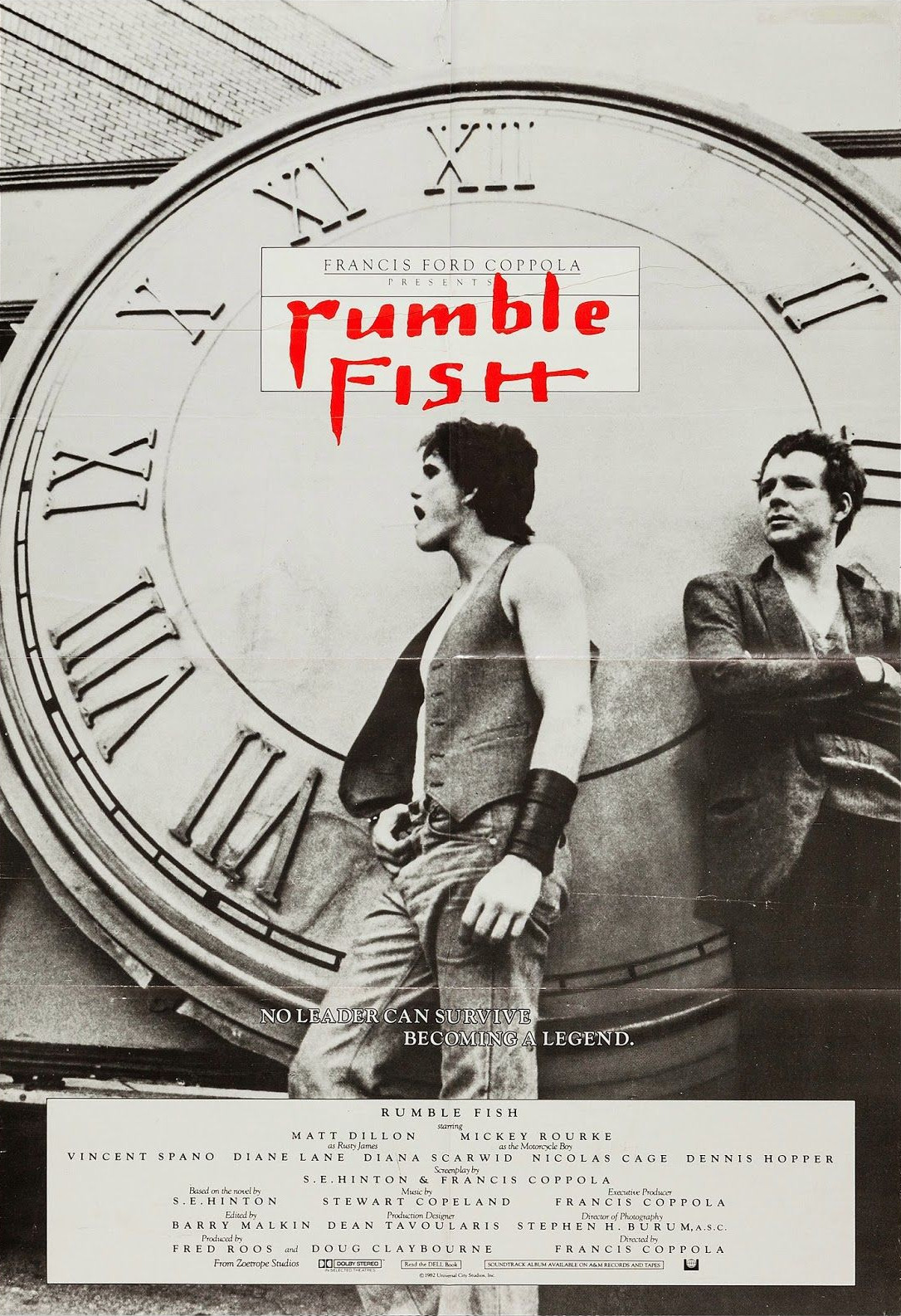
Rumble Fish (1983)

Director: Francis Coppola
Writers: S. E. Hinton and Francis Coppola, from the novel by S. E. Hinton
Stars: Matt Dillon, Mickey Rourke, Vincent Spano, Diane Lane, Diana Scarwid, Nicolas Cage and Dennis Hopper

Index: The First Thirty.

Before Valley Girl, Nicolas Cage appeared in Rumble Fish, the first of three eighties films for him that were directed by his uncle, Francis Ford Coppola. He would later make Deadfall for his elder brother, Christopher Coppola; their father, August Coppola, is Francis’s brother.

Francis Ford Coppola was a huge bankable name in 1983. He’d made some of the biggest and most important movies of the seventies, such as the first two Godfather films, Apocalypse Now—from which I got the name Apocalypse Later—and The Conversation. Arguably, that’s the only reason he was able to get this movie made, because it’s what he called “an art film for teenagers”. And he wouldn’t find it quite so easy to make something like it again.

It felt like a throwback to me, an homage to the rebel movies of the fifties but not to the rebels themselves. And that’s jarring, because the visuals in this movie, which are stunning, hearken back to the coolness of Brando and Dean and even, a little later, McQueen, but its message is that rebellion for the sake of it has become almost conservative.

When Brando’s character in The Wild One was asked what he was rebelling against, he famously answered, “Whaddya got?” If we ask Rusty James the same question here, he might say, “Because that’s what we’ve always done.” It’s his brother who might have a good answer but he’s keeping quiet. He’s the Motorcycle Boy, cool but educated, knowing and possibly half a dozen eggs short of a basket.

He’s also Mickey Rourke, in many ways the MacGuffin of the movie, because everyone is a fan of the Motorcycle Boy, the legend who got the gangs to observe a truce, but he doesn’t want the job any more. He sees the life that he’s lived as over and so he floats around in a vague attempt to persuade his idiot brother to wake up.

Monday, 9 January 2023

Valley Girl (1983)

Director: Martha Coolidge
Writers: Andrew Lane and Wayne Crawford
Stars: Nicolas Cage, Deborah Foreman, Elizabeth Daily, Cameron Dye and Michelle Meyrink

Index: The First Thirty.

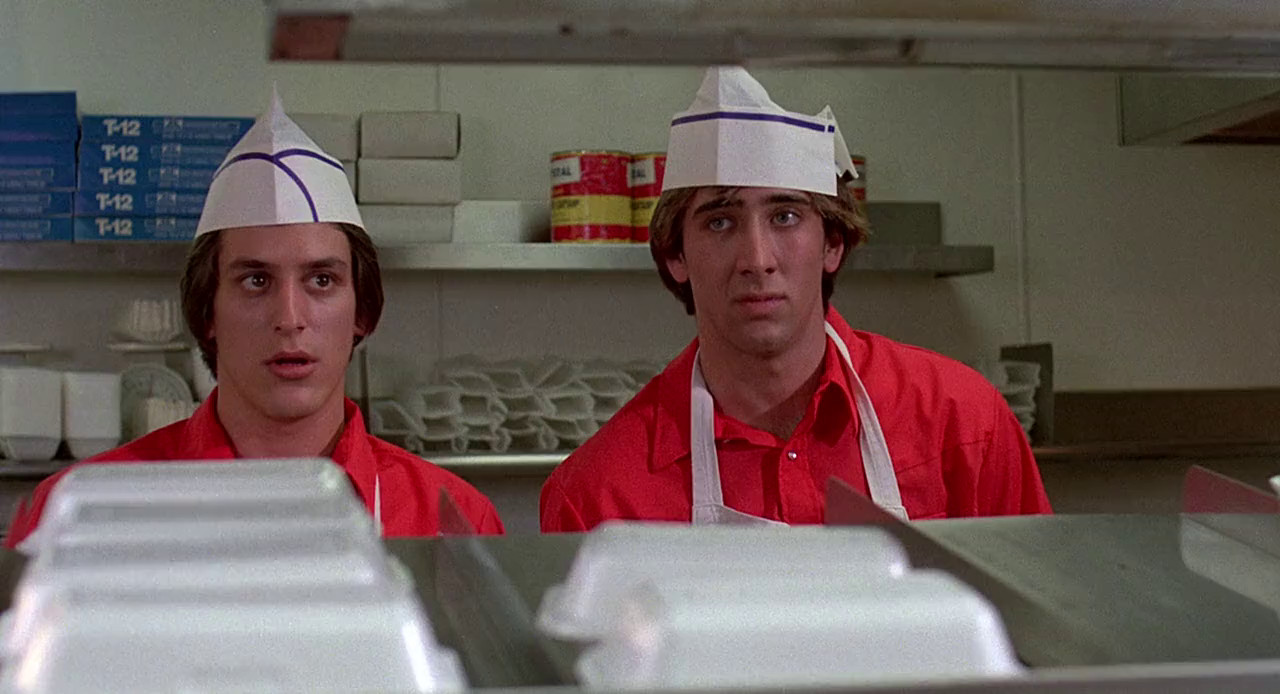
Technically, Nicolas Cage’s next movie after Fast Times at Ridgemont High was Rumble Fish, in an important supporting role.

However, given that he was only seventeen years old and the nobody nephew of the film’s director, Francis Ford Coppola, other actors in the film felt that he was there only because of nepotism. To counter that, he chose to change his name from Nicolas Coppola to Nicolas Cage and that’s the name in the credits, when it was released in October 1983.

I’m looking at Valley Girl next, though, as it was released in April 1983, half a year ahead of Rumble Fish, because it was shot in two weeks and was intended to be an exploitation flick, a feature meant to take advantage of a notable 1982 fad. Frank Zappa’s only top 40 hit, Valley Girl, popularised the peculiar vocabulary used by the youth of the San Fernando Valley and it was ripe to be exploited. However, it came out in June 1982, so this was too late to capitalise on it properly, but it’s all the better for not trying.

Well, it tries in the scenes that unfold in a valley mall behind the opening credits. Girls in pastel clothes and big hair go shopping and gossip in an echo of Moon in the song. Grody. Gnarly. I can’t stand it. Awesome. So bitchin’. It gets old before the conversation is over and we dread having to sit through ninety more minutes of that. Like totally.

Fortunately, they tone it down when they talk to guys and the whole point of being a Val appears to be that you talk to guys and, later, talk about them. We shift from the mall to the beach, where Julie first catches sight of Randy, then to a bedroom and then to a party. It’s the valley girl life.

Friday, 6 January 2023

Fast Times at Ridgemont High (1982)

Director: Amy Heckerling
Writer: Cameron Crowe, from his book
Stars: Sean Penn, Jennifer Jason Leigh, Judge Reinhold, Phoebe Cates, Brian Backer, Robert Romanus and Ray Walston

Index: The First Thirty.

I’ve seen Fast Times at Ridgemont High before, but not as often as you might expect because I’m British. This wasn’t the pivotal cinematic representation of my youth the way it was so many of my American friends.

Initially, it feels like it wants to do the same thing as The Best of Times but in our reality. It’s another film with a young ensemble cast who are coming of age, the token adult this time being Ray Walston, best known until this point for My Favorite Martian but now best known for playing Mr. Hand, nemesis of Jeff Spicoli.

But it feels vulgar not safe, film not TV, real not fake. Sure, it does that with far more relish than was needed, but it makes its point. After all, The Best of Times knows that kids about to be adults haven’t even heard of sex. Fast Times knows that they don’t think about anything else. Well, maybe Van Halen tickets. Or weed.

The first people we see are happily looking at other people’s asses. Underage girls chat about when they lost their virginity. Spicoli’s bedroom walls and locker are covered in porn. Phoebe Cates teaches Jennifer Jason Leigh how to give a blowjob. At school. In the cafeteria. Using a carrot.

It doesn’t take long to get serious, because Leigh, as Stacy Hamilton, is a fifteen year old who climbs out of her bedroom window to go on a date with a twenty-six year old man. She pretends to be nineteen, so don’t jump to the wrong conclusions. However, everything else unfolds exactly as you expect. It’s painful. It’s not glamorous. He doesn’t call. No, he doesn’t knock her up, but the next guy does and that means an abortion scene that her parents are not supposed to know about.

Wednesday, 4 January 2023

La farándula (1998)

Director: Cristian Cancho
Writer: Cristian Cancho
Stars: Erick García, Fanny Labbé, Karla Aquije and Daniël Schoonenboom

Index: Weird Wednesdays.

La farándula, which means Showbiz in Peru, where it was made, is the epitome of the movie that you won’t believe exists. While you might assume that’s because of what happens within it, given that this is basically a porn flick acted out entirely by Barbie and Ken dolls, I’d call out the hour long running time as even more unlikely. I can imagine filmmakers with the intense discipline needed to animate an hour’s worth of stop motion with Barbie dolls, because it’s been done before and with more nuance; Todd Haynes used that technique in Superstar: The Karen Carpenter Story so that he could progressively shave down the title character’s doll during the movie to illustrate her raging anorexia. I can also imagine filmmakers sitting around the mancave, probably drunk, laughing about how funny it would be to make a porno with Barbies, but never actually doing so because, hey, we’re all out of beer and we have to be at Walmart for the early shift at nine. Is that the time? The wife’s going to kill me.

The thing is that I wouldn’t have expected any crossover between those two sets of filmmakers but there’s apparently one down in South America. In fact, this isn’t the first South American adult stop motion animated Barbie movie to cross my path, because I first heard about an Argentinean short film from 2002 called Barbie Can Also Be Sad. This was apparently broadcast on television in Brazil but eventually fell afoul of Mattel, the company that manufactures Barbie. They obtained a court order to prevent it being shown at the Urban-Fest film festival in Mexico City, pushing it underground where Superstar: The Karen Carpenter Story had grown into such a cult success, after Richard Carpenter sued Haynes for copyright infringement and got the film withdrawn from circulation. This is the longest of the three films and easily the most outrageous, given just how much Cristian Cancho crams in to his hour. That’s one good reason to cover it here, with another in the hilariously broken English subtitles. “You may uncomb my hair with one fart.”

Tuesday, 3 January 2023

The Best of Times (1981)

Director: Don Mischer
Writers: Bob Arnott, Carol Hatfield & Lane Sarasohn
Stars: Crispin Glover, Jill Schoelen, Nicolas Coppola, Julie Piekarski, Kevin Cortes, Lisa Hope Ross, David Rambo, Janet Robin

Index: The First Thirty.

First up for Nicolas Cage was this failed TV pilot that I’m sure he, and the rest of the cast, would be happy to see vanished away into the black hole that contains most other failed TV pilots. It’s called The Best of Times and it was brought to the unwary people of America by Squeezably Soft Charmin. The jokes really do write themselves but I’ll try to behave.

Initially, it feels like a sitcom, with its half-hearted laughtrack and sound effects, but it’s also a sketch show and a musical. It also feels a lot longer than its sixty minute running time less commercials.

However, it’s a fascinating piece of video for bringing us crazy young versions of a number of people we know well nowadays. Cage, still going by Nicolas Coppola, is one of them, but he isn’t the only one or even the primary one. The star here is nominally Crispin Glover, who seems eager to play a normal young man, the one part that he clearly doesn’t understand how to play. It could be said that his character seems to be an alien pretending to be a human being without any understanding of what that is. He clearly hasn’t grown into himself.

This show would have us think that the best of times are those when we’re kids but soon to become adults. Crispin is a high school student living with his mum—played by Betty Glover, his actual mum—and his friends, who also go by their real first names, are likewise. But they won’t be in school for long. They’re about to graduate and theoretically grow up and this is all about that awkward moment when we’re supposed to learn who we really are.

Now, whatever you’re picturing from that is not remotely as embarrassing as this turns out to be. For everyone involved. Including us. Let me introduce you to Crispin’s friends, a cast of characters who aren’t at all likely to be friends in real life, because they represent the various stereotypes of high school.

Nicolas Coppola plays Nick, the jock. He may live on the beach where he works out all the time. He never stops moving and he’s in pretty good shape, which we see because he’s dressed only in denim shorts. He does one armed press ups, punches the air and even joins in on an ensemble musical number at a car wash doing Dolly Parton’s 9 to 5, clad in denim dungarees like a surfer dude hillbilly redneck cannibal.

Sunday, 1 January 2023

The Blizzard (1923)

Director: Mauritz Stiller
Writer: Mauritz Stiller, based on the novel The Tale of a Manor by Selma Lagerlöf
Stars: Einar Hansson, Mary Johnsson, Pauline Brunius, Hugo Björne, Thecia Åhlander, Adolf Olchanski and Stina Berg

As soon as I started researching movies that first saw release in 1923, I started to find films that are lost, especially from abroad but with plenty of British and American titles included in that number. The Blizzard isn’t lost, but the extant version is missing half an hour and it’s pretty clear that this would run smoother had that footage not vanished into the mist.

It’s a Swedish film, originally titled Gunnar Hedes saga, loosely based on En herrgårdssägen, a book by Selma Lagerlöf published in English as The Tale of a Manor, and directed by one of the legends of Swedish film, though Mauritz Stiller was actually a Finn by birth.

He had been a name in Sweden since 1912 making short films and one of his many claims to fame was discovering a young actress, Greta Gustafsson. He cast her in Gösta Berlings saga, a 1924 film also based on a Selma Lagerlöf novel, then took her to Hollywood and renamed her to Greta Garbo. He was the initial director on her 1926 film, The Temptress, before Fred Niblo replaced him, and he wrapped up his career in the U.S. making films with Pola Negri and Fay Wray. He returned to Sweden in 1927, hardly a fan of the studio structure, and he died a year later of pleurisy.

The star of Gösta Berlings saga was a popular Swedish actor named Lars Hanson, who would play opposite Lillian Gish in 1926’s The Scarlet Letter, at her request. He was supposed to take the lead here too but Einer Hansson was cast instead, in his first lead role, after a bit part in 1919’s Hemsöborna.

Friday, 21 January 2022

The Train (1964)

Director: John Frankenheimer
Writers: Franklin Coen, Frank Davis and Walter Bernstein, based on the book Le front de l’art by Rose Valland
Stars: Burt Lancaster, Paul Scofield and Jeanne Moreau

Index: 2022 Centennials.

Telly Savalas wasn’t the only important name in film to be born on 21st January, 1922, because Paul Scofield also found his way into the world, albeit on the other side of the pond in Birmingham, England. Savalas is the bigger star, because we’ve probably all seen a few of his films and his bald head made him in an instantly recognisable figure. Scofield dedicated most of his career to the theatre, having discovered Shakespeare at Varndean School in Brighton at the age of twelve, but he reached pinnacles in acting that are the envy of every classical actor. For instance, a poll of Royal Shakespeare Company actors in 2004 decreed his King Lear as the greatest Shakespearean performance of all time, potentially a greater honour to him than his triple crown of Oscar, Emmy and Tony, which he achieved in a record span of only seven years. His Tony and Oscar were both for A Man for All Seasons, the latter ahead of Richard Burton in Who’s Afraid of Virginia Woolf? and Michael Caine as Alfie. His Emmy was for Male of the Species, an NBC TV movie.

The Train was the last feature that Scofield made before A Man for All Seasons, after only two in the fifties: That Lady in 1955, in which he played King Philip II of Spain, stuck in a love triangle with Gilbert Roland for the attentions of Olivia de Havilland; and Carve Her Name with Pride, the 1958 biopic of Violette Szabo, a valiant British spy working undercover in France, though his role was fictitious, a blend of many of her male colleagues. Similarly, The Train is based on real events during World War II, but I believe that Scofield’s role, as Colonel Franz von Waldheim of the Luftwaffe, was made up for the movie. It’s an unusual role, but then it’s also a highly unusual feature, given that it wears the clothes of an action movie and wears them well; is, of course, a war movie too; but is at heart a brutal character drama. What’s stayed with me the most about The Train isn’t the train at all, but what it means to three characters: von Waldheim, a Nazi art lover; Paul Labiche, an agent of the French Resistance; and Christine, a simple café owner.

Lisa and the Devil (1974)

Director: Mario Bava
Writer: Mario Bava and Alfredo Leone
Stars: Telly Savalas, Elke Sommer, Silva Koscina, Alessio Orano, Gabriele Tinti, Kathy Leone, Eduardo Fajardo, Franz von Treuberg and Alida Valli

Index: 2022 Centennials.

In some ways, Guy Madison and Telly Savalas, born only two days apart, had similar careers. Both were best known for a television role that kept them busy for multiple seasons, but both had racked up plenty of credits on the big screen before that and had many more to come after, a majority of them in leading roles across a whole slew of genres and a three and a half decade span. There are differences too, of course, the most obvious being that Savalas landed much more prominent films than Madison but also that they started no fewer than seventeen years later. Madison’s first credit was in 1944 and his last in 1979; Savalas didn’t arrive on that big screen until 1961 but he stayed there until 1995, even though he had died a year earlier. One other similarity is that there’s just so much for me to choose from in their filmographies, but I’m not unhappy with my choices. This one is a dreamlike (or nightmarish) horror movie from 1974, an Italian, West German and Spanish co-production but shot and originally released in Spain.

One reason I chose it is because I’ve reviewed other likely candidates for other people or have them slated for other projects, while this one was directed and co-written by the incomparable Mario Bava, one of those directors whose name guarantees that a film is going to be interesting at the very least and likely more. This one is certainly interesting, shot with a haunting eye and told in such a way that we’re never quite sure what’s real. It may be that nothing is real and the entire film is a daydream generated in the very first scene, or maybe the second. A whole discussion could be had about which, if any, moments are spent in our reality. Whatever the correct answer to that unanswerable question is, it’s probably fair to say that at least the majority of the picture is the product of Lisa Reiner’s imagination, whether aided or not, and she’s played by the delightful Elke Sommer, who had starred in Baron Blood for Bava in 1972 but who I remember for comedy in Carry On Behind and as a joyous foil to Inspector Clouseau in A Shot in the Dark.

Wednesday, 19 January 2022

Reprisal! (1956)

Director: George Sherman
Writers: David P. Harmon, Raphael Hayes and David Dortort, based on the novel Reprisal by Arthur Gordon
Stars: Guy Madison, Felicia Farr and Kathryn Grant

Regular readers of my centennial reviews may be shocked to discover that I’m opening up 2022 not with Betty White but with Guy Madison. Sure, Betty was a beloved household name who’s still generating falling petals on searches for her name in Google three weeks after her death on New Years’ Eve of last year. She came within a breath of celebrating her hundredth birthday with us, but she went out as she lived: entirely on her own terms. Hey, 99 and a lot really counts as 100 if you count the leap days, or so memes would have it, but that’s nonsense. I’m 133 and going strong if you count in dog years but nobody gives a monkey’s. Anyway, Betty White did surprisingly little on film for such a prolific television actress, her most prominent role arguably being the contrary old cuss in Lake Placid, not enough to warrant me covering it as a centennial review. So, let’s kick off 1922 with Guy Madison, who was more prolific as a lead on film, as well as on television and radio, prompting a couple of stars on the Hollywood Walk of Fame.

Even though he was never an A list star, there was plenty of choice for me in what to review. I could have gone for his debut, Since You Went Away in 1944, which prompted thousands of letters from fans seeking information on who he was, even though he was a bit part sailor with only a few minutes of screen time. RKO lent him out to William Castle for Texas, Brooklyn and Heaven, before his initial round of fame as the title character in The Adventures of Wild Bill Hickok, which ran for eight seasons on TV from 1951 to 1958 and on radio from 1951 to 1956. He never stopped making features, though, and a few leap out for attention in varied genres: The Charge at Feather River, a western shot in 3D; On the Threshold of Space, not the sci-fi flick it might seem but a drama about test pilots with an unusual première on an air force base; and a weird western shot in Mexico called The Beast of Hollow Mountain. He’d later gain success in Italy, starring in an array of peplum epics, spaghetti westerns and what are now called macaroni combat films.