Wednesday, 7 January 2026

Moana (1926)

Directors: Robert J. & Francis Hubbard Flaherty
Writers: Robert J. & Francis Hubbard Flaherty with titles by Julian Johnson
Stars: Ta’avale, Fa’amgase and Pe’a

Index: That's a Wrap!

No, not the Disney animated film; that came out in 2016. And no, not their new live action version; that’s 2026. This is 1926 and it’s a very different picture, a slightly old fashioned look at life in Samoa from Robert J. Flaherty, maker of a similar film, Nanook of the North, in 1922.

John Grierson, a critic for the New York Sun, invented a new word in his review to describe what Flaherty was doing with these films. He called it a “documentary”. Ironically, it isn’t a documentary at all, in the sense that we know it today. It’s what we might call docudrama, a fictional and scripted slice of life that’s rooted in reality and acted by actual natives.

That isn’t judgement, by the way, though it isn’t difficult to get to that point. What we see in this film is valuable to anyone with interest in the history of Polynesia and I appreciate the rituals and activities that Flaherty dramatises for us. We just have to acknowledge that they are only real at a remove.

Tuesday, 6 January 2026

Kansas City Bomber (1972)

Director: Jerrold Freeman
Writers: Thomas Rickman and Calvin Clements, based on a story by Barry Sandler
Stars: Raquel Welch, Kevin McCarthy, Helena Kallianiotes and Norman Alden

Index: The First Thirty.

If the serious increase in lines, screen time and prominence that Jodie Foster received in her second film hinted at an imminent career, this third must have seemed like a kick in the teeth. She plays Rita, the daughter of the title character, Diane “K.C.” Carr, but that sounds a lot more important than it is.

Foster gets one scene a quarter of an hour in when K.C. comes home for a visit. Rita skates down the street with her mum and up to the house where she lives with her brother Walt and her grandma, who never gets a name, just Mrs. Carr. She’s good enough for us to buy into her being a kid wanting to emulate her mum, a professional skater.

She gets a few lines here, unlike her screen brother, who not only doesn’t want to talk to her, he even runs away from her, as if she’s a stranger. This whole family scene is done in a breath over two minutes. The only other time K.C. visits, the scene is just her and her mum, who argues for her to come home and be with the kids permanently. Spoiler: she doesn’t.

Sunday, 4 January 2026

Napoleon and Samantha (1972)

Director: Bernard McEveety
Writer: Stewart Raffill
Stars: Michael Douglas, Will Geer, Arch Johnson, Johnny Whitaker, Jodie Foster, Henry Jones and Major the Lion

Index: The First Thirty.

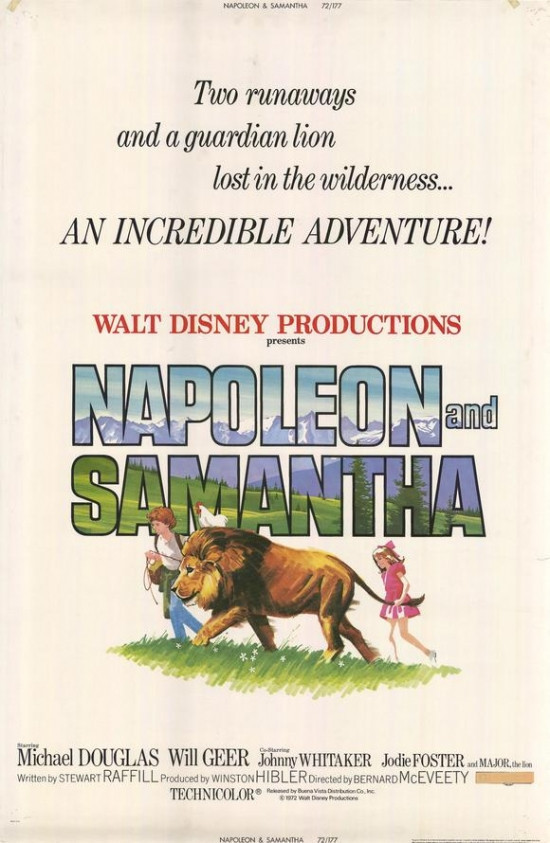
After Menace on the Mountain, here’s another Disney movie, though this one was made that way and so debuted in theatres rather than on television. However, the visible clash between the poster and the cast list above does warrant quite an explanation.

You see, this is a film about Napoleon, much more than it’s about Samantha, but the two do team up and head out into the mountains with a lion called Major. The artwork on the poster is pretty accurate for the film’s middle third.

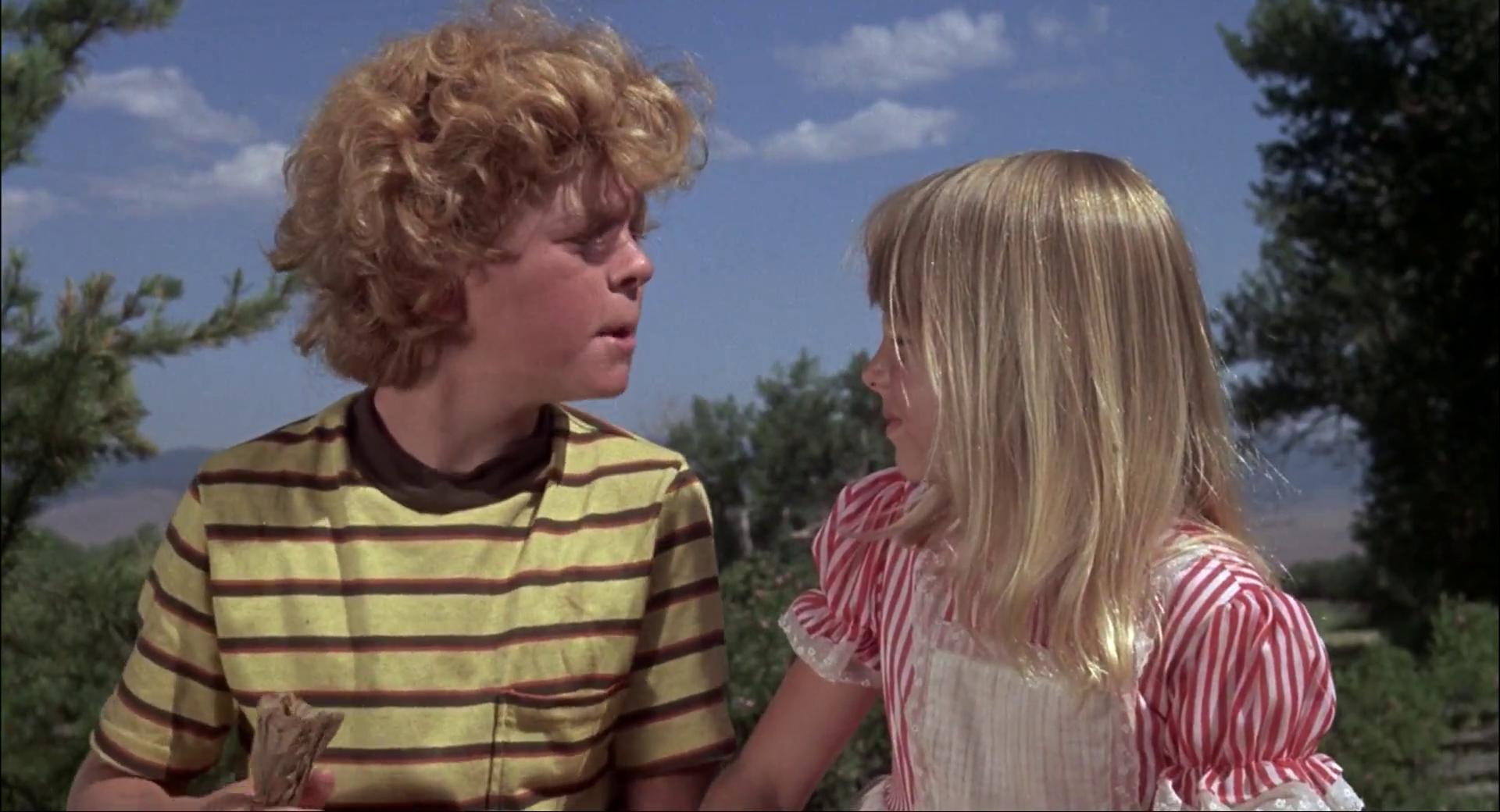
Napoleon is Johnny Whitaker, a child actor who had already made an impact, playing Jody Davis on five seasons of Family Affair. If this is anybody’s film, it’s his. Fortunately, he does an excellent job, even at twelve, and I’m looking forward to seeing him again soon playing Tom Sawyer in a film released a year later.

Samantha is his best friend, maybe his only friend other than the grandpa with whom he lives. She’s Jodie Foster, of course, and she was ten here. She has far more to do here than in the film before and the one after put together and she justifies that decision. In fact, she gets the movie rolling by delivering its first line.

Friday, 2 January 2026

Menace on the Mountain (1970)

Director: Vincent McEveety
Writer: Robert Heverly, based on the novel by Mary A. Hancock
Stars: Patricia Crowley, Albert Salmi, Charlies Aidman, Mitch Vogel, Richard Anderson and Dub Taylor

Index: The First Thirty.

The quickfire opening credits, which list no actors at all, underline that this is a TV movie, released to theatres in 1972, but it didn’t start that way. Before that, it was a two-part story on The Wonderful World of Disney in 1970. Before that, it was a book, the debut of M. A. Hancock, who sold the movie rights to Disney before the novel even reached print in 1968.

What’s odd to me about that is that it breaks so naturally into two parts that it doesn’t flow like a feature and thus presumably didn’t flow like a novel. I haven’t read it to find out.

I’m watching for Jodie Foster, because this is her debut as an actress. She was seven when it was first broadcast on TV and nine when it hit theatres. As that might suggest, she is far from the star here, but, at least for the first half, her screen brother is. He’s played by Mitch Vogel, who was fourteen and about to join the main cast of Bonanza for its final three seasons.

Thursday, 1 January 2026

The Bride of Glomdal (1926)

Director: Carl Theodor Dreyer
Writer: Carl Theodor Dreyer, from the novels by Jacob Breda Bull
Stars: Einar Sissener and Tove Tellback

Index: That's a Wrap!

When people ask me which film I believe is the best ever made, I tend to say The Passion of Joan of Arc, a French silent movie by the Danish director Carl Theodor Dreyer. That won’t pop up in this project for another couple of years, but this is the movie he made before it.

Frankly, it feels like a film by someone else, because it’s built not of majestic close ups but sparse pastoral long shots. There are scenes in farmhouses and a vicarage, but mostly, they’re of fields and the river and more fields. Even as the tension is ratcheted up during the closing scenes, it’s still a relaxing movie that allows us to slow down to the pace of the countryside.

There isn’t much of a story, mostly because Dreyer improvised it as he went, albeit loosely based on a couple of novels by the Norwegian author Jacob Breda Bull, Glomdalsbruden, which means The Bride of Glomdal, and Eline Vangen. It seems to me that the former is likely to be the bulk of the story even though the latter is the longer work. Sadly I can’t find details online.

Tuesday, 23 December 2025

The Pigeon That Took Rome (1962)

Director: Melville Shavelson
Writer: Melville Shavelson, based on the novel The Easter Dinner by Donald Downes
Stars: Charlton Heston, Elsa Martinelli, Harry Guardino, Baccaloni, Gabriella Pallotta, Marietto and Brian Donlevy

Index: 2025 Centennials.

In 4:3 aspect ratio, Paramount News tells us that Italy has been freed from the bondage of the Nazis and that a U.S. General has honoured the Carrier Pigeon Hero of Liberation. No, says the recognisable voice of Charlton Heston. The pigeon is an impostor! And so we rewind back and shift into anamorphic widescreen, though we remain in black and white.

If that didn’t suggest a comedy, the opening scenes underline it. The Italians throw bombs from bicycles, so the Nazis ban bicycles, so the Italians switch to tricycles. So it goes.

Where it will all end up is never in doubt, in part because we know that the Nazis lost the Second World War but also because everybody in Italy knows that the American Fifth Army is on its way. What nobody knows is when they’ll get there and until they do it’s about survival. Somewhere in between lies our story.

Thursday, 18 December 2025

Always a Bride (1953)

Director: Ralph Smart
Writers: Ralph Smart and Peter Jones
Stars: Peggy Cummins, Terence Morgan and Ronald Squire

Index: 2025 Centennials.

While this is a sedate British comedy about gentlemanly crooks plying their trade on the French Riviera, it unfolds against a historical backdrop that sent me down a rabbit hole and I wish the filmmakers had explored it deeper.

As we begin, our focus is on Terence Winch, who’s trying to change his hotel room without luck. We soon learn that the hotel is trying to subtly pressure him into to leaving because he intimidates their guests. It’s because his job is literally to stop them spending money.

And, because that seems to make absolutely no sense at all, I need to explain. He’s an agent of the British Treasury enforcing UK exchange controls that were designed during World War II to avoid a run on the pound and to ensure a steady flow of foreign imports. Sounds crucial, doesn’t it? Well, it probably was in 1939 during wartime but the law lingered on for decades.

Saturday, 13 December 2025

Fitzwilly (1967)

Director: Delbert Mann
Writer: Isobel Lennart, based on the novel A Garden of Cucumbers by Poyntz Tyler
Stars: Dick Van Dyke, Barbara Feldon, John McGiver, Harry Townes, John Fiedler, Norman Fell and Edith Evans

Index: 2025 Centennials.

While I review a lot of movies on hundredth birthdays, it’s rare that I get to do it while the centenarian is alive and celebrating, but today actually is Dick Van Dyke’s centenary and he’s still going strong. Why not tackle a film that I haven’t seen before that he made when he was forty-two, the ultimate answer?

I enjoyed this immensely but I left it with a string of questions, starting with, “Why wasn’t this British and black and white?” It feels like a classic Ealing comedy remade in Hollywood, keeping Dame Edith Evans because who could replace her, but recasting most other roles.

She’s Miss Victoria Woodworth, delightfully haughty as an old and rich force of nature who requires a vast staff to run her huge New York mansion and signs endless cheques to endless charities. The only catch is that she hasn’t any money and hasn’t had since her father left her a measly hundred and eighty bucks.

Monday, 8 December 2025

A Man Called Adam (1966)

Director: Leo Penn
Writers: Les Pine and Tina Rome
Stars: Sammy Davis Jr., Louis Armstrong, Ossie Davis, Cicely Tyson, Frank Sinatra Jr., Mel Tormé and Peter Lawford

Index: 2025 Centennials.

The poster appropriately points out that “in Adam’s world... the music never stops!” That’s pretty true because music is everywhere here. Even when Adam Johnson isn’t performing on stage, there’s music in the background: on the radio, on the jukebox, even on his reel-to-reel tape deck. Manny, his powerful agent, points out his problem: “Take that horn away, buddy, and what have you got? Nothing.”

It’s also our problem, because, while Sammy Davis Jr. is blisteringly good as Adam, he’s the sort of disaster of a human being that we can’t find much sympathy for, even if he truly went off the rails a decade ago in the aftermath of a tragic accident that took his wife and baby.

Instead, we’re asked to sympathise with the people who are closest to him. Nelson, his best friend from childhood, played by Ossie Davis, cites “that excitement, that quality of personal danger” as why Adam’s a genius and also why he can’t stop being there for him, regardless of what he’s done in the past.

Saturday, 6 December 2025

The Plastic Age (1925)

Director: Wesley Ruggles
Writers: Eve Unsell and Frederica Sagor, based on the novel by Percy Marks
Stars: Donald Keith and Clara Bow

Index: That's a Wrap!

As I write, Paramount are involved in a new merger, trying to buy Warner Brothers against opposition from Netflix. This film was made by Preferred Pictures, who had been founded by a former Paramount publicist in 1918, who then merged his company with Paramount because they wanted its leading lady, Clara Bow.

I’m watching with her in mind, even though the film is far more about the character played by Donald Keith. There are reasons why Clara Bow’s name is still remembered while Keith’s is not and they’re obvious after she’s been on screen for about ten seconds.

I did have other names in mind too, because I know that Clark Gable and Carole Lombard are both in here somewhere, as they would be again later in the month in Ben-Hur: A Tale of the Christ, but I couldn’t find either of them. It was early for both of them, as neither made a major name for themselves until the thirties. They were both huge stars when Donald Keith was retiring, in 1936, though not yet married to each other. That happened in 1939.

In 1925, twenty-two year old Keith is the all-American boy ready to go to Prescott College, with the fastest 440 yard dash ever made by a prep student. We’re also told that the thrill of going to college is the thrill for the plastic age of youth, which is the only mention of the title anywhere in the film.