
Director: Alan Parker
Writer: Alan Parker
Stars: Scott Baio, Florrie Dugger, Jodie Foster and John Cassisi
 |
Index: The First Thirty.
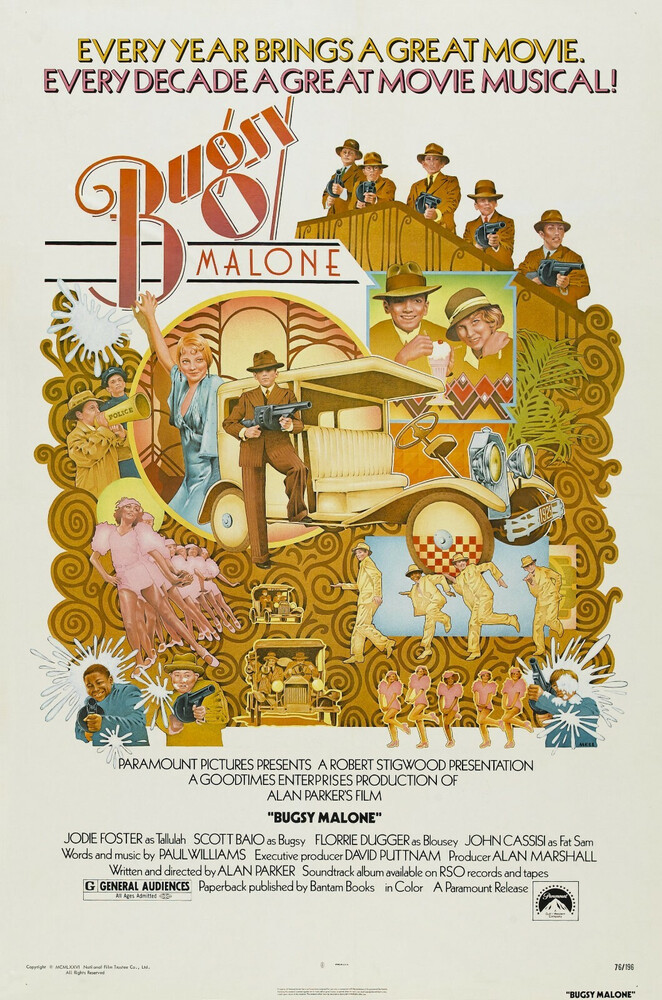
If we’re being brutally honest, Bugsy Malone is a curiosity, a Prohibition era gangster spoof performed by an all-child cast and staged as a musical with songs by and mostly sung by Paul Williams. It should sit alongside films like The Terror of Tiny Town, an all midget western shot on regular sized sets, or The Crippled Masters, a kung fu movie starring a pair of actors with no arms and no legs respectively.
Certainly it can’t escape its gimmick, even if it looks bigger and more sophisticated than its sub-million pound budget might warrant. Alan Parker, at this point known only as a director of TV commercials, somehow survived this to make such notable dramatic films as Midnight Express, Birdy and Mississippi Burning, as well as musicals cast for adults like Fame, Pink Floyd’s The Wall and The Commitments. This therefore stands the test of time as his curiosity rather than merely a curiosity.
And, if we can sit back and suspend disbelief one time, it does offer rather a lot of fun. That shouldn’t surprise. What surprised me is that a majority of that fun sprang from sources that I wasn’t expecting far more than the ones I was. Only a few details held up to expectations, like Parker’s direction being much better than his script. He’s fondly remembered as a director; I doubt anyone remembers him as a writer.
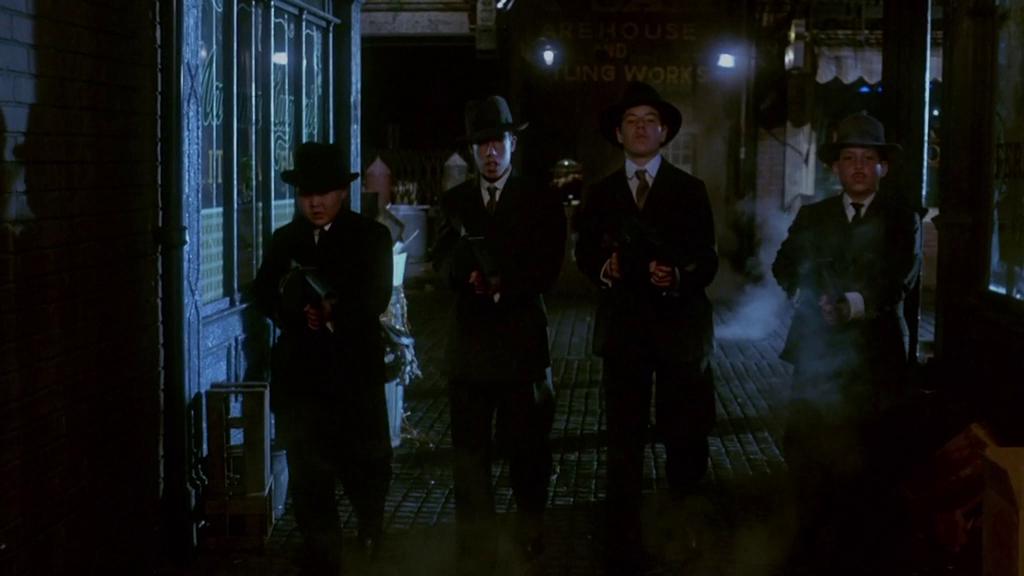 |
The story here is loose and unfocused, but is generally centered on a turf war between two rival gang leaders in what I believe is meant to be New York City: Fat Sam Staccetto, who runs the rackets, and Dandy Dan, who wants them. That begins immediately, with Roxy Robinson, one of Fat Sam’s men, herded into a blind alley and splurged by four of Dandy Dan’s.
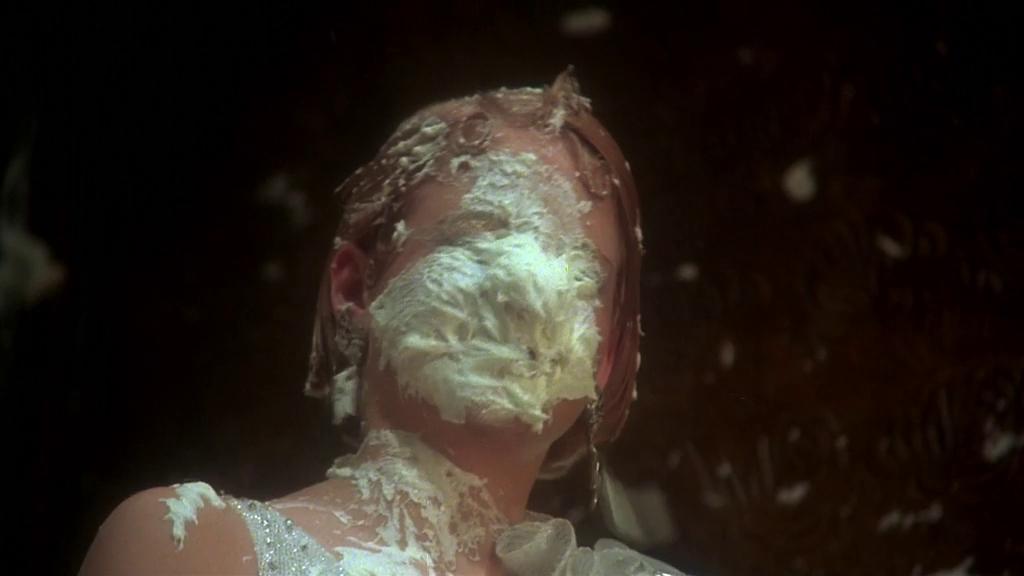
Yes, splurged. That’s not jazz era slang; it’s a highly appropriate term to describe being shot in this world. There are no bullets, just cream, even if the assumption is that anyone splurged is removed from the field of play, as if this is an elaborate play acting game with a rulebook reliant on the honour system. That holds until the finalé, in which everybody is splurged but carries on regardless. It’s more like an homage to the great pie fights of silent cinema.
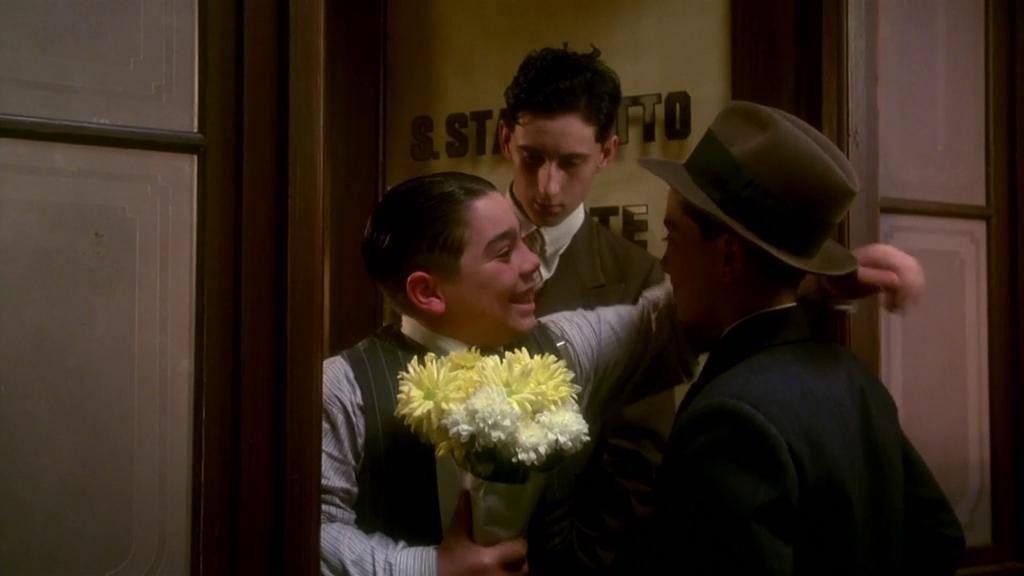
To me, Fat Sam and Dandy Dan are the most watchable major characters here, even though neither was played by a future name. Fat Sam is John Cassisi, who obviously relished his role; he was cast when Parker visited Brooklyn and asked students to identify “the naughtiest boy in class”. Dandy Dan is Martin Lev, who had an earlier credit in a Gerry Anderson production directed by Charles Crichton, either titled The Day After Tomorrow or Into Infinity.
 |
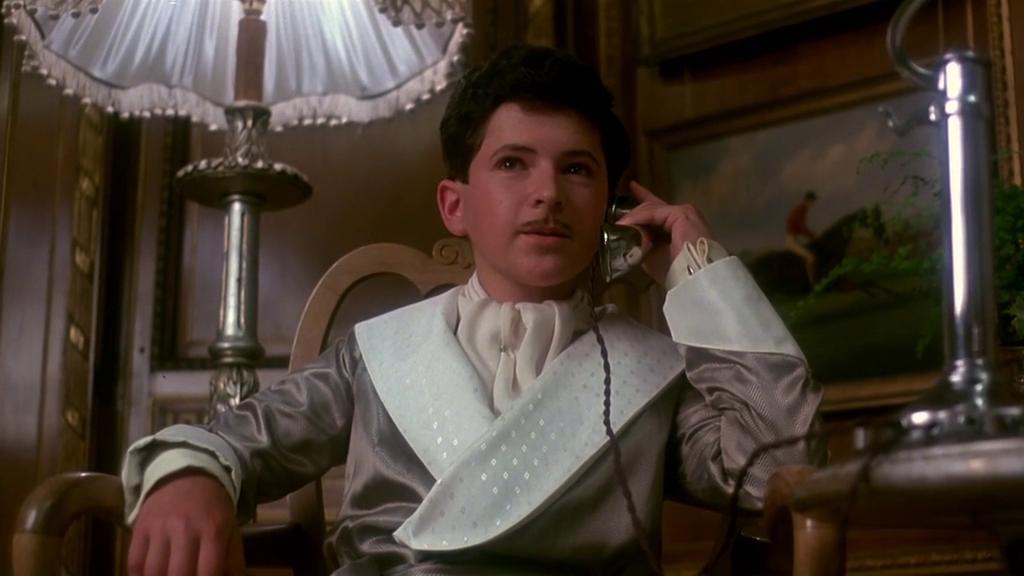 |
Cassisi steals the film immediately and has a blast throughout. Of everyone in the cast, he’s the one we can most believe might run rackets for real, even if they’re grocery or sarsaparilla rackets. Ironically, after his brief acting career as a regular in Fish, the Barney Miller spinoff, he served six years for bribery. Lev is much more subtle but grows in impact alongside his share of the power. Sadly, he suffered from chronic fatigue syndrome, co-founding the Action for ME charity, and took his own life in 1992.
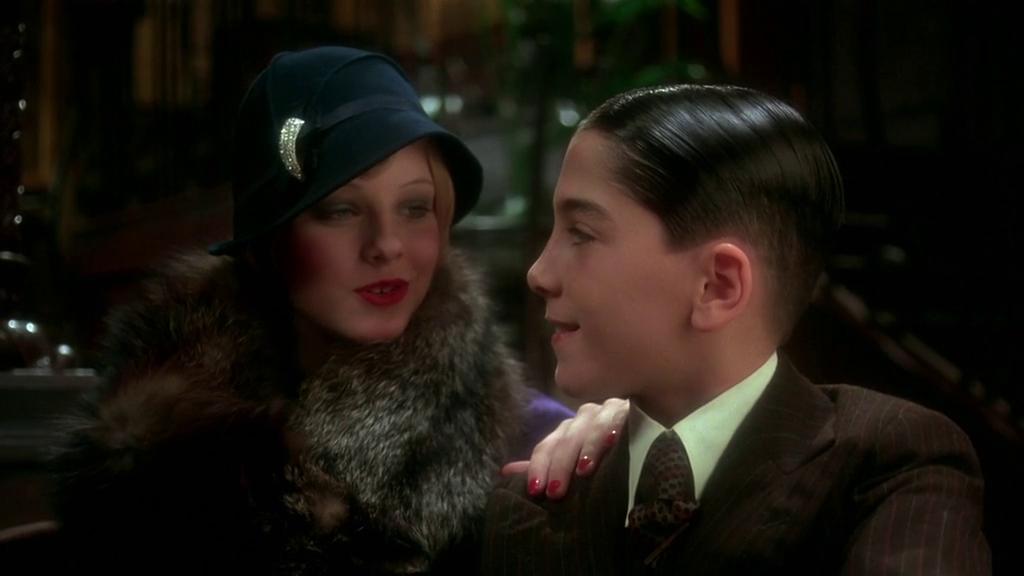
There are future names in the cast, the most obvious two being Scott Baio and Jodie Foster. Baio, possibly the oldest member of the cast at fourteen, is a capable Bugsy Malone, even if he really isn’t a substantial character. Foster, who was twelve when cast, looks older as Tallulah, Fat Sam’s moll. She’s in the film much less but oddly does more, with a number of her own.
Baio debuted here and breezes through the picture without ever doing much of anything other than being a lead. Bugsy isn’t a gangster, for a start, though he does look like one; he’s a boxing promoter, I believe, but he only does a single thing on that front, to take Leroy Smith to Cagey Joe’s gym. Mostly he charms Blousey Brown, a singer with aspirations of Hollywood, while resisting the attentions of his old flame, Tallulah, who enjoys needling Blousey.
 |
Foster is obviously the best actor in the cast, though a nine year old Dexter Fletcher does an impeccable job as Baby Face and Bonita (later Bonnie) Langford effortlessly steals a scene as spoiled singer, Lena Marelli. However, Foster’s power rests with her voice and her face. When that’s taken away, that power evaporates.
For instance, there’s one scene in which she tries to seduce Bugsy and it’s uncomfortable to watch. Even though Foster was over two years younger than Baio, it feels more like she’s an adult predator who’s seducing a child. Even an awkward line such as “You know, you’re aces, Bugsy” comes out with real subversive intent, while Baio gulps in reply like a six year old.
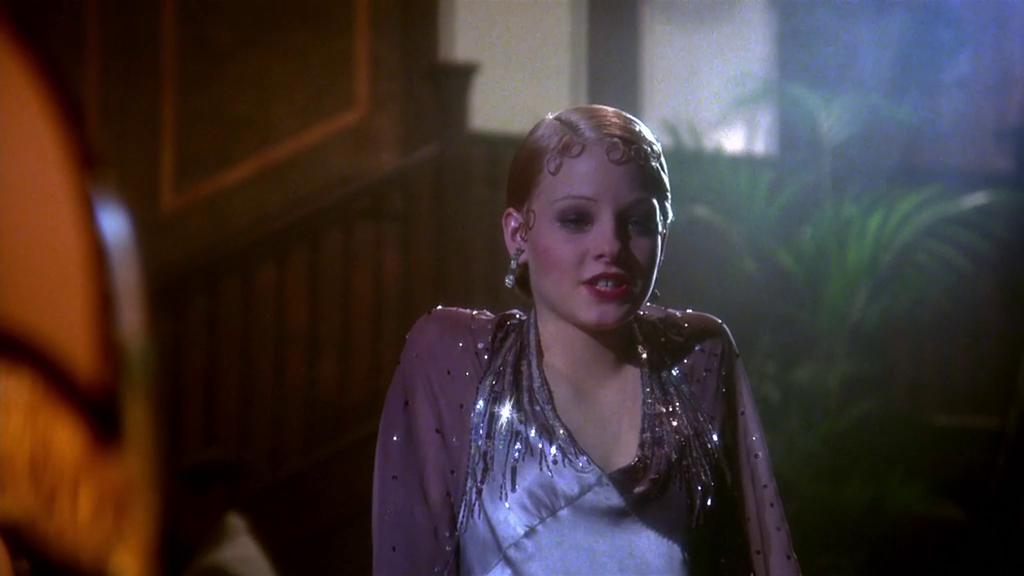
Her voice is much of the seduction here but she backs it up physically: her eyes, her smile and even her hands playing their part. Yet, the My Name is Tallulah song falls flat. Her eyes are lost behind overdone make up and her voice is dubbed by Louise “Liberty” Williams. She only gets to move, from stage to audience, but she seems so awkward in this dress that it looks as if she forgets her movements won’t be dubbed too. There are only moments in interactions.
 |
If Foster sometimes acts so like an adult that we’re brought out of the play acting illusion at odd moments, it’s mostly the play acting that’s enjoyable. You can tell that some of these kids, who may be only twelve or thirteen years old on average and many of whom don’t appear to be actors, are having the time of their lives.
In fact, Baio summed that up perfectly: “You get to dress up as a gangster, you get to shoot guns that fire whipped cream, you get to drive cars with pedals that look like real cars, and you get to talk like a grown-up. I mean, you couldn’t ask for a better first big gig.” And yes, I do very much want one of those cars.
Apparently, those splurge guns were a little problematic, which prompted one of the looks of the film. The special effects crew had loaded wax balls with cream but they hurt on impact, so they switched to table tennis balls and used editing for effect. Whenever guns come out, it prompts a montage of kids being splurged in freeze frame, though Tallulah gets to mutter, “So this is show business?” when splurged.
 |
Well, this was show business for most of the kids in this film, who never went on to further credits. Baio went on to Happy Days and Foster to Academy Awards, Fletcher and Langford to notable careers, others to milder ones. Florrie Dugger, however, decent as Blousey, became a medical admin for the Air Force; Cassisi went into construction and Lev into design.
This is a notable curiosity for their families to enjoy. Really, though, is it much more?


 Posts
Posts


No comments:
Post a Comment